
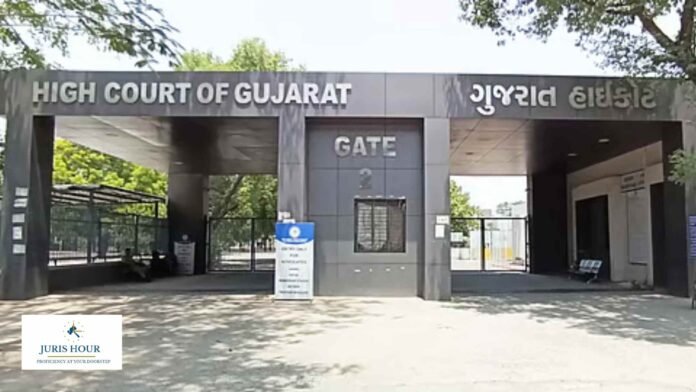
The Gujarat High Court has quashed reassessment proceedings involving an alleged income escapement of ₹499.65 crore, holding that mere suspicion arising from a Suspicious Transaction Report (STR), without supporting material showing bogus transactions or accommodation entries, cannot form the basis for reopening an assessment.
The bench of Justice A.S. Supehia and Justice Vaibhavi D. Nanavati observed that the Income Tax Department had failed to demonstrate how fully disclosed financial transactions between related business entities resulted in the escapement of income chargeable to tax.
Buy Now: 80+ Income Tax Judgments | E-Magazine July 2026
The Court was considering two writ petitions challenging notices issued under Section 148 of the Income Tax Act, 1961, and orders passed under Section 148A(3) for Assessment Year 2020–21. Since both petitions involved the same issue, they were decided through a common judgment.
The petitioner was a partner and the proprietor. The reassessment proceedings were initiated after certain banking transactions connected with these entities were flagged through an STR on the Income Tax Department’s Insight portal.
The Suspicious Transaction Report (STR) reportedly reflected transactions amounting to ₹45.50 crore in the ICICI Bank account of Sundaram Landscape LLP and approximately ₹499.65 crore in the account of Sunderdeep Builders.
The Department issued a show-cause notice under Section 148A(1), asking why a notice for reassessment should not be issued. Following the proceedings, the Assessing Officer passed an order under Section 148A(3), concluding that income amounting to ₹499.65 crore had escaped assessment.
The Revenue pointed to the pattern of transactions in the bank accounts. It referred, among other transactions, to a credit of ₹60 crore received from Infi M and M Developers LLP on January 31, 2020, which was transferred out through internet banking on the same day. It also cited a transaction of ₹15 crore involving Raghuleela Infra Energy Private Limited on March 19, 2020.
According to the Department, the manner in which these amounts were credited and transferred justified further examination through reassessment proceedings.
The petitioner argued that the reassessment was founded entirely on suspicion generated by the STR and that the Department had no concrete evidence suggesting that the transactions were bogus or represented accommodation entries.
It was submitted that the petitioner had responded to summons issued under Section 131(1A) and supplied extensive records, including audit reports, financial statements, bank books, cash books and ledgers of the parties with whom transactions had been carried out.
The petitioner also filed detailed replies to the show-cause notice, explaining the nature of the transactions and providing the relevant books of account.
Despite these submissions, the reassessment order stated that the petitioner had not supplied documents establishing the nature or genuineness of the transactions. The petitioner contended that this finding was factually incorrect and directly contradicted the documents already placed before the investigation authorities.
It was further argued that the Department did not possess any seized material, third-party statement or other evidence indicating that the transactions were bogus or constituted accommodation entries.
On examining the record, the High Court found that the petitioner had submitted a detailed response to the summons on February 5, 2025, together with the audit report, balance sheets and profit and loss accounts.
However, the subsequent show-cause notice recorded that the petitioner had not responded until that point. The Bench described this statement as factually incorrect.
The Court also found that the order under Section 148A(3) incorrectly stated that the petitioner had not submitted details or documents proving the nature and genuineness of the transactions.
According to the Bench, the order’s assertion that the petitioner failed to explain the nature or pattern of the transactions was contrary to the detailed replies and records submitted by the petitioner.
The High Court reiterated that reassessment under Section 147 is permissible only when the Assessing Officer has reason to believe that income chargeable to tax has escaped assessment.
In the present case, the provisions were invoked on the basis of the STR and the Department’s doubts concerning transactions involving the petitioner’s partnership firm and proprietorship concern.
The Court noted that the petitioner had disclosed the relevant details, recorded the transactions in the books of account and furnished those records to the investigation department.
Significantly, the Revenue was unable to point to any material showing that the transactions were bogus, represented accommodation entries or otherwise resulted in taxable income escaping assessment.
The Bench observed that nothing had been placed before it to explain how loans or financial transactions between partners themselves constituted escapement of income.
The Court clarified that it did not doubt the department’s power to initiate an examination based on an STR. However, suspicion generated by such a report must be supported by material that justifies the conclusion that taxable income has escaped assessment.
The Bench observed, “The mere suspicion without any material justifying such suspicion cannot be made a basis for reopening the assessment.”
Membership Required to Access Case Details & Order Copy
To view the complete Case Details and Download Order Copy, you must have an active membership. Please subscribe to continue.

