
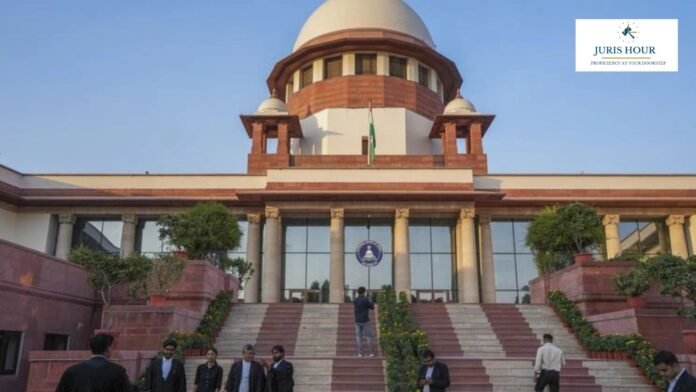
The Supreme Court has held that a married daughter cannot be denied allotment of a fair price shop merely because of her marital status.
The bench of Justices Pamidighantam Sri Narasimha and Alok Aradhe ruled that excluding married daughters from the definition of “family” for compassionate allotment of fair price shops is unconstitutional and violative of Articles 14 and 15(1) of the Constitution.
The appellant’s mother, Badrun Nisha, had been operating a fair price shop in Amethi district, Uttar Pradesh since 2012. Following her death in March 2024, Kulsum Nisha applied for allotment of the shop under the dependent quota scheme.
Despite claiming to be the sole earning member responsible for supporting her four sisters, including a visually impaired sister, her application was rejected by the Sub-Divisional Magistrate. The rejection was based exclusively on a Government Order that excluded married daughters from the definition of “family” for purposes of compassionate allotment. The decision was subsequently upheld by the Deputy Commissioner and later by the Allahabad High Court.
The High Court, however, acknowledged that the issue raised substantial questions concerning the rights of married daughters and granted a certificate for appeal to the Supreme Court.
The principal issue before the Supreme Court was whether the exclusion of married daughters from the category of eligible family members under the Uttar Pradesh Essential Commodities (Regulation of Sale and Distribution) Control Order, 2016 and the related Government Order was constitutionally valid.
The State Government defended the exclusion by arguing that married daughters ordinarily shift to their matrimonial homes and therefore may not satisfy the local residence requirement applicable to fair price shop dealers. It also contended that the classification between unmarried, widowed, legally separated, and married daughters constituted a reasonable classification under constitutional principles.
The Court firmly rejected the State’s justification, observing that the exclusion was founded on outdated gender stereotypes. It held that marriage does not sever a daughter’s relationship with her parental family, nor can it automatically be presumed that a married daughter is no longer dependent upon or connected with her natal household.
The Bench noted that many married daughters continue to reside with, support, or remain dependent upon their parents. At the same time, not every son is necessarily dependent on the family despite being automatically included within the definition of family.
According to the Court, dependency is a question of fact and cannot be conclusively determined merely on the basis of marital status.
The judgment emphasized that while married sons continued to remain eligible irrespective of their marital status, married daughters were excluded solely because they were women who had married. Such a distinction, the Court held, perpetuates historical notions of gender inequality that the Constitution seeks to eliminate.
The Bench found that the exclusion lacked any rational nexus with the objective of the dependent quota scheme, which is intended to provide immediate financial relief to the family of a deceased dealer and ensure continuity in the public distribution system. Consequently, the provision failed the test of reasonable classification and was held to be manifestly arbitrary.
Rather than striking down the provision entirely, the Court adopted the doctrine of purposive construction. It held that the expression “daughter” in the relevant provisions must be interpreted to include married daughters, provided they establish dependency on the deceased dealer and satisfy all other eligibility requirements, including local residence.
The Court reasoned that the purpose of the scheme was welfare-oriented and dependency-based, not succession-based. Therefore, restricting eligibility solely on the basis of marital status would frustrate the very objective of the scheme.
The Supreme Court approved earlier progressive rulings of the Allahabad, Bombay, Karnataka, and Calcutta High Courts that recognized the rights of married daughters in welfare and compassionate schemes.
At the same time, it expressly overruled the contrary views adopted in Saida Begum and Kusumlata, holding that those decisions did not lay down the correct legal position.
Applying the law to the facts of the case, the Court noted that Kulsum Nisha had continued to reside in the same village even after marriage and had actively assisted her mother in running the fair price shop. Following her mother’s death, she had assumed responsibility for maintaining her sisters, including a visually impaired sibling.
Since the authorities had never disputed these facts and had rejected her application solely because she was a married daughter, the Court found the rejection unsustainable.
Accordingly, the Supreme Court quashed the orders passed by the High Court, the Deputy Commissioner, and the Sub-Divisional Magistrate, and directed the competent authority to issue the allotment order in favour of Kulsum Nisha within four weeks.
Case Details
Case Title: Kulsum Nisha Versus State of UP
Citation: JURISHOUR-1514-SC-2026
Case No.: Civil Appeal No. 7667 Of 2025
Date: 02/06/2026

