
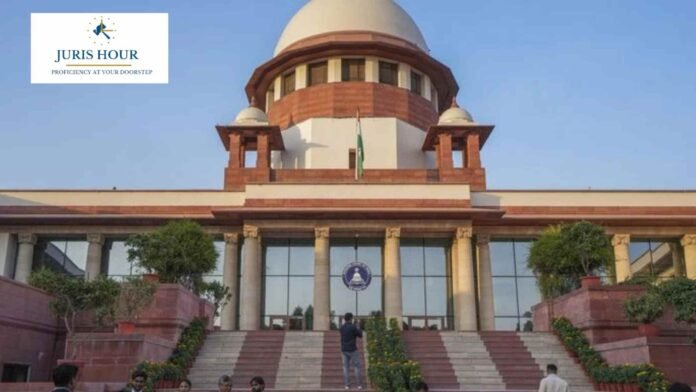
The Supreme Court has acquitted a man convicted in a nearly four-decade-old double-murder case, holding that the prosecution failed to establish a complete and credible chain of circumstances pointing exclusively towards his guilt.
The bench of Justice Sanjay Karol and Justice Augustine George Masih particularly found serious doubts surrounding the testimony of a child witness, the alleged recoveries, the absence of forensic links, the failure to establish motive and last-seen evidence, and the unexplained delay in registration of the FIR.
The prosecution case arose from events in September 1989. On September 26, a truck driver passing through Bhero Ghat encountered a young boy, approximately four to five years old, who appeared injured and was seeking assistance. The child was taken first to a local person and thereafter to the police station and for medical treatment. Over the next two days, the bodies of a woman and a male child were discovered in the area.
Buy Now: 50+ Supreme Court Judgments – July 2026
According to the prosecution, the deceased woman had left Kanpur on September 20, 1989, with her two sons and the accused, who was their father, ostensibly for a trip to Khajuraho. The prosecution alleged that the accused subsequently killed the woman and one of the children and attempted to kill the surviving child, who escaped.
The investigation initially resulted in two FIRs being registered on October 1, 1989. During the investigation, the surviving child gave a statement implicating his father and claiming that he had witnessed the killing of his mother and brother. The accused was eventually arrested in March 1990. The prosecution further relied upon an alleged confession and recoveries of clothes and a bottle from the place of occurrence.
The Additional Sessions Judge, Panna, acquitted the accused in December 1993 after finding that the prosecution had failed to prove its case beyond reasonable doubt.
The trial court was particularly concerned about the reliability of the child witness. The child was only around four-and-a-half years old when the incident occurred, and the court noticed contradictions and circumstances suggesting that his testimony might have been influenced. The trial court also found insufficient independent corroboration for the child’s version.
The State challenged the acquittal before the Madhya Pradesh High Court. The High Court accepted the child’s testimony as reliable and treated the accused’s alleged abscondence and his explanation under Section 313 of the Code of Criminal Procedure as circumstances supporting the prosecution case. It consequently convicted the accused and sentenced him to life imprisonment.
The Supreme Court began its analysis by stressing the heightened protection available to an accused where an appellate court is considering interference with an acquittal.
The Court held that an accused who has already been acquitted by the trial court benefits from a double presumption of innocence. The first arises from the fundamental principle that every person is presumed innocent until proven guilty. The second arises because the accused has secured an acquittal from the trial court, thereby strengthening the presumption of innocence.
Relying on the principles laid down in Chandrappa v. State of Karnataka, the Court held that where two reasonable conclusions are possible on the evidence, an appellate court should not disturb the acquittal merely because it prefers another view.
In the present case, the Supreme Court concluded that the High Court had not crossed the threshold required for overturning the trial court’s acquittal.
A central issue before the Supreme Court was whether the testimony of the surviving child could, in the circumstances of the case, form the primary basis for conviction.
The Court reiterated that there is no absolute legal requirement that the testimony of a child witness must always be corroborated. However, corroboration constitutes an important rule of prudence, particularly because evidence given by a young child must be examined with considerable care due to the possibility of tutoring or influence.
The Court noted that the child was only four-and-a-half years old when the incident occurred, while his evidence was recorded approximately four years later. It was also undisputed that he had lived with a police constable. Significantly, the child himself stated during his evidence that the police had shown him a statement before he went to court and instructed him to give the same statement before the Magistrate.
The Supreme Court also noticed inconsistencies between the child’s account and the medical evidence. The child had alleged that an attempt had been made to strangulate him and that acid had been thrown on him. However, the medical evidence did not support those claims.
The Court therefore held that the trial court’s decision to seek independent corroboration, particularly in view of the doubts surrounding the child’s testimony, could not be described as unreasonable or impermissible.
The Supreme Court also rejected the High Court’s reliance on the accused’s alleged conduct and explanation for his absence.
The Court made it clear that suspicion arising from an accused’s explanation cannot substitute for proof of each individual circumstance forming part of the prosecution’s case. In a case resting substantially on circumstantial evidence, every incriminating circumstance must be established by cogent evidence and the circumstances, taken together, must form a chain that points only towards the guilt of the accused.
Referring to the established principles governing circumstantial evidence, the Court reiterated that suspicion, however strong, cannot take the place of proof. Where a missing link permits another reasonable hypothesis consistent with innocence, the accused must receive the benefit of doubt.
The Court further emphasised that the chain of circumstances must be complete enough to leave no reasonable ground for a conclusion consistent with the accused’s innocence. If an evidentiary gap remains, a finding of guilt cannot safely be sustained.
Another significant deficiency identified by the Supreme Court was the absence of reliable forensic or scientific evidence connecting the accused to the alleged offences.
The Court noted that the bodies had undergone advanced decomposition by the time post-mortem examinations were conducted. Consequently, the doctors could not give a definite opinion regarding the cause of death. The chemical examination of the blood-stained soil was also inconclusive because the available blood had decomposed and was insufficient for examination.
The alleged recovery of clothes and a bottle likewise failed to provide the necessary forensic connection. There was no evidence establishing that the recovered clothes belonged either to the deceased or to the accused.
The Court found further problems with the alleged recovery proceedings.
The independent witnesses associated with the alleged confession and recovery had turned hostile. They stated that they had merely signed the arrest and recovery documents without enquiring into their contents.
The timing and circumstances of the recovery also raised substantial doubts. The articles were allegedly recovered around six months after the bodies had been discovered. The Court further noted that the investigating officer admitted that the recovered articles did not contain water, mud or earth residue, despite the prosecution’s claim that they had been buried approximately six feet underground for several months.
In these circumstances, the Supreme Court held that the possibility of the articles having been planted could not be ruled out.
The Court also found that the prosecution had failed to establish the crucial circumstance that the deceased were last seen with the accused.
Witnesses from the neighbourhood did not establish that the accused had been present near the deceased’s residence around the relevant period. One witness stated that the deceased had left with a person whom he could not identify. Another witness specifically stated that the person sitting in the car was not the accused and that the accused had not visited the deceased for several months.
The Supreme Court therefore found a substantial gap in the prosecution’s attempt to establish the accused’s presence with the deceased immediately before the incident.
The Court found no convincing evidence establishing a motive for the alleged crime.
Rather than demonstrating hostility between the accused and the deceased, one of the witnesses stated that their relationship was amicable. The evidence indicated that they had resolved their differences and were living separately, with the deceased paying her own rent.
While motive is not invariably indispensable where there is overwhelming direct evidence, its absence assumes significance in a case dependent upon a chain of circumstantial evidence, particularly where other links in that chain are themselves doubtful.
The Supreme Court also criticised the investigation for failing to trace and examine individuals who could potentially have provided important evidence.
According to the prosecution’s case, the deceased and children had travelled in a truck and a car, and the surviving child had referred to a truck driver who could allegedly have been a witness to the incident. Although the investigating officer obtained a road-tax receipt, no effective effort was made to trace or examine the driver. The car and its driver were also not traced.
The Court held that these omissions created another significant gap in the prosecution’s chain of circumstances.
The Supreme Court attached considerable importance to the delay in registering the FIR.
The surviving child had reached the police station on September 26, 1989. According to the prosecution itself, he disclosed the identity of the accused to the investigating officer on September 29. Yet the FIR was registered only on October 1, 1989.
The Court held that the unexplained delay was particularly significant because the identity of the alleged accused was purportedly known before the FIR was registered. In the Court’s view, the delay undermined the credibility of the prosecution version and raised the possibility of embellishment during the investigation.
After examining the entire evidentiary record, the Supreme Court concluded that the prosecution had failed to produce cogent evidence establishing guilt beyond reasonable doubt.
The Court found that the prosecution case suffered from multiple independent weaknesses: doubts surrounding the child witness, lack of medical and scientific linkage, questionable recoveries, absence of reliable last-seen evidence, failure to establish motive, failure to trace important witnesses, and unexplained delay in lodging the FIR.
Accordingly, the Supreme Court allowed the appeal, set aside the Madhya Pradesh High Court’s October 9, 2012 judgment and order, and acquitted the accused of the charges. The Court also directed that his bail bonds stand discharged.
Membership Required to Access Case Details & Order Copy
To view the complete Case Details and Download Order Copy, you must have an active membership. Please subscribe to continue.
Read More: Revenue Mutation Can’t Extinguish Property Title, Limits HC’s Power in Second Appeal: Supreme Court

