
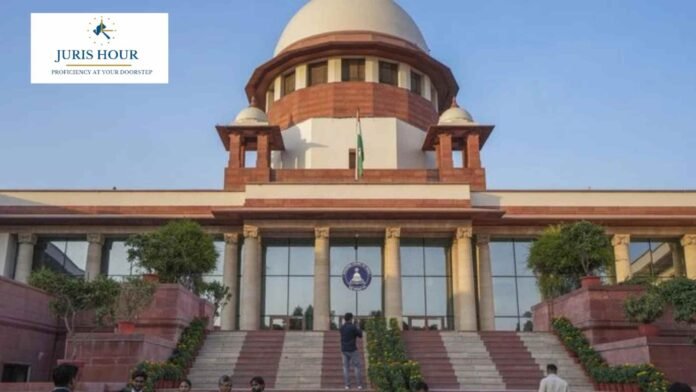
The Supreme Court has reaffirmed a fundamental principle of criminal jurisprudence by holding that the recovery of a blood-stained weapon under Section 27 of the Indian Evidence Act, without a complete chain of corroborative evidence, cannot be the sole basis for convicting an accused.
Setting aside the Bombay High Court’s order directing a fresh consideration of evidence, the bench of Justice J. B. Pardiwala and Justice K. Vinod Chandran restored the trial court’s acquittal of six persons accused in a 1988 murder case, emphasizing that suspicion, however strong, cannot substitute proof beyond reasonable doubt.
The appeal arose from a long-pending criminal case relating to the alleged murder of one Qavi on February 14, 1988. The trial court had acquitted all the accused after finding that the prosecution failed to establish their guilt beyond reasonable doubt.
Buy Now: Supreme court Judgements E-Compilation – JUNE 2026
Aggrieved by the acquittal, the deceased’s brother filed a criminal revision before the Bombay High Court. The High Court initially interfered with the acquittal, but the Supreme Court remanded the matter because the accused had not been afforded an opportunity of hearing as required under Section 401(2) of the Code of Criminal Procedure (CrPC).
Upon remand, the High Court again directed the Additional Sessions Judge to reconsider the testimony of eyewitnesses, the recoveries made under Section 27 of the Evidence Act, and the chemical analysis report. However, it agreed with the trial court in rejecting the alleged dying declarations.
The accused challenged this order before the Supreme Court.
The Bench comprising Justice J.B. Pardiwala and Justice K. Vinod Chandran first examined the legal framework governing revisions against acquittal.
The Court observed that after the 2009 amendment introducing the proviso to Section 372 CrPC, a victim has a statutory right to file an appeal against an order of acquittal. Consequently, where such an appellate remedy exists, a criminal revision ordinarily cannot be entertained at the instance of the victim. The Court also noted that although Section 401 CrPC empowers the High Court to convert a revision into an appeal in appropriate cases, such conversion is discretionary and depends upon the facts and the applicable High Court rules.
The Supreme Court undertook an independent re-appreciation of the evidence considering that the incident had occurred nearly four decades earlier.
The prosecution relied primarily upon three alleged eyewitnesses. However, the Court agreed with the trial court that their evidence suffered from significant inconsistencies.
One eyewitness repeatedly referred to another person who allegedly witnessed both the earlier altercation and the assault, yet that witness was never examined before the court. Another eyewitness’s statement under Section 161 CrPC was recorded only several days after the inquest without any explanation from the investigating officer. The Court also noticed that the eyewitnesses did not corroborate each other’s presence at the crime scene.
Further, despite claiming to have witnessed a brutal attack, none of these witnesses immediately informed the police or transported the injured to the hospital, even though the police station was only a few minutes away. These circumstances substantially weakened the credibility of their testimony.
The prosecution also relied on alleged oral dying declarations made to the deceased’s brother, father, and a doctor.
The Supreme Court found major contradictions regarding whether the deceased was conscious after the attack.
The doctor who first attended the injured stated that he was brought unconscious to the hospital by an auto-rickshaw driver without any accompanying relatives and never regained consciousness. In contrast, the surgeon who examined the patient much later stated that the injured was conscious enough to make a dying declaration.
The Court noted that these contradictory medical opinions, coupled with inconsistent accounts of when and where the alleged dying declarations were made, rendered the prosecution version unreliable. It held that the medical evidence could not support the alleged dying declarations.
One of the principal pieces of evidence relied upon by the prosecution was the recovery of a weapon under Section 27 of the Indian Evidence Act.
Although chemical examination confirmed the presence of human blood on the recovered weapon, the Court observed that the prosecution failed to establish any direct connection between the weapon and the crime. The blood was not shown to belong to the deceased, and the eyewitnesses were not even confronted with the weapon during trial.
The Supreme Court categorically held that recovery under Section 27, standing alone, cannot justify a conviction unless supported by other reliable circumstances completing the chain of evidence.
The Bench also pointed out several investigative deficiencies.
Despite the prosecution alleging a violent attack involving multiple stab injuries, the investigating officer failed to recover blood or other tell-tale signs from the alleged scene of occurrence. This omission cast doubt on whether the prosecution had correctly established the place where the crime occurred.
The Court further held that the prosecution had failed to establish any convincing motive, while the eyewitness testimony and dying declarations remained doubtful. In these circumstances, the evidence did not form a complete chain pointing exclusively toward the guilt of the accused.
The Supreme Court observed that once a trial court records an acquittal, the presumption of innocence in favour of the accused stands reinforced.
The Court emphasized that an acquittal should not be overturned merely because another view of the evidence is possible. Unless the findings of the trial court are manifestly unreasonable or perverse, appellate interference is unwarranted.
It observed that while the murder was undoubtedly brutal and the anguish of the victim’s family was understandable, criminal courts cannot convict on assumptions when the prosecution evidence fails to satisfy the standard of proof beyond reasonable doubt.
The Supreme Court set aside the Bombay High Court’s order and restored the trial court’s judgment acquitting all the accused.
The Court directed that if any of the accused remained in custody, they should be released forthwith unless required in any other case. It also ordered cancellation of bail bonds wherever applicable and disposed of all pending applications.
Membership Required to Access Case Details & Order Copy
To view the complete Case Details and Download Order Copy, you must have an active membership. Please subscribe to continue.

