
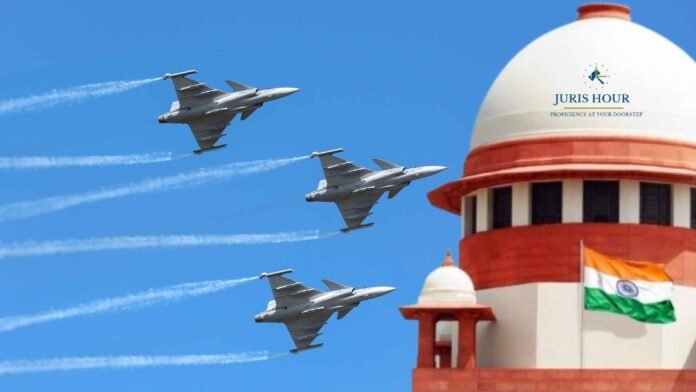
The Supreme Court has ruled that an Air Force personnel who applies for a civilian post without obtaining prior permission from the competent Air Force authority cannot later seek a No Objection Certificate (NOC) merely because he has been selected for the civil post.
Holding that the procedural framework under Air Force Order (AFO) No. 33/2017 is mandatory and directly linked to maintaining the operational preparedness of the Indian Air Force (IAF), the bench of Justice Ujjal Bhuyan and Justice Atul S. Chandurkar dismissed the appeal filed by an Air Force Corporal seeking discharge to join as an Assistant Professor.
The appellant, a Corporal in the Indian Air Force, had completed the minimum qualifying service of seven years and applied for the post of Assistant Professor (Hindi) pursuant to an advertisement issued by the Rajasthan Public Service Commission in November 2020. He successfully cleared the written examination, appeared for the interview, and was declared selected on 1 October 2022.
Buy Now: Supreme court Judgements E-Compilation – JUNE 2026
Following his selection, the appellant applied on 3 October 2022 seeking issuance of a No Objection Certificate (NOC) and discharge from service to enable him to join the civilian post. However, the Air Officer Commanding declined to recommend his request on the ground that he had not obtained prior permission before applying for the post as mandated under Air Force Order No. 33/2017.
Aggrieved by the refusal, the appellant approached the Armed Forces Tribunal. The Tribunal observed that although the earlier requirement of possessing Skill Grade “A” had already been declared ultra vires by the Delhi High Court, the appellant’s request could still not be accepted because he had failed to comply with the mandatory requirement of seeking prior permission before applying for the civilian post. The Tribunal consequently dismissed the application, and the Delhi High Court affirmed the decision.
Before the Supreme Court, the appellant argued that denial of an NOC solely on account of non-compliance with procedural requirements was unjust. He submitted that the provisions requiring prior permission merely regulated the manner of applying for civilian employment and did not affect his substantive right to seek better career opportunities.
It was argued that once he had been selected for the post of Assistant Professor, the procedural lapse ought to have been condoned in the interest of justice. Reliance was placed on earlier High Court decisions to contend that the procedural requirements were directory rather than mandatory.
The Union of India opposed the appeal, contending that Air Force Order No. 33/2017 was specifically framed to regulate premature discharge of Air Force personnel so as to maintain adequate manpower and operational readiness.
The Government argued that obtaining prior permission before applying for a civilian post was a mandatory precondition. It further submitted that both permission to apply and grant of an NOC were privileges under the Air Force Order and not enforceable legal rights. Since the appellant had failed to produce any evidence showing that he had obtained or even properly sought prior permission, the refusal to grant an NOC was fully justified.
The Supreme Court examined Air Force Order No. 33/2017 in detail and observed that it had been framed after considering the adverse impact that premature discharge of Air Force personnel could have on operational preparedness.
The Court noted that the policy balances two competing considerations—allowing Air Force personnel to pursue better civilian career opportunities while simultaneously ensuring that manpower requirements of the force are not adversely affected. It therefore prescribes a structured two-stage process: first, obtaining prior permission before applying for a civilian post; and second, seeking an NOC after selection.
The Bench observed that Clause 19 expressly provides that an NOC may be refused if prior permission was not obtained before applying. Clause 20 further clarifies that permission to apply and issuance of an NOC are privileges and cannot be claimed as matters of right.
The Court found that the appellant’s claim of having attempted to submit an online application for permission in November 2020 was unsupported by any documentary evidence. Similarly, he failed to establish that an alleged offline application had ever been submitted or acknowledged by the authorities.
The findings recorded by the Armed Forces Tribunal and affirmed by the Delhi High Court that there was no proof of any online or offline request for prior permission were therefore upheld. The Supreme Court held that there was no reason to interfere with these concurrent findings of fact.
Rejecting the appellant’s principal argument, the Supreme Court held that the requirement of obtaining prior permission cannot be treated as a mere procedural formality capable of being waived after selection.
The Court observed that the requirement bears a direct nexus with the objective of regulating premature exits from military service and ensuring operational preparedness. Since the Air Force Order itself prescribes the consequence of failing to obtain prior permission—namely rejection of the request for an NOC—the condition must be treated as mandatory.
The Bench further remarked that permitting an Airman to first secure selection in a civilian post and then seek waiver of the prior permission requirement would effectively present the authorities with a fait accompli, defeating the very purpose of the policy.
The Court also relied upon its earlier decision in Amit Kumar Roy v. Union of India, wherein it was held that members of the Air Force do not possess an unrestricted right to leave service at will.
Reiterating that the interests of the armed forces and operational preparedness are paramount, the Court observed that Air Force personnel remain bound by the statutory framework and Air Force Orders governing applications for civilian employment. It held that such requirements cannot be ignored on the ground of individual career aspirations alone.
Finding no infirmity in the concurrent findings of the Armed Forces Tribunal and the Delhi High Court, the Supreme Court dismissed the appeal and upheld the refusal to grant an NOC to the appellant.
The Court held that Air Force personnel must strictly comply with the mandatory requirement of obtaining prior permission before applying for civilian posts, and failure to do so disentitles them from seeking an NOC or discharge after securing selection.
Membership Required to Access Case Details & Order Copy
To view the complete Case Details and Download Order Copy, you must have an active membership. Please subscribe to continue.

