
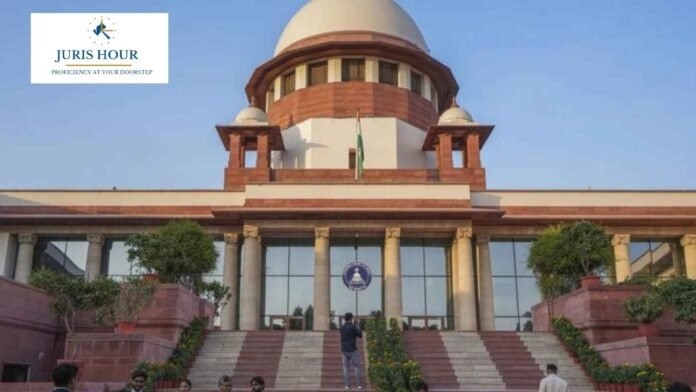
The Supreme Court has set aside a 10-year prison sentence in a 2009 rape case, holding that the prosecution had failed to prove the rape charge beyond reasonable doubt.
A bench of Justices Ujjal Bhuyan and Atul S. Chandurkar allowed Paramjit Singh Bedi’s appeal against a Punjab and Haryana High Court judgment that had upheld his conviction under Section 376 of the Indian Penal Code (IPC).
The Sessions Court at Ludhiana had sentenced him in 2012 to 10 years’ rigorous imprisonment and a fine of ₹5,000. The High Court affirmed that decision in 2013.
Buy Now: Supreme Court Judgments E-Magazine – 5 Month Combo (2026) (1st February – 30th June 2026)
According to the prosecution, the complainant left her home in Ludhiana on June 19, 2009, to buy groceries. She alleged that Bedi, whom she knew through his daughter, took her to a flat in Ludhiana and later to a room in an abandoned factory at Malerkotla. She said he had sexual intercourse with her against her will and threatened to kill her when she objected. Police apprehended Bedi after the two returned to Ludhiana on June 25.
The trial court acquitted Bedi of the charge under Section 366 IPC, which concerned kidnapping or abduction for the purpose alleged by the prosecution. It nevertheless convicted him of rape. The acquittal under Section 366 was not challenged by the State or the complainant’s father.
The State argued before the Supreme Court that a school certificate placed the complainant’s age at about 15 at the time. It submitted that consent would therefore be immaterial and also relied on the presumption concerning absence of consent under Section 114A of the Evidence Act.
The Supreme Court noted, however, that the trial court had found the documentary and oral evidence insufficient to prove the prosecution’s claimed date of birth beyond reasonable doubt. After considering an ossification test that estimated her age at 17 to 19 years, the trial court had accepted her age as 19. On that basis, it held that kidnapping had not been proved. That finding had attained finality.
Bedi’s counsel argued that the complainant had accompanied him voluntarily and that her evidence contained contradictions. He also alleged false implication arising from financial and tenancy disputes involving her family. The Supreme Court’s decision turned on its assessment of the prosecution evidence; it did not establish the alleged disputes as the cause of the complaint.
The Supreme Court identified contradictions in the complainant’s account, including whether she and Bedi returned from Malerkotla to Ludhiana by car or train. It also considered her testimony about travelling through crowded areas during the intervening days without seeking help. Taken together, the bench held, her evidence did not inspire the confidence needed to sustain the rape conviction.
The trial court had relied in part on medical evidence showing spermatozoa in a vaginal swab. The Supreme Court held that this finding, viewed alongside the other evidence, did not by itself prove rape. It also noted that the medical examination found no external injury or injury to the complainant’s private parts. The judgment’s conclusion rested on its assessment of the evidence as a whole.
The bench criticised the trial court’s reasoning for rejecting the complainant’s account when deciding the Section 366 charge while accepting it to prove rape on the same factual record. It said a conviction can rest on the sole testimony of a complainant when that testimony inspires the court’s confidence, but found that standard was not met in this case.
At the same time, the Supreme Court acknowledged that agreeing to travel or stay with a man does not, by itself, mean a woman consents to sex. It also called the trial judge’s description of women who do so as “daring” uncalled for. Its finding was specific to the evidence and circumstances it examined in this appeal.
“Immorality of an act sans credible evidence cannot justify a conviction,” the Court said, emphasising that a criminal charge must be proved through evidence rather than conjecture or a judge’s personal value judgment.
The Supreme Court set aside both the Sessions Court’s June 1, 2012 judgment and the High Court’s September 12, 2013 judgment insofar as they convicted and sentenced Bedi under Section 376 IPC. It allowed his criminal appeal and cleared him of that charge. Bedi had been released on bail in 2015 after the Supreme Court noted that he had already spent almost six years in custody.
Membership Required to Access Case Details & Order Copy
To view the complete Case Details and Download Order Copy, you must have an active membership. Please subscribe to continue.
Read More: Retrospective Income Tax Amendment Can’t Be Used to Recall Earlier Tribunal Order: ITAT

