
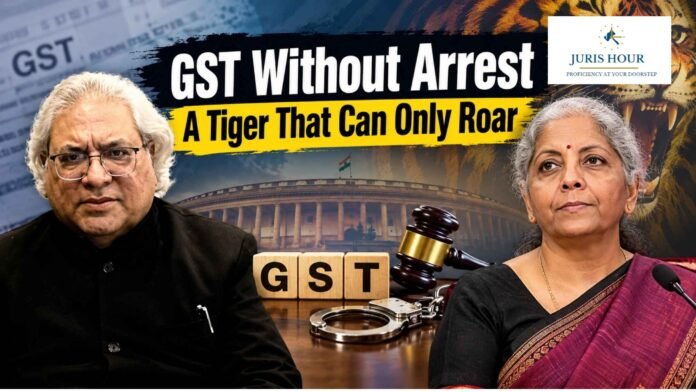
This Article pertaining to “GST Without Arrest – A Tiger That Can Only Roar” is written by Dr Monish Bhalla. He is a distinguished author, legal expert, and former officer of India’s Narcotics Control Bureau (NCB). With 37 years in public life, Dr. Bhalla has been a key figure in drug law enforcement and indirect taxation in India. His expertise in the fields of GST, Customs, and narcotics control has made him a leading voice in legal reforms and national policy. He is also a well-known columnist and has authored several books on GST, drug trafficking, and legal matters.
A tiger without teeth and claws is still a tiger. It can still roar, and from a distance it may even look fearsome. But the jungle is never fooled for long. Once the animals come to know that it cannot bite, the roar becomes mere noise, and nobody runs. I fear this is exactly what is about to happen to GST in India.
Buy Now: 160+ GST E-Magazine September 2026
The 57th meeting of the GST Council, held on 8 October 2026, has been hailed in many quarters as a landmark. Of its many recommendations, the one that has made the loudest headlines is the proposal to omit Section 69 of the CGST Act, 2017 altogether. If Parliament accepts it, no GST officer, of whatever rank, will have the power to arrest any person under the GST law. Industry chambers welcomed it. Many of my professional colleagues have welcomed it too, and I fully understand why. Yet after years of watching smugglers , Tax evader Mafias, anti-nationals and syndicates from close quarters, I cannot bring myself to join the celebration. A tax law without the power of arrest is a tiger that can only roar. It frightens no one, and it catches no one — least of all those it was meant to catch.
A tax law without the power of arrest is a tiger that can only roar. It frightens no one, and it catches no one — least of all those it was meant to catch.
The honest manufacturer who files his returns on time and pays his tax has never lost sleep over Section 69. He was never going to be arrested. The power was never meant for him, and the Board’s own guidelines kept it well away from him. The person who fears arrest is the one who has reason to fear it. We must also accept a hard reality about our country. In spite of digitisation, e-invoicing and e-way bills, India still has a large parallel cash economy. Wherever unaccounted cash moves, tax evasion follows as a matter of course. For a certain class of operators, evasion is not a mistake or an oversight. It is the business itself.
The Anatomy of Evasion
The bogus billing racket is the clearest example, and it is run with the discipline of a well-managed company. At the bottom are the dummy proprietors — daily wage earners, students, sometimes domestic workers — whose PAN and Aadhaar details are bought for a few thousand rupees or simply misused without their knowledge. Firms are registered in their names at addresses which, on verification, turn out to be a paan shop, an empty plot or a locked godown. Above them are the operators who handle dozens of such GSTINs, file the returns and manage the bank accounts. And above the operators sit the real beneficiaries, who buy this paper credit to set off their genuine tax liability.
The money moves in a neat circle. The beneficiary pays through the bank, the operator withdraws the amount in cash, and after deducting his commission the cash goes back to the beneficiary. On paper, goods have moved from one State to another. In reality, not a single truck has left the yard. What has really moved is the government’s revenue.
Fake invoicing is only one method among many. There are inflated exports, where goods of negligible value are shown at many times their worth so that an equally inflated refund can be claimed. There are refund rackets, where bogus credit is first created through fictitious purchases and then encashed as refund — here the State does not merely lose its tax, it actually pays out money it never collected. There is the old trick of billing to one party and delivering the goods to another, usually a buyer in the cash market who wants no paper trail. And there is circular trading, where the same invoices go round and round among a ring of related firms to inflate turnover, raise bank finance and generate credit. In each of these, the amounts involved run into hundreds of crores.
None of this is a dispute over a rate or a classification. These are planned conspiracies involving exporters, transporters, intermediaries, shell entities and cash handlers. When the department finally reaches the dummy proprietor, he knows nothing. He has never seen the invoices, never operated the account, never met the buyer. The trail goes cold at the very first step. The only way up the chain is to confront the operator, and the operator talks only when he knows that silence will have consequences.
This is precisely where the power of arrest matters. Its purpose is not to punish. Its purpose is to break the chain before evidence is destroyed, before the shell firms are cancelled and before the money disappears through hawala channels. In such cases every day of delay is a gift to the fraudster. The Board itself recognised this in Instruction No. 02/2022-23, which specifically names the mastermind or key operator behind dummy GSTINs as a person whose arrest may be justified. Without that power, what is the officer left with? A summons under Section 70. To a hardened operator, a summons is just a piece of paper. He will ignore it, send his lawyer with an adjournment letter, or simply vanish. When the law loses its teeth, the officer who enforces it loses his authority as well.
When the law loses its teeth, the officer who enforces it loses his authority as well.
Prosecution Is No Substitute
Those who support the change say fraud will still be punished, since prosecution under Section 132 remains. On paper, that is correct. But anyone who has followed a complaint case through our criminal courts knows how it actually goes. The complaint is filed, summons are issued, the accused does not appear. Then comes a bailable warrant, then a non-bailable one, then adjournment after adjournment. Witnesses retire, the investigating officer is transferred, and years pass. By the time the matter reaches judgment, the shell companies have long been wound up and the money has long been spent.
The Council has also recommended raising the threshold for prosecution from ₹1 crore to ₹5 crore. Read both changes together and the message to the habitual evader is very clear. Below ₹5 crore, he faces only civil recovery. Above it, he faces a trial that may take a decade, with no arrest along the way. For a racket that turns over crores every month, such risks are simply a cost of doing business. Deterrence depends on certainty and speed. A distant possibility of conviction deters no one. Take away the immediate consequence and you take away the fear, and with it whatever compliance we were getting from people who were never going to comply on their own.
Misuse Is No Reason to Disarm
I do not wish to defend what cannot be defended. There have been officers who used the threat of arrest to blackmail and extort. Businessmen have been kept in offices till late at night, pressed to make so-called voluntary deposits, and in some cases made to pay to avoid custody. Courts have repeatedly pulled up the department for such conduct, and rightly so. Each such case brings shame to the service.
But it would be unfair to paint every officer, or the entire GST administration, with the same brush. A large number of officers do their work honestly and with great dedication, often against evaders who are far better resourced and better connected than they are. If a power is misused by some, the answer is to discipline those officers, not to take the power away from all. We do not disband the police because some policemen are corrupt. In fact, the misuse grew not because the power existed but because accountability was weak. The guidelines were there; what was missing was the will to act against those who violated them. Had a few officers been made an example of for illegal arrests or coerced deposits, the message would have reached every Commissionerate far faster than any amendment.
If a power is misused by some, the answer is to discipline those officers, not to take the power away from all.
And the guidelines were substantial. Arrest required the Commissioner’s authorisation on recorded reasons to believe, based on credible material. It was confined to specified offences above a monetary limit, and below ₹5 crore the offence was bailable, with the Assistant or Deputy Commissioner bound to release the person on bail. Instruction No. 02/2022-23, issued after the Supreme Court’s observations of August 2021, made it clear that arrest should not be resorted to where the demand rests on a difference of opinion in interpreting the law, and that intent to evade and mens rea must be evident. It also required an arrest memo in terms of D.K. Basu, intimation to a nominated person, production before a Magistrate within twenty-four hours, and a report to the Board within the same period. The brakes were already fitted. They simply needed to be applied.
One Country, Two Standards
There is also an inconsistency we cannot ignore. The power of arrest, with its own safeguards, continues to exist across our economic laws. Section 104 of the Customs Act and Section 13 of the Central Excise Act, which still governs petroleum and tobacco, both retain it. So do Section 19 of the PMLA, Section 212(8) of the Companies Act for serious corporate fraud, and the NDPS Act. An importer who undervalues one container can still be arrested under the Customs law, but a syndicate that generates ₹100 crore of fake credit across several States will face no arrest under GST. Both are cheating the same exchequer, often through the same hawala channels. The fraudster understands these gaps better than anyone. Money and mischief always move towards the weakest law, and GST is now set to become the softest of our fiscal statutes.
The Middle Path
Between arbitrary arrest and no arrest at all, there was a sensible middle path, and I believe the Council should have taken it. The power could have been retained, but fenced in with checks that make its misuse difficult and its use meaningful. My suggestions are simple:
- Raise the arrest threshold to ₹10 crore. No small or medium trader commits evasion of ₹10 crore by an honest mistake. Evasion of that size is nearly always organised and deliberate, and that is exactly where the State must be able to act quickly.
- Confine arrest to clear cases of fraud. Fake invoicing, credit without any supply of goods, inflated export refunds, and tax collected but not deposited. Disputes on classification, valuation or interpretation must stay outside, as the Board’s own instructions already require.
- A committee, not a single officer. Every arrest should need the prior written approval of a committee of senior officers, headed by the Principal Chief Commissioner, so that no one officer holds the key.
- Video recording of statements. Every statement recorded in custody should be on camera, with the advocate permitted to remain within sight.
- Personal accountability for misuse. Officers found using the power for harassment or extortion should face suspension and prosecution, not a mere transfer.
- Time-bound review. Where no prosecution complaint is filed within a fixed period after arrest, the matter should go before an independent authority for review.
That would have given us a law with teeth, but also with a muzzle — firm with the fraudster, fair to the honest taxpayer. What we are heading towards instead is a law with neither.
Before the Ink Dries
It must be remembered that the Council has only made a recommendation. Section 69 remains on the statute book until Parliament and the State legislatures amend the law. There is still time for a rethink. I would humbly urge our lawmakers not to mistake leniency for reform. Trust-based taxation is a good ideal, and I support it, but trust has to be balanced with deterrence. It is deterrence that protects the honest taxpayer from being undercut by the dishonest one. Every rupee of fake credit that goes unchecked is a rupee taken from the public purse, and an unfair advantage handed to the cheat over the trader who pays his dues.
The bogus billing networks, the refund racketeers and the big evaders are watching this debate very closely. I fear that on 8 October they did not hear a reform. They heard a roar, with nothing behind it. A tiger that can only roar is a spectacle, not a deterrent. Let us not pull out its teeth and claws. Let us keep them, and simply put the tiger on a leash.
Let us not pull out its teeth and claws. Let us keep them, and simply put the tiger on LEASH.

