
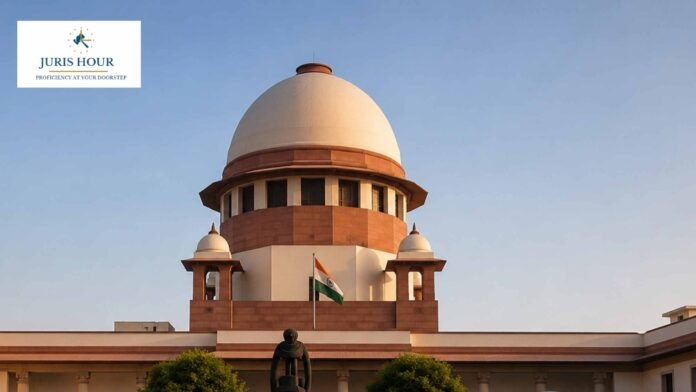
The Supreme Court has held that the Commission does not possess adjudicatory powers to issue binding directions in service matters, including orders directing payment of arrears or implementation of promotions.
The bench of Justice Sanjay Karol and Justice Augustine George Masih clarified that while the NCSC is empowered to investigate complaints relating to the deprivation of rights and safeguards of Scheduled Castes, its role remains recommendatory and advisory, not judicial.
The appeal was filed by the Mumbai Port Authority against an order of the Bombay High Court, which had upheld directions issued by the NCSC requiring the employer to grant promotion-related benefits and pay arrears to an employee belonging to the Scheduled Caste category.
Buy Now: Supreme court Judgements E-Compilation – JUNE 2026
The controversy arose from the service career of Madhavi K. Chandorkar, who joined the Mumbai Port Authority as a Typist-cum-Computer Clerk in 1997 and was subsequently promoted as Stenographer Grade-I under the reservation policy then in force.
The dispute traces its origins to changes in the Department of Personnel and Training (DoPT) Office Memoranda governing consequential seniority for Scheduled Caste and Scheduled Tribe employees. While a 1997 Office Memorandum restored seniority to general category employees promoted later, a subsequent 2002 Office Memorandum granted consequential seniority to SC/ST employees retrospectively from 17 June 1995 following the Constitution (Eighty-Fifth Amendment) Act, 2001.
The 2002 Office Memorandum was later quashed by the Bombay High Court in 2016. Pursuant to that judgment, the Mumbai Port Authority revised seniority lists and initiated review of promotions. As part of this exercise, the respondent employee was issued a show cause notice and was ultimately demoted notionally from Stenographer Grade-I to Grade-II with retrospective effect.
Aggrieved by her demotion, the employee approached the National Commission for Scheduled Castes alleging violation of reservation safeguards.
After hearing both parties, the NCSC directed the Mumbai Port Authority to strictly follow DoPT guidelines on reservation in promotion, prepare reservation rosters correctly, grant promotions in accordance with reservation rules, implement its directions and pay arrears within 30 days, and submit an Action Taken Report to the Commission.
The Mumbai Port Authority challenged these directions, arguing that the Commission lacked constitutional authority to issue mandatory orders affecting service rights.
The Bombay High Court dismissed the writ petition filed by the Port Authority. It held that the minutes recorded by the NCSC did not exceed its constitutional jurisdiction and observed that the direction regarding payment of arrears substantially reiterated an earlier order of the Commission that had attained finality.
This prompted the Port Authority to approach the Supreme Court.
The Supreme Court undertook an extensive examination of Article 338 of the Constitution, which establishes the National Commission for Scheduled Castes and enumerates its duties.
The Bench noted that Article 338(5) authorises the Commission to investigate and monitor constitutional safeguards, inquire into specific complaints concerning deprivation of rights, advise on socio-economic development, submit reports to the President, and make recommendations for effective implementation of safeguards.
However, the Court emphasised that these provisions nowhere confer adjudicatory authority comparable to that exercised by courts or tribunals.
The Court also analysed Article 338(8), which grants the Commission certain powers of a civil court during investigations.
It observed that these powers are confined to procedural matters such as summoning witnesses, examining persons on oath, requiring production of documents, receiving evidence on affidavits, and requisitioning public records.
According to the Court, these powers facilitate investigations but do not transform the Commission into a judicial authority capable of issuing enforceable directions or adjudicating disputes.
The NCSC had argued that its constitutional duty to safeguard the rights of Scheduled Castes necessarily included the power to enforce those safeguards by issuing binding directions.
Rejecting this contention, the Supreme Court held that the Constitution deliberately confers only investigative and recommendatory functions upon the Commission.
The Bench observed that after conducting an inquiry, the Commission may record factual findings and make recommendations to the Central or State Government, but it cannot compel implementation through binding orders.
The Court relied upon its earlier judgments, including All India Indian Overseas Bank SC and ST Employees’ Welfare Association v. Union of India (1996) and Collector v. Ajit Jogi (2011).
Those decisions had similarly held that although the Commission possesses certain powers akin to those of a civil court during inquiries, it is not a court or tribunal and cannot grant injunctions or determine service rights.
The Bench also referred to its decision concerning the Orissa State Commission for Women, reiterating that statutory or constitutional commissions entrusted with investigative functions cannot assume adjudicatory powers unless expressly authorised by law.
The Supreme Court observed that constitutional commissions such as the NCSC perform an important social and constitutional role in protecting vulnerable communities.
However, the Court emphasised that their constitutional mandate is recommendatory and advisory rather than adjudicatory.
It held that while the Commission may investigate complaints, monitor implementation of safeguards and recommend remedial measures, it cannot issue mandatory directions requiring authorities to pay arrears or grant service benefits.
Allowing the appeal, the Supreme Court set aside the Bombay High Court’s judgment and declared that the NCSC’s direction directing the Mumbai Port Authority to implement its order and pay arrears within 30 days was contrary to the Constitution and non est in law.
Membership Required to Access Case Details & Order Copy
To view the complete Case Details and Download Order Copy, you must have an active membership. Please subscribe to continue.
Read More: Recovery of Blood-Stained Weapon Alone Can’t Sustain Conviction: Supreme Court

