
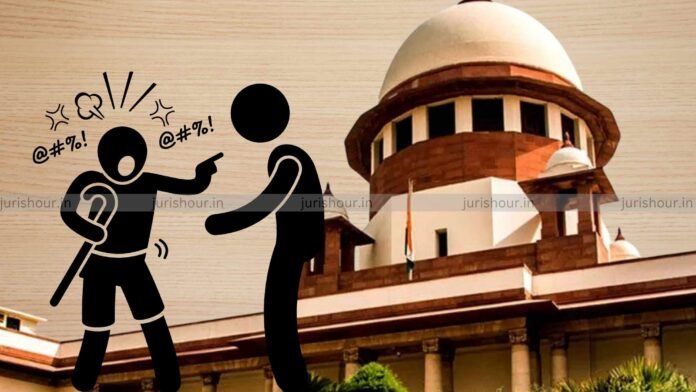
The Supreme Court has ruled that the use of abusive, vulgar or profane language, however offensive or uncivil, does not by itself amount to the offence of obscenity under Section 294(b) of the Indian Penal Code (IPC).
Drawing a clear legal distinction between “obscenity” and “vulgarity”, the bench of Justice Sanjay Karol and Justice Vipul M. Pancholi observed that only speech which is lascivious, appeals to prurient interests and has the tendency to deprave or corrupt can attract prosecution under the provision.
The bench set aside his convictions under Sections 294(b) and 506(ii) IPC, it upheld his conviction under Section 326 IPC for voluntarily causing grievous hurt by a dangerous weapon, albeit with a substantially modified sentence.
Buy Now: Supreme court Judgements E-Compilation – JUNE 2026
The prosecution alleged that the dispute originated from a disagreement over land between the appellant and the complainant’s family. According to the prosecution, an altercation first occurred on 22 August 2017. Two days later, on 24 August 2017, another confrontation allegedly took place when the appellant quarrelled with the complainant’s nephew. When the complainant intervened, the appellant allegedly abused him, used caste-based insults and subsequently attacked him with a billhook, causing injuries to his forehead, nose and thumb. The complainant was immediately taken to the Government Hospital at Bhavani for medical treatment.
An FIR was registered under Sections 294(b), 324 and 506(ii) IPC along with provisions of the Scheduled Castes and Scheduled Tribes (Prevention of Atrocities) Act. During investigation, the charge under Section 324 IPC was altered to Section 326 IPC after medical examination revealed grievous injuries.
The Trial Court convicted the accused under IPC as well as the SC/ST Act, holding that eyewitness testimony and medical evidence sufficiently established both the assault and the caste-based abuse. It sentenced him to imprisonment under various provisions, including five years under Section 326 IPC.
On appeal, the Madras High Court acquitted the appellant of all offences under the SC/ST Act after finding that the evidence did not establish caste-based humiliation as contemplated by the statute. Nevertheless, it upheld his convictions under Sections 294(b), 326 and 506(ii) IPC while reducing the sentences imposed by the Trial Court. Since neither the State nor the complainant challenged the acquittal under the SC/ST Act, that aspect attained finality before the Supreme Court.
The principal question before the Supreme Court was whether the abusive words allegedly uttered by the appellant amounted to “obscene” words punishable under Section 294(b) IPC.
The Court undertook an extensive review of earlier precedents, including Ranjit D. Udeshi, Aveek Sarkar, Samaresh Bose, N.S. Madhanagopal and Apoorva Arora, to explain the legal meaning of obscenity.
It observed that Section 294 IPC does not define the expression “obscene”. However, judicial precedents have consistently held that obscenity is confined to material or expressions that are lascivious, appeal to prurient interests, or possess a tendency to deprave and corrupt those exposed to them. The Court emphasised that vulgarity, profanity and abusive language are conceptually distinct from obscenity.
According to the Bench, words may be insulting, rude or deeply offensive without satisfying the legal ingredients of obscenity. Offensive language may evoke disgust, anger or revulsion, but unless it carries the sexual or lascivious character recognised by law, it cannot attract Section 294(b) IPC.
Applying these principles to the facts, the Supreme Court noted that although the appellant allegedly used highly abusive expressions during the quarrel, the prosecution failed to establish that the words were lascivious or appealed to prurient interests.
The Court further pointed out that another essential ingredient of Section 294(b)—that the utterance caused annoyance to others in a public place—had also not been proved. In the absence of these mandatory requirements, the conviction under Section 294(b) IPC could not be sustained. Accordingly, the conviction under that provision was set aside.
The Court next examined the conviction under Section 506(ii) IPC relating to criminal intimidation.
Although the prosecution alleged that the appellant threatened the complainant while brandishing the billhook, the Court held that criminal intimidation requires proof that the threat was intentionally made to cause alarm or to compel a person to do or omit an act.
The Bench found that apart from the allegation that threatening words had been uttered during the quarrel, there was no evidence demonstrating any intention to cause such alarm. Mere threatening language exchanged during an altercation, without proof of the requisite intention, was held insufficient to constitute criminal intimidation under Section 506(ii). The conviction under this provision was therefore also set aside.
However, the Supreme Court affirmed the conviction under Section 326 IPC.
The Court relied upon the testimony of the injured witness, corroborating eyewitnesses and the medical evidence of the attending doctor, who confirmed multiple lacerations and, significantly, a fractured nasal bone. The Bench observed that a fracture squarely falls within the statutory definition of “grievous hurt” under Section 320 IPC.
The medical evidence also established that the injuries could have been caused by the recovered billhook, a dangerous weapon. Consequently, all ingredients necessary for conviction under Section 326 IPC stood fully proved, leaving no reason to interfere with the finding of guilt.
While maintaining the conviction for grievous hurt, the Supreme Court substantially modified the sentence.
The Court noted that the incident arose from a longstanding land dispute between the parties, that the appellant was approximately 70 years old, and that his health warranted a compassionate approach. Instead of directing him to undergo imprisonment, the Court ordered that he remain in custody only till the rising of the Court on a date fixed by the concerned court.
The Bench further directed the appellant to pay a fine of ₹50,000 within two months. With these modifications, the appeal was allowed in part.
Membership Required to Access Case Details & Order Copy
To view the complete Case Details and Download Order Copy, you must have an active membership. Please subscribe to continue.
Read More: Supreme Court Quashes Kerala HC’s Cryptic Reversal in Will Dispute

