
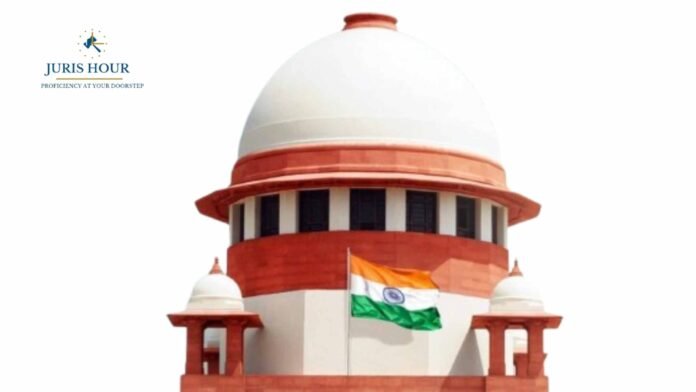
The Supreme Court has upheld the authority of the National Council for Teacher Education (NCTE) and its Executive Committee to require recognised teacher-education institutions to submit annual Performance Appraisal Reports (PARs), observing that constitutional courts should not adopt a technical or pedantic approach while reviewing measures taken by statutory regulators.
The Bench of Justice Pamidighantam Sri Narasimha and Justice Alok Aradhe set aside a Delhi High Court judgment that had invalidated an NCTE public notice requiring institutions to upload their Performance Appraisal Reports and pay the prescribed processing charges.
The Supreme Court held that the September 22, 2019 public notice issued by the Member Secretary of the NCTE Executive Committee was legal and valid. It ruled that both the Council and its Executive Committee were acting within their jurisdiction when they called upon teacher-education institutions to submit the reports.
Buy Now: E-Handbook: Draft Replies to GST Notices On 40+ Issues
The central issue before the Supreme Court was whether the NCTE Executive Committee, acting through its Member Secretary, was legally empowered to issue the public notice making submission of Performance Appraisal Reports mandatory.
The Court found that Section 12(k) of the National Council for Teacher Education Act, 1993 expressly authorises the Council to evolve suitable performance-appraisal systems, norms and mechanisms for enforcing accountability among recognised institutions.
According to the Bench, the NCTE had considered and approved the introduction of the PAR system during the 48th meeting of its General Body held on February 5, 2019. The Executive Committee, as the Council’s executive arm, was consequently authorised to implement that decision through a suitable proforma.
The Member Secretary’s issuance of the public notice was therefore an implementation of the Council’s decision and not an unauthorised exercise of power, the Court said.
“We fail to understand as to how a regulatory measure of a statutory body” responsible for the planned and coordinated development of teacher education could be restrained from requiring institutions to file Performance Appraisal Reports, the Bench observed.
The Court added that even in the absence of specific statutory language, such a regulatory measure would be incidental and ancillary to the functions of a regulator.
The proceedings originated from a challenge filed by teacher-education institutions against the NCTE’s September 2019 public notice.
The notice required all institutions conducting NCTE-recognised courses to submit their Performance Appraisal Reports online for the 2018-19 academic year. Central and state government institutions were required to pay ₹5,000 per institution, while institutions falling under other categories were required to pay ₹15,000.
The notice also stated that failure to submit a PAR would attract action under Section 17(1) of the NCTE Act.
A Single Judge of the Delhi High Court initially dismissed the institutions’ writ petition. However, the Division Bench allowed their appeal on March 13, 2023.
The Division Bench concluded that there was no material demonstrating that the PAR proforma uploaded with the public notice had been developed or approved by the Council itself. It also found no evidence that the Council’s function under Section 12(k) had been delegated to the Member Secretary under Section 27 of the Act.
On that basis, the High Court declared the notice unsustainable and quashed it. It did not decide whether the prescribed amounts of ₹5,000 and ₹15,000 constituted a fee or a tax.
Disagreeing with the High Court, the Supreme Court held that its approach impaired the NCTE’s regulatory jurisdiction.
The Bench examined the statutory framework governing the Council, its Executive Committee and the Regional Committees. It noted that the Executive Committee is constituted under Section 19 of the NCTE Act to discharge functions assigned to it by the Council or determined through regulations.
The Executive Committee is not merely an incidental body but the institution that actually discharges and implements the Council’s functions, the judgment said.
The Court found that the General Body had specifically approved the proposal to replace the earlier annual-renewal requirement with the PAR system. It had also authorised the NCTE to proceed through a proforma developed for that purpose.
Once that policy decision was taken, the Executive Committee was under a duty to carry forward the Council’s mandate. The Member Secretary performed precisely that function by issuing the public notice, the Court held.
The Supreme Court placed significant emphasis on accountability in institutions responsible for teacher education.
It explained that accountability has three essential dimensions—responsibility, answerability and enforceability. Responsibility involves identifying duties and performance obligations; answerability requires reasoned decision-making; and enforceability permits corrective action when an institution or authority fails to discharge its obligations.
A performance-appraisal system enables the regulator to examine whether recognised institutions are complying with prescribed norms and maintaining the required standards, the Court noted.
The Bench reasoned that because the NCTE itself is subject to performance audits by the Comptroller and Auditor General of India, it is natural and incidental for the Council to seek similar performance information from institutions falling within its regulatory jurisdiction.
The reports would assist the NCTE in maintaining an information system, periodically reviewing recognised institutions and taking corrective action where deficiencies are found.
The Supreme Court said that courts undoubtedly have a duty to ensure that executive authorities and statutory bodies do not exercise powers that have not been conferred upon them. At the same time, constitutional courts have a positive duty to ensure that regulatory authorities exercise their lawful powers effectively, efficiently and accountably.
When reviewing a regulator’s action, a court must determine whether it violates a mandatory statutory provision or exceeds the power vested in the authority. The action must be examined in the context of the legislation’s larger purpose and the regulator’s overall mandate.
“In this context, Courts cannot adopt a technical or a pedantic view of the action taken by the regulators,” the Bench observed.
The Court found that the Delhi High Court had examined the PAR notice too narrowly instead of considering the NCTE’s wider responsibility to regulate and maintain standards in teacher education.
The Supreme Court also addressed the payments required under the public notice.
It held that the amount collected along with a Performance Appraisal Report was in the nature of a processing fee. The power to charge such a fee was incidental and ancillary to the regulatory authority vested in the NCTE.
Although the Court was informed that procedural and technical issues associated with the 2019 notice had subsequently been rectified at the NCTE’s 53rd meeting, it nevertheless considered it necessary to decide the dispute.
The Bench said that a definitive ruling was required to clarify the scope of the powers and functions that statutory regulators are expected to exercise.
The judgment went beyond the immediate dispute and examined the role of teachers, teacher-education institutions and the NCTE in fulfilling the fundamental right to education under Article 21A of the Constitution.
The Court noted that free and compulsory elementary education for children between six and 14 years of age is an enforceable fundamental right. Effective enjoyment of that right depends substantially on the availability of properly trained and qualified teachers.
Referring to its earlier decision in Dinesh Biwaji Ashtikar v. State of Maharashtra, the Court recalled five duty bearers responsible for implementing the right to elementary education: the appropriate government, local authorities, neighbourhood schools, parents or guardians, and elementary-school teachers.
The Bench added two more duty bearers to this framework.
It identified teacher-education institutions as the sixth duty bearer because they are responsible for educating and training those who will teach children. Such institutions must obtain recognition and comply with the standards prescribed under the NCTE Act.
The Court identified the NCTE as the seventh duty bearer. The Council is responsible for ensuring planned and coordinated development of the teacher-education system and for making certain that training institutions function effectively, efficiently and with integrity.
The duties entrusted to the NCTE, its Executive Committee and its Regional Committees are “perhaps the highest of all the duty bearers,” the Bench remarked.
The Supreme Court underlined that the life and development of a child are integrally connected with the role of an elementary-school teacher.
Teacher education has assumed greater constitutional significance after elementary education became a fundamental right, the judgment said. The Right of Children to Free and Compulsory Education Act, 2009 recognises the importance of qualified teachers and empowers an academic authority to prescribe minimum qualifications for their appointment.
The NCTE is the academic authority contemplated under Section 23 of the RTE Act.
The Court observed that effective regulation of teacher-training institutions is therefore not a routine administrative exercise. It is connected directly with the quality of school education and the fulfilment of children’s constitutional rights.
Institutions involved in this regulatory structure must demonstrate administrative efficiency, professional expertise, innovation, transparency, integrity and accountability through regular reviews, audits and assessments, it added.
Membership Required to Access Case Details & Order Copy
To view the complete Case Details and Download Order Copy, you must have an active membership. Please subscribe to continue.
Read More: JURISHOUR | TAX LAW DAILY BULLETIN : 5 SEPTEMBER, 2026

