
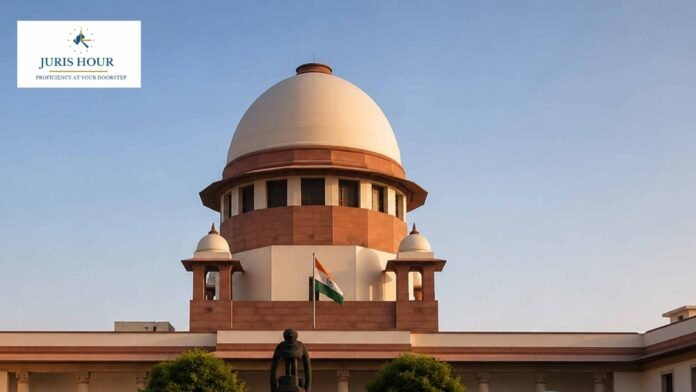
The Supreme Court has dismissed a constitutional challenge to the statutory prescription of hanging as the mode of execution of a death sentence, holding that no sufficient basis has been shown to refer its earlier decision in Deena v. Union of India to a larger Bench for reconsideration.
The bench of Justice Vikram Nath and Justice Sandeep Mehta ultimately declined to interfere with the existing legal position, but expressly left open the possibility of future constitutional scrutiny if compelling scientific, medical or empirical evidence emerges demonstrating that the factual basis underlying the earlier ruling has materially changed.
The petition was instituted under Article 32 of the Constitution challenging Section 354(5) of the Code of Criminal Procedure, 1973, insofar as it prescribed hanging as the sole method of execution of a death sentence. Following the enactment of the Bharatiya Nagarik Suraksha Sanhita, 2023, the corresponding provision is Section 393(5), which retains the same statutory prescription.
Buy Now: JurisHour Ultimate Legal Research Combo – 4 Premium E-Magazines at an Unbeatable Price
The petitioner sought a declaration that the provision was unconstitutional, particularly on the ground that it violated Articles 14 and 21. He also sought recognition of a fundamental right to die through a dignified procedure where a death sentence was required to be carried out.
The constitutional challenge therefore did not principally concern whether the State could impose capital punishment. Instead, the central question was whether the method chosen by the State to execute a lawful death sentence satisfies the constitutional requirements of fairness, reasonableness and human dignity under Article 21.
The Supreme Court noted that the constitutional validity of capital punishment itself is settled. In Bachan Singh v. State of Punjab, the Constitution Bench had reaffirmed the validity of the death penalty while laying down the “rarest of rare” doctrine.
However, the Court emphasised that the validity of the punishment does not automatically settle the constitutionality of the method by which it is implemented. The judgment recognised that the manner of execution remains subject to constitutional scrutiny, particularly under Article 21.
The Court also referred to the evolution of Article 21 jurisprudence and the principle that the right to life encompasses living with human dignity. The petition raised the question whether that constitutional protection also requires the State, even when carrying out a lawful death sentence, to adopt a method that minimises unnecessary suffering and preserves the dignity of the condemned person.
The judgment traced the statutory history of execution by hanging. The Court noted that the colonial-era Code of Criminal Procedure introduced hanging by the neck as the prescribed method, and that subsequent criminal procedure enactments continued the same position.
The 1973 CrPC retained the prescription through Section 354(5). More recently, despite the enactment of the BNSS as part of the overhaul of India’s criminal laws, Parliament retained hanging under Section 393(5). Thus, the statutory method has continued substantially unchanged through successive generations of criminal procedure legislation.
The Court also noted that historical commissions and the Law Commission of India had previously considered whether hanging satisfied the requirements of a humane method of execution.
The Law Commission’s 35th Report had observed that a method of execution should be “certain, humane, quick and decent”, while the 187th Report subsequently revisited the issue in light of developments in scientific knowledge and international practices.
Rishi Malhotra, appearing in person, argued that retaining hanging as the exclusive mode of execution was inconsistent with constitutional guarantees of dignity.
The petitioner relied upon the Law Commission’s 187th Report and scientific material to contend that hanging could involve significant uncertainty and that its actual outcome could vary depending upon several factors.
He argued that the method could therefore not automatically be characterised as a quick, painless and scientifically certain means of execution. The petitioner’s case was that a method carrying such uncertainties was incompatible with Article 21’s requirement of a just, fair and reasonable procedure.
The petitioner also invoked Article 14. His argument was based partly on the fact that the military statutes—the Army Act, Air Force Act and Navy Act—recognise shooting as an alternative method of execution in certain circumstances, whereas civilians sentenced under ordinary criminal law are subject only to hanging.
According to the petitioner, the differential treatment lacked a rational basis and therefore raised an issue of constitutional arbitrariness.
The petitioner also relied upon international standards concerning the execution of death sentences, including the ECOSOC safeguards, to contend that where capital punishment is retained, the State should ensure that it causes the minimum possible suffering.
He urged the Court to reconsider the earlier constitutional approval of hanging in light of developments in medical science, forensic knowledge, constitutional jurisprudence and international standards.
As an alternative to striking down the provision altogether, the petitioner suggested that the law could be read down to permit another method considered less painful or more humane.
Project 39A, National Law University, Delhi, appearing through senior counsel, supported reconsideration of the existing position.
It was argued that when the Supreme Court decided Deena, the evidentiary material before it was materially different from the scientific and medical literature available today. According to the submissions, the earlier decision did not have the benefit of the present body of scientific research concerning the consequences and reliability of judicial hanging.
At the same time, Project 39A cautioned that simply replacing hanging with another method would not resolve the constitutional question unless the alternative itself was subjected to rigorous scrutiny.
The submissions specifically questioned whether lethal injection could automatically be regarded as a more humane alternative, pointing to concerns regarding its practical implementation in other jurisdictions.
The Union Government strongly opposed the petition.
The Attorney General argued that the petition effectively invited the Supreme Court to redesign a legislative policy concerning punishment and its implementation. According to the Union, determining the appropriate method of execution was primarily a matter for Parliament and the executive, subject to constitutional limitations.
The Government further relied upon the Supreme Court’s three-Judge Bench judgment in Deena v. Union of India, which had upheld hanging as constitutionally valid.
It was submitted that Deena had considered the medical and expert material then available and had concluded that properly administered hanging did not violate Article 21.
The Union also emphasised that Parliament had consciously retained hanging in Section 393(5) of the BNSS. According to the Government, that legislative decision demonstrated that Parliament had considered the issue while replacing the CrPC and nevertheless chose to continue the existing method.
The Supreme Court’s reasoning turned significantly on the doctrine of precedent.
The Court noted that the constitutionality of hanging under Section 354(5) had already been examined by a three-Judge Bench in Deena. Consequently, a two-Judge Bench could not depart from that binding precedent merely because the issue remained controversial.
The Court invoked the principle of stare decisis, observing that a smaller Bench should not depart from a decision rendered by a larger Bench that had stood for more than four decades unless there were compelling grounds demonstrating that the earlier judgment had been rendered constitutionally unsustainable by subsequent developments.
The Court further noted that Deena had subsequently been considered and approved by a Constitution Bench in Shashi Nayar v. Union of India. This made the scope for interference by the present Bench even narrower.
A crucial factor for the Court was the evidentiary record.
The Court noted that although the petitioner asserted that hanging was physically painful and psychologically traumatic, the submission was not supported by what the Court considered unimpeachable scientific or empirical evidence sufficient to justify overruling the earlier precedent.
Similarly, the material placed concerning lethal injection did not establish that the alternative method was demonstrably superior or more humane. Instead, the material relied upon by the intervenor itself highlighted uncertainties and practical difficulties associated with lethal injection.
The Court therefore found no sufficiently established scientific basis to conclude that lethal injection represented a constitutionally preferable alternative to hanging.
The Court also rejected the argument based upon the availability of shooting under military legislation.
It held that the Army Act, Air Force Act and Navy Act operate in a distinct legal field and govern persons subject to military law. The existence of an alternative mode of execution under those specialised statutes could not, by itself, be used to test the constitutional validity of the provisions governing civilians convicted under ordinary criminal law.
The Court thus declined to treat the different statutory treatment as constitutionally impermissible discrimination.
The Court placed substantial reliance upon the reasoning in Deena, where different methods of execution had been considered.
The earlier judgment had examined methods including electrocution, lethal gas, shooting and lethal injection and had concluded that none had demonstrated a distinct advantage over hanging sufficient to justify replacing the statutory method.
The present Bench found no adequate material establishing that the scientific and factual foundations of Deena had been so fundamentally displaced as to permit a two-Judge Bench to reopen the constitutional issue.
The decisive conclusion came in paragraph 63 of the judgment.
The Court held that it was not persuaded that a case had been made out for referring Deena v. Union of India to a larger Bench for reconsideration of the constitutional validity of Section 354(5) CrPC or Section 393(5) BNSS.
Accordingly, the constitutional challenge to hanging as the prescribed mode of execution was rejected.
While dismissing the petition, however, the Supreme Court made an important qualification.
The Court clarified that its judgment should not be understood as permanently foreclosing future constitutional scrutiny.
If compelling scientific, medical or empirical evidence emerges showing that the factual and scientific foundations on which Deena proceeded have been materially displaced, the constitutional validity of the method could potentially be examined again.
This observation leaves open an important constitutional pathway for future litigation if developments in science establish a substantially different factual position.
The Court also clarified that its decision does not prevent the Union Government from undertaking a comprehensive review of the existing method of execution.
The Court observed that the Government could, if it considered appropriate, constitute an expert body comprising specialists in areas including law, forensic medicine, neuroscience, penology and allied disciplines.
Such a body could examine whether an alternative method would better serve the constitutional objective of minimising unnecessary suffering while preserving the dignity of a condemned prisoner.
Importantly, the Court placed such an exercise within the domain of the Executive and Legislature, rather than directing Parliament to replace hanging with a particular alternative.
Membership Required to Access Case Details & Order Copy
To view the complete Case Details and Download Order Copy, you must have an active membership. Please subscribe to continue.

