
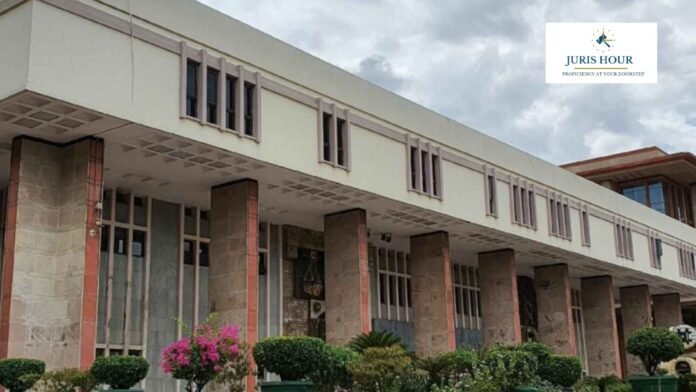
The Delhi High Court has held that interest arising from customs confiscation and redemption proceedings cannot be calculated retrospectively for a period during which the liability sought to be subjected to interest had not itself been determined.
The bench of Justice Anil Kshetarpal and Justice Shail Jain directed Customs authorities to exclude the period from the original assessment in May 2015 up to February 28, 2023, while recomputing the disputed interest liability. However, it declined to grant a complete waiver and permitted the authorities to determine any interest legally payable for the subsequent period.
Buy Now: 100+ Judgements On Customs Classification
The petitioner, a proprietorship concern engaged in importing and selling petroleum products, filed a Bill of Entry on May 8, 2015, at the Inland Container Depot, Tughlakabad, New Delhi. It declared the imported goods as bitumen under Customs Tariff Heading 27132000, with a transaction value of ₹36,73,758.
Customs duty of ₹9,22,210 was assessed on May 8–9, 2015. However, the consignment was placed on hold for physical examination by the Special Intelligence and Investigation Branch.
The examination revealed that 80 of the 90 declared drums contained a black-coloured substance, while 10 drums were empty. Samples sent to the Central Revenue Control Laboratory were identified as used oil rather than bitumen.
Based on the laboratory report, Customs treated the goods as used oil falling under Customs Tariff Heading 27101990 and considered them a restricted item requiring the necessary permissions or licence. The goods were seized on June 5, 2015, under Section 110 of the Customs Act, 1962.
The importer maintained that it had ordered bitumen and that the overseas supplier had mistakenly supplied used oil. It also claimed to have furnished a written communication from the supplier acknowledging the mistake.
Despite the importer’s request for waiver of the show cause notice and early adjudication, Customs issued a notice on September 15, 2015, proposing confiscation and penalties.
The importer submitted its reply on October 1, 2015, disputing the allegation that the goods were restricted or prohibited and asserting that they were not hazardous waste. Its counsel attended a personal hearing on December 8, 2015.
When another hearing was scheduled in October 2016, the importer informed the authority that it had already submitted its reply and attended a hearing. It declined a further hearing and again requested an expeditious decision because the consignment remained uncleared.
The proceedings eventually culminated in an Order-in-Original dated February 28, 2023, after another hearing in January 2023.
The adjudicating authority changed the description and classification from bitumen to used oil. However, it found the used oil to be non-hazardous, accepted the declared transaction value and held that no additional duty beyond the previously assessed ₹9,22,210 was payable. The order recorded that this duty had already been paid and appropriated.
The authority ordered confiscation but permitted redemption on payment of a ₹1,83,000 fine. It also imposed a ₹5,000 penalty under Section 112(a)(ii) and a ₹1,83,000 penalty under Section 114AA. The proposed penalty under Section 114A was dropped.
The Bill of Entry was subsequently amended and reassessed on August 29, 2023.
When the importer sought clearance following adjudication and reassessment, an amount described as interest appeared in the Customs EDI System.
According to the petitioner, the amount stood at approximately ₹11,74,806 on November 16, 2023, rose to ₹12,10,874 on February 22, 2024, and reached ₹15,21,645 by May 1, 2026.
The importer made several representations seeking removal of the interest liability. Receiving no effective response, it approached the High Court.
It argued that it could not be burdened with interest for the prolonged period during which the goods remained seized and adjudication was pending, particularly when it had repeatedly requested an early decision.
Customs opposed the petition, arguing that redemption under Section 125 carried an obligation to pay duty and other statutory charges. It also contended that the importer had accepted the adjudication order and had an alternative statutory appellate remedy.
The court clarified that the dispute did not concern charges for delayed filing of a Bill of Entry under Section 46(3). There was no allegation that the Bill of Entry had been presented late. Customs sought to justify the interest as a consequence of confiscation and redemption.
Examining the Supreme Court’s decision in Navayuga Engineering Co. Ltd. v. Union of India, the bench distinguished the obligation arising from redemption under Section 125(2) from the statutory machinery for assessing and determining duty under Section 28.
In the present case, the consequences of the confiscation proceedings were determined only through the February 28, 2023 adjudication order. The original May 2015 assessment had been based on the declaration of the goods as bitumen and was followed by examination, seizure and confiscation proceedings.
The court therefore held that the liability arising from those proceedings could not retrospectively be treated as having remained payable since May 2015 merely to calculate interest.
The bench expressly clarified that departmental delay alone does not extinguish statutory interest. Its finding was narrower: interest could not be calculated for a period during which the particular liability subjected to interest had not been determined.
The court rejected the argument that accepting the Order-in-Original prevented the importer from questioning the subsequent interest computation.
The petitioner was not seeking to reopen the findings on classification, confiscation, redemption fine or penalties. Its challenge concerned the period used to calculate consequential interest.
The bench also observed that the EDI System cannot create a liability unsupported by the Customs Act. Equally, a legally payable amount cannot be avoided simply because it appears in that system. The decisive issue was whether the computation complied with the statutory provisions.
The availability of an alternative appellate remedy did not warrant dismissal because the material facts were undisputed and the limited issue could be resolved through a direction for recomputation.
The High Court directed Customs to exclude the period from the original May 2015 assessment up to February 28, 2023, and determine any interest payable thereafter strictly under the applicable statutory provisions.
The authorities must consider the August 29, 2023 reassessment and give credit for amounts already paid or appropriated towards customs duty, redemption fine and penalties. A fresh computation must be issued within four weeks of receiving a copy of the judgment.
The existing EDI computation was set aside to the extent that it treated the period before February 28, 2023 as delayed payment of the liability determined in the confiscation proceedings.
The court left the classification, confiscation, redemption fine and penalties undisturbed. It also clarified that its ruling did not address any independent statutory liability arising from a separate, legally recognised default. The importer remains liable to pay any amount lawfully found due after recomputation.
Membership Required to Access Case Details & Order Copy
To view the complete Case Details and Download Order Copy, you must have an active membership. Please subscribe to continue.

