
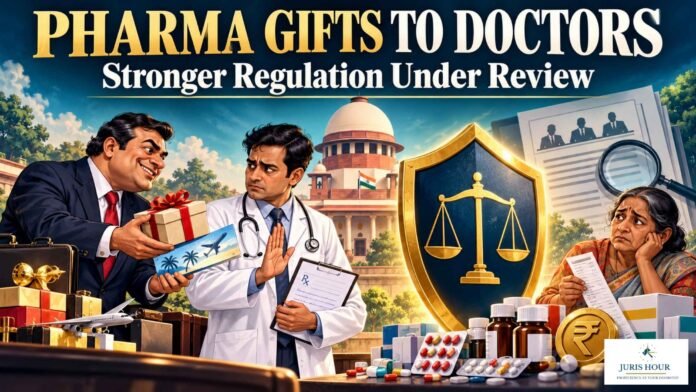
The Supreme Court has directed the Centre to constitute a committee within two weeks to examine measures for strengthening the regulation of pharmaceutical marketing practices, observing that the existing framework has not proved entirely effective in preventing unethical conduct in the sector.
The Bench of Justice Vikram Nath and Justice Sandeep Mehta said that the effectiveness of pharmaceutical regulation must be assessed through its actual implementation and enforcement, particularly when the practices involved directly affect public health, medicine affordability and the right to health.
Buy Now: 90+ Supreme Court Judgments – September 2026
The October 8, 2026 order was passed in a petition filed by the Federation of Medical & Sales Representatives Association of India and others seeking an enforceable framework against unethical promotional practices by pharmaceutical companies. The Court exercised its powers under Articles 32 and 142 of the Constitution, in furtherance of the right to health protected under Article 21.
The proceedings concern whether the existing framework adequately regulates pharmaceutical companies that offer gifts, monetary benefits, sponsored travel, hospitality or other inducements to influence doctors’ prescribing decisions.
The petitioners sought statutory backing for the Uniform Code for Pharmaceutical Marketing Practices, together with monitoring mechanisms, transparency requirements, accountability and consequences for violations. They also requested binding judicial guidelines until an effective law was enacted.
While acknowledging the need for stronger regulation, the Court left the choice of the appropriate statutory or regulatory framework to the Centre. Its directions require a comprehensive consultation process, a reasoned government decision and subsequent reporting to the Court.
The petitioners alleged that pharmaceutical companies extend direct or indirect benefits to medical practitioners to influence the medicines they prescribe.
According to their submissions, these practices may encourage excessive or irrational prescribing, the use of medicines beyond therapeutic requirements, irrational drug combinations and a preference for expensive branded medicines.
They argued that the consequences extend beyond the financial burden on patients. Irrational medicine consumption, adverse drug reactions and antimicrobial or antibiotic resistance were among the public health concerns raised.
The petitioners also highlighted what they described as a regulatory gap: although medical practitioners are subject to statutory ethical restrictions concerning their dealings with pharmaceutical companies, there was no corresponding enforceable regime through which companies could be proceeded against for inducing or facilitating such conduct.
The federation stated that it had raised concerns about unethical pharmaceutical marketing since 2005 and had repeatedly engaged with the Government for an effective regulatory framework.
The petition initially challenged the adequacy of the Uniform Code for Pharmaceutical Marketing Practices, 2015, which was introduced for voluntary adoption by pharmaceutical companies.
The petitioners contended that its voluntary character, coupled with inadequate monitoring and enforceable consequences, had undermined its effectiveness.
They relied on governmental deliberations acknowledging the need for stronger regulation, as well as India’s international obligations concerning health and corruption, to argue that the absence of an enforceable framework affected the constitutional right to health.
The Supreme Court issued notice in the matter on March 11, 2022. Subsequent hearings involved the submission of suggestions by the petitioners and intervenors and repeated opportunities for the Centre to deliberate on an appropriate response.
The Centre informed the Court through an affidavit that it proposed to establish a three-member committee to examine the appropriate statutory and regulatory framework governing pharmaceutical companies’ dealings with medical practitioners.
The affidavit referred to meetings held in August 2026 between the Department of Pharmaceuticals and the Department of Health and Family Welfare, followed by consultations with pharmaceutical industry associations.
The discussions addressed transparency, independent scrutiny, compliance monitoring, disclosures and complaint-handling mechanisms.
The Centre stated that the Uniform Code for Pharmaceutical Marketing Practices, 2024 would continue to govern pharmaceutical marketing in the meantime, until the proposed committee’s recommendations were considered and acted upon.
Regarding doctors, the Government relied on the Indian Medical Council (Professional Conduct, Etiquette and Ethics) Regulations, 2002. The order records that these regulations restrict acceptance of gifts, travel facilities, hospitality and monetary grants from the pharmaceutical and allied healthcare industry, while permitting bona fide research subject to prescribed safeguards.
Violations can attract disciplinary action, including censure and, in appropriate cases, removal from the relevant medical register for the prescribed period.
Senior advocate Sanjay Parikh, appearing for the petitioners, questioned the need for another committee, referring to a high-level committee constituted in September 2022 that was expected to submit recommendations within 90 days. He submitted that the issue remained unresolved.
Solicitor General Tushar Mehta disputed the suggestion that the earlier exercise had produced no concrete outcome.
He stated that the earlier committee, chaired by Dr. V.K. Paul, had examined legally enforceable mechanisms and international practices. According to the Centre, it recommended strengthening the existing framework rather than giving the 2015 code statutory status at that stage.
The Solicitor General submitted that those recommendations contributed to the formulation of the 2024 code, which introduced enhanced disclosure and oversight mechanisms, CEO self-declarations, stricter provisions concerning gifts and promotional activities, complaint timelines, audits and referral mechanisms.
The petitioners ultimately expressed no objection to the new committee, while seeking meaningful participation in its consultations.
The Supreme Court found that the material before it warranted a careful examination of measures to strengthen pharmaceutical marketing regulation.
It observed that the existence of prescribed norms alone could not establish the effectiveness of a framework. Implementation, monitoring, transparency, accountability and enforcement were equally necessary.
The Bench emphasised that regulation must balance the legitimate interests of the pharmaceutical industry with the paramount need to protect patients and ensure ethical, accessible and affordable healthcare.
The Court also recognised that selecting the statutory framework and determining the nature of regulatory oversight primarily fall within the executive and legislative domains. It said it could not substitute its own policy determination for that of the executive.
At the same time, judicial restraint could not require indifference to concerns directly affecting public health and the right to health. The Court therefore focused on ensuring that the Government’s review was comprehensive, informed and responsive to the concerns raised.
The Court directed the Centre to constitute the proposed committee within two weeks of the order, if it had not already been constituted.
The committee must comprehensively examine unethical pharmaceutical marketing practices, the adequacy of existing laws and regulations, and the effectiveness of monitoring, oversight and enforcement mechanisms.
It must consider the material already submitted before the Court and give the petitioners and intervenors a reasonable opportunity to present their views. Other relevant stakeholders must also receive an appropriate opportunity to make representations.
The committee may seek assistance from technical, medical, pharmaceutical and other domain experts or institutions.
It must endeavour to complete the exercise and submit its recommendations within two months of its first meeting, after undertaking the consultation process. The Centre must then consider the recommendations and take an appropriate, reasoned decision at the earliest.
Membership Required to Access Case Details & Order Copy
To view the complete Case Details and Download Order Copy, you must have an active membership. Please subscribe to continue.

