
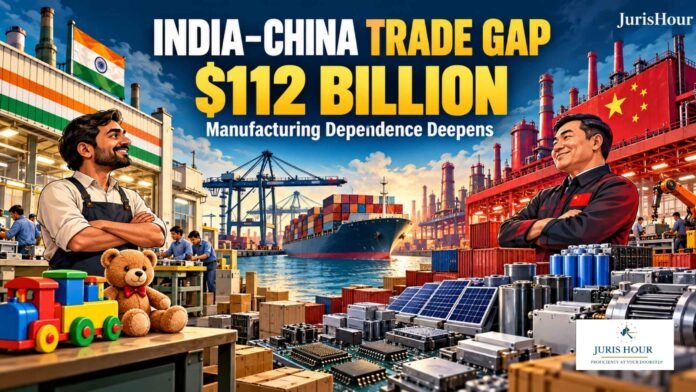
India’s success in reducing toy imports has shown how targeted customs duties and quality standards can strengthen domestic production. Yet the country’s wider trade relationship with China presents a far greater challenge, with a growing dependence on Chinese industrial supplies contributing to a trade deficit of about $112 billion.
India imported goods worth $131.63 billion from China in the financial year 2025–26, while exports stood at $19.47 billion, according to Department of Commerce figures cited by Moneycontrol. The resulting $112.16 billion gap highlights the difficulty of translating domestic manufacturing ambitions into a more balanced trading relationship.
Buy Now: E-Magazine: 1000+ Landmark GST Judgments (2017–2026)
The imbalance has persisted despite years of diplomatic friction following the deadly Galwan Valley clashes in 2020. Restrictions on Chinese apps, tighter investment scrutiny and trade measures did not substantially reduce the role of Chinese goods in Indian supply chains.
Toy Manufacturing Offers a Policy Success Story
The toy industry provides an example of how coordinated policy measures can change import patterns. India increased the basic customs duty on toys from 20% to 60% in February 2020 and subsequently to 70% in 2023. A mandatory Quality Control Order took effect on January 1, 2021, adding safety and certification requirements.
Although retailers initially questioned whether Indian manufacturers could meet demand and compete with imported products, the supplied BBC report describes a substantial decline in toy imports alongside an increase in exports.
Its approximate figures put imports at $100 million, compared with nearly $300 million in 2020, and exports at about $200 million, against $129 million earlier. A decline from $300 million to $100 million represents a reduction of roughly two-thirds.
However, the broader manufacturing economy cannot easily replicate this experience. Many Chinese imports are essential inputs used by Indian factories rather than finished products sold directly to consumers.
Local Assembly Leaves Component Dependence Intact
According to experts cited in the BBC report, India’s progress in producing smartphones and other manufactured goods has not been matched by an equivalent expansion in domestic component production.
Ajay Srivastava of the Global Trade Research Initiative said Chinese supplies remain central to several industries, including electronics, machinery, batteries, chemicals and solar manufacturing. Consequently, an increase in production within India can also generate additional demand for imported inputs.
This creates a distinction between manufacturing more products domestically and retaining more of their value within the country. Where factories rely heavily on overseas components, higher output alone may do little to narrow the trade deficit.
Soumya Bhowmik of the Observer Research Foundation, cited in the report, warned that disruptions to these supplies could affect manufacturing activity itself. The exposure therefore extends beyond the availability of consumer goods to the ability of Indian businesses to maintain production.
Export Barriers Complicate Efforts to Narrow the Gap
Increasing exports to China is another difficult part of the equation. Kevin Zongzhe Li of the Asia Society Policy Institute’s Centre for China Analysis told the BBC that Indian businesses face tariff and regulatory obstacles that limit their ability to expand in the Chinese market.
His assessment suggests that improved diplomatic relations will deliver limited economic gains unless they are accompanied by meaningful changes in market access.
Pharmaceuticals could offer opportunities as China’s population ages and demand for healthcare grows. Nevertheless, expanding a few export categories would address only part of a deficit of this scale.
Diplomatic Thaw Brings Trade Imbalance Into Focus
The trade relationship featured in discussions between Prime Minister Narendra Modi and Chinese President Xi Jinping during their September 2026 meeting on the sidelines of the BRICS summit in New Delhi. The leaders discussed structural trade imbalances, supply-chain concerns and closer economic engagement as bilateral relations continued to recover.
The central challenge is whether this engagement can produce commercial outcomes, including more predictable supplies and greater access for Indian exporters.
Meanwhile, the BBC report attributes part of the pressure on Indian manufacturers to China’s excess production capacity. Chinese companies seeking overseas buyers can offer competitively priced goods, while restrictions in other major markets may encourage them to target India.
Investment Must Build Domestic Capabilities
India has also introduced limited easing of restrictions on investment linked to China, including changes relevant to electronics, capital goods and solar cells. The measures provide an additional route for industrial cooperation.
Srivastava cautioned in the supplied report that the nature of such investment will matter. Projects centred on distribution or assembly using Chinese components could increase imports, whereas investments supporting technology transfer, domestic components and exports could help strengthen Indian manufacturing.
The longer-term response, experts argue, requires policies tailored to individual industries, supported by affordable electricity, accessible finance, efficient logistics and predictable regulation.
The toy sector demonstrates the potential of a focused industrial strategy. Reducing the much larger trade gap with China will require India to deepen domestic production capabilities while securing better opportunities for its businesses in the Chinese market.

