
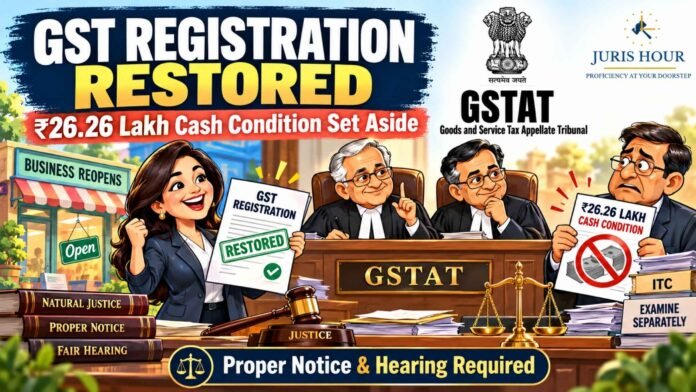
The Goods and Services Tax Appellate Tribunal (GSTAT), Lucknow State Bench, has set aside a condition requiring a taxpayer to deposit ₹26.26 lakh in cash within seven days to secure restoration of its GST registration.
The Bench of Narendra Kumar (Judicial Member) and Alok Chopra (Technical Member) has observed that a registration cancellation appeal could not be used to determine disputed input tax credit (ITC) liability without following the prescribed procedure and providing a meaningful opportunity of hearing.
BUY NOW: E-Magazine: 1000+ Landmark GST Judgments (2017–2026)
The order invalidated a clause under which the relief granted by the First Appellate Authority would automatically become void if the taxpayer failed to make the cash deposit within seven days.
The appellant/taxpayer engaged in the business of chemicals and leather fittings, received a show cause notice dated April 30, 2026, proposing cancellation of its GST registration under Rule 21(a) of the Uttar Pradesh GST Rules, 2017.
The notice alleged that the taxpayer was not conducting business from its declared premises. However, the cancellation order dated May 19, 2026, relied on allegations concerning ITC availed from four suppliers whose registrations had been cancelled.
The taxpayer challenged the cancellation before the First Appellate Authority. During those proceedings, the business premises were inspected again, and the taxpayer furnished an affidavit expressing willingness to reverse the disputed ITC, subject to verification.
The re-inspection report dated July 13, 2026, negated the allegation of non-existence at the declared place of business. Consequently, the First Appellate Authority set aside the cancellation and directed restoration of registration.
However, its order dated July 20, 2026, required the taxpayer to deposit ₹26,26,000 in cash within seven days of restoration. Failure to comply would automatically render the appellate order void.
The taxpayer approached GSTAT against these conditions.
The taxpayer argued that the First Appellate Authority had travelled beyond the scope of the registration cancellation proceedings by imposing a cash payment obligation relating to disputed ITC.
It submitted that the affidavit merely expressed willingness to reverse credit subject to verification. No specific opportunity had been provided to contest mandatory cash payment, its quantum or the proposed mode of compliance.
The taxpayer further maintained that the eligibility of ITC required a separate examination of the underlying transactions and supporting records. Such a determination could not be made as a condition for restoring registration when the original notice concerned only the alleged absence of business activity at the declared premises.
The department defended the condition, arguing that it arose from the taxpayer’s own undertaking and was connected with restoration of registration. According to the department, the direction did not amount to an independent adjudication of ITC liability.
The Tribunal found that the original show cause notice neither raised a tax demand nor alleged wrongful availment of ITC. Its basis was the alleged non-existence of the registered firm.
Nevertheless, the proper officer cancelled registration on a different ground involving disputed ITC. The Tribunal held that an order founded on allegations outside the show cause notice was legally unsustainable.
Referring to Section 75(7) of the CGST/SGST Act, the Bench emphasised that a demand cannot be confirmed on grounds other than those specified in the notice.
The Tribunal also noted that the ground stated in the notice and the ground relied upon in the cancellation order were different and inconsistent.
The Bench held that determining entitlement to ITC was a distinct substantive exercise requiring the statutory notice and adjudication process, supported by an opportunity to contest the allegations and produce evidence.
Those safeguards had not been followed in this case. The First Appellate Authority therefore could not direct reversal of ₹26.26 lakh in proceedings arising from cancellation of registration.
The Tribunal examined Section 107(11), including its safeguards governing orders requiring payment of tax or ITC. It held that an appellate authority could confirm, modify or annul the challenged order but could not travel beyond it without following the procedure established by law.
The taxpayer’s conditional statement in an affidavit did not remove these requirements. The Bench explained that an admission must be conclusive and that a conditional admission or a simple averment could not substitute statutory procedure and proper examination.
The Tribunal found that no notice had been issued before imposing the cash deposit condition. It held that an effective and meaningful opportunity must precede the imposition of tax or penalty.
Any alleged wrongful availment of ITC required proper investigation, detailed inquiry and a separate show cause notice. Imposing the payment condition without those steps violated both the GST law and the principles of natural justice.
GSTAT held the orders of the adjudicating authority and the First Appellate Authority to be null and void. It revoked the registration cancellation and removed the cash deposit condition and automatic-void clause.
The Tribunal expressly preserved the department’s liberty to initiate proceedings afresh. The ruling therefore does not conclusively settle the taxpayer’s entitlement to the disputed ITC; it requires any such liability to be examined through lawful proceedings.
Buy Now: 160+ GST E-Magazine September 2026
Membership Required to Access Case Details & Order Copy
To view the complete Case Details and Download Order Copy, you must have an active membership. Please subscribe to continue.

