
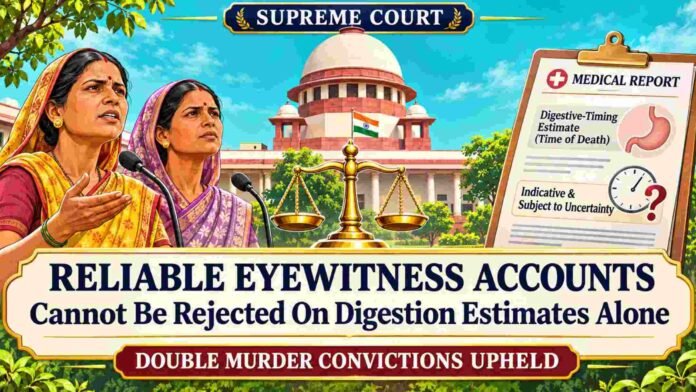
The Supreme Court has upheld the convictions and life sentences in a double-murder case, holding that an inconclusive medical estimate based on digestion could not be the sole ground for rejecting trustworthy eyewitness accounts of the killings.
A Bench of Justice K. V. Viswanathan and Justice Arun Palli dismissed the appeal against the Karnataka High Court’s judgment reversing the trial court’s acquittal. The Court found that the trial court had disregarded crucial evidence and given undue importance to peripheral discrepancies despite the reliable testimony of the victims’ wives.
Buy Now: 90+ Supreme Court Judgments E-Magazine – October 2026
The prosecution traced the hostility to a dispute arising after a bull belonging to one of the accused injured Nagappa’s goat. Nagappa sought ₹600 towards treatment expenses. A goat was initially left with him pending payment, but was subsequently taken back, leading to further confrontation.
The deceased, Mallappa and Gulappa, had supported Nagappa in the dispute. According to the prosecution, the accused believed that the two men had encouraged Nagappa to lodge a police complaint following an earlier assault.
The killings occurred around 1 a.m. during the intervening night of September 8 and 9, 2001. Mallappa was sleeping on a raised platform outside his house with his wife, Doddasiddavva, and their infant child. Gulappa and his wife, Siddavva, were sleeping in a cattle shed approximately 60 to 70 feet away.
Doddasiddavva, examined as PW-17, described waking when her infant cried and seeing the accused armed with axes. She testified that some restrained her while others attacked her husband. The group then proceeded towards the cattle shed, where Gulappa was assaulted.
Siddavva, examined as PW-18, described the attack on Gulappa and the individual roles of the accused. She also sustained an injury when struck with the wooden handle of an axe.
The trial court acquitted the accused after questioning the eyewitness accounts, lighting conditions, recovery of weapons, absence of independent witnesses and timing of the complaint. It also relied on medical testimony suggesting a four-hour interval between the two deaths.
The High Court reversed the acquittal and convicted the appellants under Sections 143, 148, 302, 323 and 341 read with Section 149 of the Indian Penal Code. They were sentenced to life imprisonment for murder and varying terms for the other offences.
Before the Supreme Court, the appellants challenged the High Court’s interference with their acquittal.
The Supreme Court reiterated that an appellate court has full power to review and reassess the evidence underlying an acquittal. However, where the evidence permits two reasonable conclusions, the trial court’s acquittal should remain undisturbed.
Referring to Arulvelu and Another v. State Represented by the Public Prosecutor and Another, the Bench explained that reversal requires a clear finding that the acquittal was perverse or wholly unsustainable in law.
Applying this standard, the Court agreed that the trial court had ignored material evidence implicating the accused and magnified matters that did not undermine the direct accounts of the victims’ spouses.
“No two views are possible in this case, and the only view possible is the guilt of the appellants.”
The Court found the presence of the two wives at the scene entirely natural because the attacks occurred in the middle of the night while they were sleeping beside their husbands.
The witnesses knew the accused and described their individual acts during the assaults. Nothing elicited in cross-examination shook their credibility, the Bench found. Minor variations did not detract from the core of their evidence.
The Court also rejected the suggestion that their relationship with the deceased made their testimony inherently partisan. It reiterated that a related witness need not be an interested witness and found both accounts natural and trustworthy.
PW-18’s status as an injured witness further supported her presence. The examining doctor recorded fresh swelling on her forehead and a complaint of neck pain. He confirmed that the injury could have been caused by the handle of an axe.
The post-mortem injuries of both victims also corroborated the eyewitness accounts on material aspects.
The trial court had doubted whether sufficient light was available to identify the attackers. The Supreme Court rejected its treatment of the evidence on this issue.
PW-17 testified that an electric light outside the door was burning. The prosecution also produced a certificate concerning electricity supply and examined the Assistant Executive Engineer.
The Bench found that the trial court had adopted convoluted reasoning to discard this evidence. It further noted that the accused were already known to the witnesses and were standing close to them during the incident.
A central issue concerned the doctor’s answer to a court question about the contents of the victims’ stomachs and intestines. On the assumption that both had eaten together, the doctor suggested that Gulappa died four hours after Mallappa.
The trial court treated this answer as inconsistent with the prosecution’s account that the murders occurred in quick succession.
The Supreme Court agreed with the High Court that this isolated answer could not justify rejecting the eyewitness evidence. The doctor’s testimony had to be considered in its entirety. He had also acknowledged that the interval between a meal and death could not be determined solely from the contents of the small intestine.
Referring to Nihal Singh and Others v. State of Punjab, the Bench explained that digestion varies according to the nature of the food, the individual’s digestive capacity and their health at the relevant time.
Where acceptable eyewitnesses clearly speak to the timing of an incident, probabilities drawn from digestion cannot alone justify rejecting their evidence.
The Court also relied on Shivaji Sahabrao Bobade and Another v. State of Maharashtra, which cautions against treating stomach contents as a precise measure of the time of death.
In the present case, the eyewitness accounts established that the attacks occurred one after the other around 1 a.m. The inconclusive medical inference did not undermine that evidence.
The Court rejected reliance on the omission of eyewitness names from the inquest report as a reason to doubt the prosecution case.
It reiterated that an inquest under Section 174 of the Code of Criminal Procedure serves the limited purpose of ascertaining the apparent cause and circumstances of death.
An inquest report need not contain the complete prosecution narrative, the names of all accused or eyewitnesses, or a summary of witness statements. The omission therefore did not justify discarding the testimony of the two wives.
The Supreme Court also rejected the contention that the delay in lodging the first information report indicated consultation or false implication.
The attacks occurred at night, leaving two members of the same family dead. The family was grieving, villagers assembled in the morning, and no bus facility was available. The police station was approximately six kilometres away.
PW-17 explained that she went to the police station in the morning and that the police insisted on a written complaint. Somashekhar, examined as PW-20, helped write the complaint at her request.
The Court found no material contradiction between their accounts. It endorsed the High Court’s conclusion that the circumstances explained the delay and that the trial court’s inference of deliberation to falsely implicate the accused was unsupported by a proper appreciation of the evidence.
The Bench reiterated that motive loses significance where trustworthy direct evidence establishes the offence. Nevertheless, it found that the earlier dispute and the deceased men’s support for Nagappa established a motive in this case.
The Court also rejected the argument based on the absence of independent witnesses. Given the timing and location of the attacks, the victims’ wives were the most natural witnesses.
Questions about whether certain other persons had actually witnessed the assaults did not undermine the reliable evidence of PW-17 and PW-18.
Finding no ground to interfere with the High Court’s judgment, the Supreme Court dismissed the appeal and directed the appellants to surrender forthwith.
Membership Required to Access Case Details & Order Copy
To view the complete Case Details and Download Order Copy, you must have an active membership. Please subscribe to continue.

