
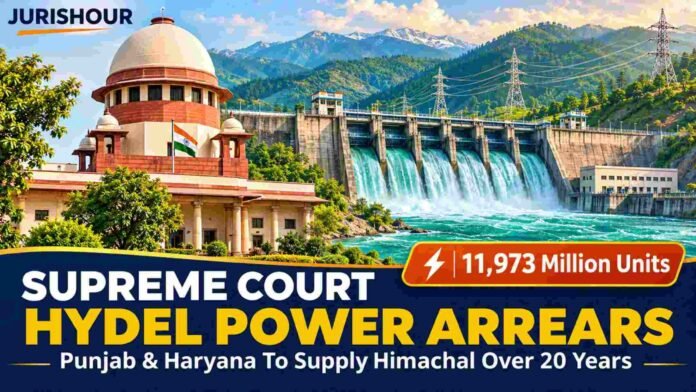
The Supreme Court has directed Punjab and Haryana to supply approximately 11,973 million units of electricity to Himachal Pradesh over 20 lean seasons, after adjusting its capital-cost liability against outstanding power entitlements from the Bhakra-Nangal and Beas hydroelectric projects.
Bringing the decades-long dispute to a close, the bench of Chief Justice of India Surya Kant, Justice Joymalya Bagchi and Justice V. Mohana accepted the Union Government’s computation of gross energy arrears at 13,066 million units. It approved a cashless settlement under which Himachal Pradesh’s ₹420.77 crore capital-cost liability will be adjusted against approximately 1,093 million units, valued at ₹3.85 per unit.
Buy Now: 90+ Supreme Court Judgments E-Magazine – October 2026
The central legal issue concerned implementation of the Supreme Court’s September 27, 2011 decree recognising Himachal Pradesh’s entitlement to a share of electricity generated from the projects.
The Court clarified that the present exercise was in the nature of execution proceedings, necessitated by disagreements over the Union Government’s computation. It did not provide an opportunity to reopen matters conclusively decided in 2011.
The outstanding questions concerned the quantity of energy arrears, Himachal Pradesh’s corresponding contribution towards project capital costs, the valuation of that liability, and the manner and schedule of settlement.
The projects were conceived when Punjab existed as a composite State. Substantial land now forming part of Himachal Pradesh was submerged for their construction.
The judgment records that the Bhakra-Nangal Project involved submergence of approximately 27,869 acres in the erstwhile State of Bilaspur, while the Beas Project involved over 65,050 acres in Kangra district.
Following Punjab’s reorganisation on November 1, 1966, certain territories and their population were transferred to Himachal Pradesh. Section 78 of the Punjab Reorganisation Act, 1966 provided for apportionment of the composite State’s rights and liabilities in the projects among the successor States.
Himachal Pradesh maintained that the electricity allocations made to it were tentative and that its final entitlement remained unsettled. Its claim to a 7.19% share rested on the proportion of composite Punjab’s population transferred to it.
After representations and settlement efforts failed, Himachal Pradesh instituted an original suit under Article 131 of the Constitution in 1996.
In its 2011 judgment, the Supreme Court recognised Himachal Pradesh’s entitlement to 7.19% of the power attributable to composite Punjab.
Expressed as shares of total project generation, the entitlements were 6.095% from Bhakra-Nangal, 5.752% from Beas Unit I and 2.984% from Beas Unit II.
The Bhakra-Nangal entitlement operated from November 1, 1966, while the Beas entitlements operated from the respective dates on which production commenced.
The Court had separately rejected Himachal Pradesh’s claim to 12% free power under the Home State principle. The present judgment implements the previously recognised power-sharing entitlement.
Following the earlier decree, revised energy allocations took effect from November 1, 2011. However, disagreements continued over the arrears for the preceding period.
The Union Government computed the historical shortfall at 8,523 million units from Bhakra-Nangal, 3,145 million units from Beas Unit I and 1,398 million units from Beas Unit II, aggregating to 13,066 million units.
Following successive attempts to resolve the dispute, the Attorney General proposed a framework under which Punjab and Haryana would discharge the arrears through electricity supplies. Himachal Pradesh’s capital-cost liability would be adjusted against part of its energy entitlement.
The proposal initially contemplated supply over 15 lean seasons. Himachal Pradesh and Haryana agreed to the framework in principle, while Punjab raised objections.
Punjab contended that the computation failed to account for the supply of 1.2 lakh units of electricity per day to Himachal Pradesh. It argued that adjusting those supplies would reduce the arrears to 11,094 million units.
The Supreme Court rejected the contention, explaining that these supplies had already been considered and accounted for in the capital-cost liability worked out under the Union Government’s framework.
The Bench found Punjab’s objections vague and superficial and considered them an attempt to revisit issues already settled by the earlier decree.
It accepted that the Union Government’s computation incorporated several variables, including the applicable energy-distribution ratios, the arrears owed by Punjab and Haryana, and Himachal Pradesh’s liability for energy supplied to it.
Punjab also disputed the conversion of Himachal Pradesh’s capital-cost liability into electricity at ₹3.85 per unit. It sought application of the current operation and maintenance rate of 79 paise per unit, which would substantially reduce the remaining energy entitlement.
The Court rejected this approach, observing that it appeared to inflate Himachal Pradesh’s liability and consequently reduce the arrears owed to it. The Bench reasoned that arrears relating to an earlier period could not be computed using a rate prevailing today.
The Court accepted Himachal Pradesh’s capital-cost liability at ₹420.77 crore, comprising ₹249.23 crore attributable to Punjab and ₹171.55 crore attributable to Haryana. These figures represent the unreimbursed share of loan servicing undertaken by the two States since 1966–67.
Valuing the adjustment at ₹3.85 per unit results in a deduction of approximately 1,093 million units, leaving approximately 11,973 million units payable to Himachal Pradesh.
Punjab sought a 30-year period to discharge the energy arrears, relying on an earlier submission made by the Union Government.
The Supreme Court found insufficient justification for that request. Nevertheless, considering the total arrears and the burden on the supplying States, it extended the proposed settlement period from 15 years to 20 years.
The net balance must be supplied at approximately 598 million units annually over 20 lean seasons, covering October to March.
Punjab and Haryana must bear the supply obligation in the ratio of 58:42 for Bhakra-Nangal and 60:40 for the Beas projects.
Himachal Pradesh must pay the charges determined by the Bhakra Beas Management Board for the year in which each tranche of electricity is received. Accordingly, the cashless framework adjusts the capital-cost liability against energy arrears while retaining the obligation to pay applicable supply charges.
The Supreme Court expressed concern that a dispute pending for decades continued to require judicial intervention.
It emphasised that the directions were binding on all stakeholders and had to be implemented without reservation. Unwillingness on the part of a judgment debtor could not be allowed to render the decree fruitless.
The Bench also acknowledged the Attorney General’s sustained efforts to facilitate settlement and formulate a workable framework.
Membership Required to Access Case Details & Order Copy
To view the complete Case Details and Download Order Copy, you must have an active membership. Please subscribe to continue.

