
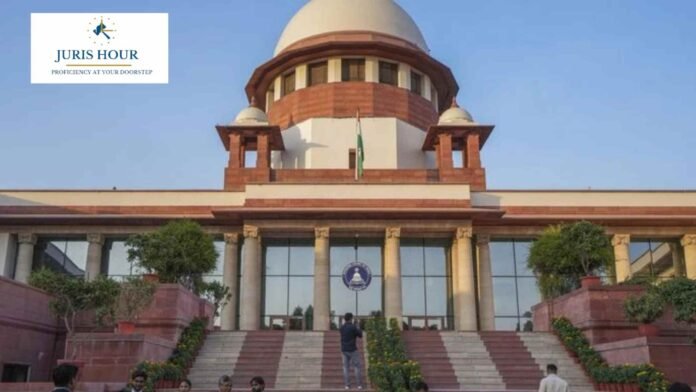
The Supreme Court has dismissed a Special Leave Petition filed by a retired Professor of the National Institute of Rural Development (NIRD), holding that the petitioner was not entitled to shift from the Central Provident Fund (CPF) Scheme to the General Provident Fund-cum-Pension (GPF) Scheme after his services were regularised in 2012 on terms that expressly continued his coverage under the existing CPF Scheme.
The Bench of Justice Ujjal Bhuyan and Justice Atul S. Chandurkar has observed that the petitioner was similarly situated to another NIRD Professor whose claim had already been rejected by the Supreme Court.
The bench found no justification to reopen the issue, particularly since the petitioner had accepted the terms of his regularisation, received CPF-related retiral benefits, and raised his grievance only after retirement.
Buy Now: JurisHour Ultimate Legal Research Combo – 4 Premium E-Magazines at an Unbeatable Price
The case arose from the petitioner’s claim that, having rendered long service at NIRD and ultimately retired as a Professor, he should have been covered by the GPF-cum-Pension Scheme instead of the CPF Scheme.
The petitioner was initially appointed as a Research Associate with NIRD on a contractual basis on November 12, 1984. An Office Order dated November 13, 1984 placed him under the CPF Scheme. His services were subsequently regularised with effect from November 7, 1985.
He was later appointed as Assistant Director on a regular basis on March 9, 1992, and subsequently served as Deputy Director and Professor. His appointment as Professor was initially contractual from May 1, 2007. His services as Professor were ultimately regularised through Office Order No. 98 dated May 4, 2012.
The petitioner retired on January 31, 2017, and received his retiral benefits on February 14, 2017. Those benefits included NIRD’s contribution to his CPF account as well as his own contribution.
After retirement, the petitioner approached the Central Administrative Tribunal (CAT), Hyderabad, seeking a declaration that NIRD’s decision to continue him under the CPF Scheme instead of the GPF Scheme was illegal.
He relied, among other things, upon the NIRD Rules of 2011 and the NIRD Service Bye-laws, particularly Chapter IX, Paragraph 52, Section 4. He sought consequential benefits flowing from his requested conversion to the GPF Scheme.
The petitioner’s case was closely connected with the earlier litigation involving another NIRD Professor, Shyam Sunder Prasad Sharma, whose services had also been regularised on May 4, 2012.
In that earlier matter, the CAT had granted relief to Sharma, and the High Court had dismissed the challenge brought by the Union of India and others. The CAT subsequently found that the petitioner’s case was covered by the earlier decision and, by judgment dated July 15, 2019, directed NIRD to permit him to come under the GPF Scheme from the date on which he became eligible.
The legal position, however, changed following the Supreme Court’s judgment dated February 28, 2023, in National Institute of Rural Development v. Shyam Sunder Prasad Sharma and Others.
In that case, the Supreme Court examined the relevant NIRD Bye-laws and the Rules of 2011 and held that Sharma’s regularisation pursuant to the May 4, 2012 order would operate from the date of that order. It would not relate back to his original date of appointment.
The Supreme Court particularly relied upon the express terms of the regularisation order, which stated that regularisation would take effect from the date of issuance of the order. Since that condition had not been challenged, the Court held that Sharma remained entitled to benefits under the CPF Scheme. The orders of the CAT and High Court granting him GPF-related relief were consequently set aside.
When NIRD’s challenge to the CAT’s order in the petitioner’s case came before the Telangana High Court, the Supreme Court’s 2023 judgment in the Sharma matter was brought to its notice.
The High Court concluded that the petitioner stood on the same footing as Sharma. It therefore held that the effect of the petitioner’s regularisation also commenced from May 4, 2012, rather than from his initial appointment.
The High Court additionally noted that the petitioner had approached the CAT only after his retirement and after receiving CPF benefits. It accordingly allowed NIRD’s writ petition and set aside the CAT’s July 15, 2019 order. The petitioner thereafter approached the Supreme Court.
Before the Supreme Court, counsel for the petitioner attempted to distinguish his case from the earlier Sharma judgment. The Union of India and the other respondents, however, argued that the petitioner was similarly situated and that the Supreme Court’s earlier decision applied directly to his case.
The Supreme Court rejected the attempt to distinguish the case.
Justice Atul S. Chandurkar, writing the judgment, noted that the petitioner’s case was founded on Office Order No. 98 dated May 4, 2012, under which the services of academic staff working on a contractual basis were regularised.
Crucially, the regularisation order contained conditions stating that the regularisation would take effect from the date of the order and that the petitioner’s service would continue to be governed by the existing CPF Scheme.
The Court attached significant importance to the fact that the petitioner had never challenged the terms and conditions contained in the May 4, 2012 regularisation order.
The Supreme Court observed that the petitioner had accepted the terms on which his services were regularised and subsequently raised his grievance only after retirement, after accepting benefits under the CPF Scheme.
The Court held that the High Court had rightly rejected his claim.
The Court also relied upon its detailed consideration in the Sharma case of Rule 6 of the NIRD Rules of 2011 and Bye-law 52(a), read with Bye-laws 48 and 49. It stated that it was in complete agreement with the conclusions reached in the earlier judgment.
The Supreme Court ultimately found that the petitioner and Sharma were similarly placed, particularly because both had their services regularised under the same Office Order dated May 4, 2012 and on identical conditions.
The Court held that there was no reason to exercise its discretionary jurisdiction under Article 136 of the Constitution.
Membership Required to Access Case Details & Order Copy
To view the complete Case Details and Download Order Copy, you must have an active membership. Please subscribe to continue.

