
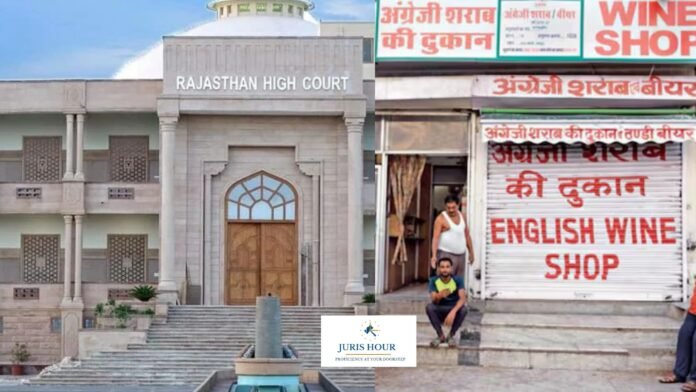
The Rajasthan High Court at Jodhpur has initiated suo motu public interest proceedings over alleged systemic violations of liquor vend closing hours and apparent failures in excise enforcement in Jodhpur city, observing that unchecked regulatory breaches relating to liquor trade directly affect public health, public order, road safety and citizens’ right to live with dignity under Article 21 of the Constitution.
The bench of Justice Pushpendra Singh Bhati and Justice Nupur Bhati passed the order while taking note of an investigative report published in Rajasthan Patrika which alleged that liquor sales were continuing even after prescribed closing timings through concealed mechanisms such as small access windows and partially closed shutters. The Court observed that the issue was not merely one of commercial regulation but raised larger constitutional concerns involving Articles 14, 21 and 47 of the Constitution, emphasizing the State’s obligation to protect public health and maintain effective regulatory enforcement.
The Court remarked that the trade in liquor is not an ordinary trade but a privilege regulated by the State because of its potential impact on public health, public order and social welfare. It stressed that when statutory safeguards and licence conditions are openly violated, constitutional objectives become meaningless and public confidence in governance suffers.
The Bench referred to the findings emerging from the newspaper’s “Patrika Sting” investigation which allegedly documented multiple instances of liquor being sold after the prescribed 8:00 PM closure time. According to the report cited by the Court, liquor sales allegedly continued through small openings and restricted access mechanisms even after shops appeared to be closed. The report referred to alleged instances at Jaljog Chauraha, Milkman Colony and areas near Ashok Udhyan where sales activities reportedly continued despite statutory restrictions.
The Court observed that the allegations suggested a recurring pattern rather than isolated violations. It specifically noted the reported use of so-called “emergency windows” (“Chhoti Khidki” or “Imarjensi Vindi”), which allegedly enabled clandestine sales after official closure timings. The Bench also took note of allegations of regulatory inaction and possible lapses on the part of police and excise authorities that may have permitted such practices to continue.
Summarising the issues emerging from the report, the Court noted several apparent concerns including continuing violations of mandatory closing hours, deliberate circumvention of closure norms through concealed access points, inadequate enforcement and monitoring mechanisms, and broader implications for public nuisance, road safety and citizen welfare. The Court observed that such practices may undermine public faith in the rule of law and adversely affect neighbourhood tranquillity, women’s safety and youth welfare.
The Bench further observed that concerns relating to enforcement of liquor regulations are not unique to Rajasthan. Referring to developments in other states, it noted that Tamil Nadu had recently ordered closure of hundreds of liquor outlets situated near sensitive locations such as educational institutions and places of worship, indicating a growing recognition of the State’s duty to regulate intoxicants in the interest of public welfare.
The Court referred to provisions of the Rajasthan Excise Act, 1950 and Rajasthan Excise Rules, 1956, particularly Sections 41, 54 and 58 and Rule 75, which provide regulatory powers and contemplate suspension or cancellation of licences in cases of breaches. The Court observed that the statutory framework itself reflects a legislative intent for strict supervision of liquor trade.
Finding the matter serious enough to warrant immediate judicial intervention, the Court invoked its suo motu jurisdiction and directed registration of a writ petition titled “Systemic Violations of Liquor Closing Hours and Excise Regulations in Jodhpur City versus State of Rajasthan and Others.” Notices were issued to various state authorities including the Chief Secretary, Principal Secretaries of Home and Excise Departments, Director General of Police, Excise Commissioner, police authorities and district administration officials.
The Court directed authorities to submit detailed status reports addressing action taken against the liquor vendors identified in the sting report, measures proposed to eliminate “emergency windows,” inspection records of the previous three years, details of night-time monitoring systems and proposals for technological reforms including CCTV surveillance, e-POS systems and digital billing mechanisms.
As an interim measure, the Bench directed the Commissioner of Police and District Excise Officer in Jodhpur to constitute special enforcement teams for surprise inspections and covert checks between 8:00 PM and midnight. It ordered that inspections should be geo-tagged and videographed wherever possible to ensure transparency. The Court also asked authorities to examine implementation of high-resolution CCTV systems linked with police and excise control rooms, timestamp-based closure verification mechanisms and a centralised grievance redressal mechanism.
The Excise Commissioner and District Collector have been asked to assess the status of liquor vends located near educational institutions, hospitals, residential colonies and places of worship and submit recommendations for stricter regulation where necessary. The matter has been listed for further hearing on July 6, 2026, with two advocates appointed as Amicus Curiae to assist the Court.
Case Details
Case Title: IN RE: Systemic Violations Of Liquor Closing Hours And Excise Regulations In Jodhpur City
Citation: JURISHOUR-1372-HC-2026(RAJ)
Date: 22/05/2026
Read More: Woman’s Family Alleges Murder, Questions Fall Theory After Suspicious Injuries Found on Body

