
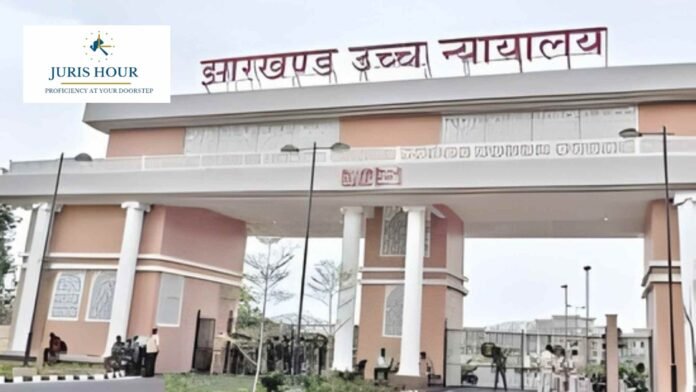
The Jharkhand High Court has held that a contractor cannot be denied reimbursement of service tax merely because the Goods and Services Tax (GST) regime came into force before the reimbursement claim was processed.
The bench of Justice Ananda Sen ruled that contractual benefits and vested rights cannot be defeated on technical grounds arising out of the transition from the erstwhile service tax regime to GST, particularly when the contractor had duly paid the tax and there were no proceedings pending against it.
The petitioner, a partnership firm, had been awarded a contract by Bharat Coking Coal Limited (BCCL) for the work of Diversion of Kumari Jore (Balance Work) under the Katras Area. The work order was issued in October 2014, and a formal agreement was subsequently executed between the parties. In accordance with the contract, the petitioner completed the work and deposited service tax amounting to ₹18,25,269, which was reflected in its statutory service tax returns (ST-2).
Buy Now: 130 GST Judgments – E-Magazine July 2026
Despite repeated representations seeking reimbursement of the service tax as contemplated under the contractual terms, BCCL failed to release the amount. The petitioner earlier approached the High Court, which directed BCCL to consider the reimbursement claim. However, by an order dated 1 February 2019, BCCL rejected the claim, leading to the present writ petition.
BCCL argued that the petitioner had obtained service tax registration and deposited service tax after a considerable delay. According to the company, because of the delayed payment, it could not avail CENVAT credit within the permissible period prescribed under the CENVAT Credit Rules, 2004. It was further contended that after the introduction of GST on 1 July 2017, there was no mechanism available to claim such credit, making reimbursement impossible.
The respondents also alleged that the petitioner had failed to comply with statutory requirements relating to service tax registration and documentation, thereby justifying rejection of the reimbursement claim.
The contractor contended that it had completed the work strictly in accordance with the contract, paid the applicable service tax, and fulfilled every contractual obligation necessary for reimbursement. It argued that no proceedings had ever been initiated by the Service Tax Department questioning the payment of tax and that the Union of India itself admitted that there were no pending proceedings against the petitioner. Consequently, denial of reimbursement merely because of the GST transition was arbitrary and contrary to the contractual terms.
The High Court closely examined the contractual clauses governing tax liability. It noted that the work order specifically provided that while the contractor would bear applicable taxes, service tax was expressly excluded and was liable to be reimbursed by the employer on actual basis as per prevailing norms.
The agreement also stipulated that all taxes and levies payable by the contractor would be borne by the contractor except service tax, confirming that reimbursement formed part of the contractual bargain between the parties.
The Court observed that the dispute essentially arose from interpretation of the contractual clauses and the impact of the transition from the service tax regime to GST.
Justice Sen held that the petitioner had completed the work, paid service tax, and complied with the contractual requirements. The only objection raised by BCCL was that, due to delayed registration and payment of service tax, it could not avail corresponding CENVAT credit after the implementation of GST.
The Court found this reasoning legally unsustainable. It emphasized that there was no statutory provision creating an absolute bar against reimbursement merely because the tax regime had changed. Nor had the respondents identified any provision extinguishing the petitioner’s contractual entitlement solely due to the introduction of GST.
An important factor influencing the Court’s decision was the undisputed position that no proceedings had been initiated against the petitioner under either the erstwhile service tax law or the GST regime.
The Union of India itself acknowledged in its counter affidavit that there were no pending proceedings affecting the petitioner’s eligibility. Therefore, the Court held that there was no legal embargo preventing consideration of the reimbursement claim.
The Court referred extensively to Section 140 of the Central Goods and Services Tax Act, 2017, which governs transitional arrangements for carrying forward CENVAT credit into the GST regime.
The Court noted that the object of the transitional provisions was to facilitate migration of legitimate tax credits rather than extinguish vested rights because of procedural or technical difficulties arising during the shift to GST.
The bench also relied upon the Madras High Court’s decision in Ganges International Pvt. Ltd. v. Assistant Commissioner of GST & Central Excise, wherein it was held that transitional provisions under Section 140 should not be interpreted in a manner that deprives taxpayers of legitimate credits solely because of procedural complications during the transition to GST.
The Jharkhand High Court found the reasoning persuasive and observed that technical changes in tax administration should not defeat substantive rights available under the earlier tax regime.
The Court concluded that the petitioner had become entitled to reimbursement under the contract once it paid the service tax and fulfilled its contractual obligations.
It held that BCCL’s refusal was based only on technical considerations arising from the introduction of GST and not on any contractual breach or statutory prohibition. Since BCCL would itself be entitled to avail the benefit of the corresponding tax credit once reimbursement was granted, denying reimbursement served no legitimate purpose.
The Court observed that benefits flowing from contractual obligations cannot be denied merely because of technical changes brought about by the GST regime.
Allowing the writ petition, the High Court set aside BCCL’s order dated 1 February 2019 rejecting the reimbursement claim.
The court directed BCCL to verify and process the petitioner’s claim for reimbursement strictly in accordance with the contractual terms.
The court directed the Union of India to facilitate extension of the corresponding tax credit to BCCL.
The bench ordered that the entire exercise be completed within twelve weeks.
Membership Required to Access Case Details & Order Copy
To view the complete Case Details and Download Order Copy, you must have an active membership. Please subscribe to continue.

