
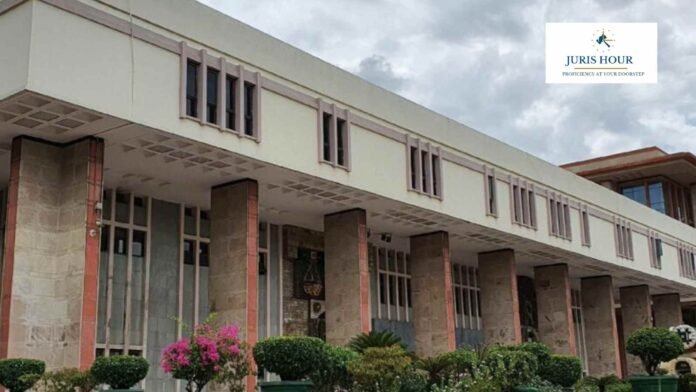
The Delhi High Court has held that the interim moratorium under Section 96 of the Insolvency and Bankruptcy Code, 2016 (IBC) does not operate as a bar against criminal prosecution under Section 138 of the Negotiable Instruments Act, 1881.
Setting aside a trial court’s order that had stayed cheque dishonour proceedings, the bench of Justice Madhu Jain ruled that insolvency proceedings cannot be used to halt criminal liability arising from dishonoured cheques.
The dispute originated from a friendly loan transaction dating back to June 2015. According to the petitioner, the respondent borrowed ₹30 lakh, and the parties executed a loan agreement on 6 July 2015. To repay the loan, the respondent issued six post-dated cheques of ₹5 lakh each.
While two cheques were honoured, presentation of the remaining four was deferred at the respondent’s request. When these cheques were eventually presented in July 2018, they were dishonoured with the endorsements “Insufficient Funds” and “Payment Stopped by Drawer.” Following issuance of a statutory demand notice and non-payment within the prescribed period, the petitioner initiated proceedings under Section 138 of the Negotiable Instruments Act.
Buy Now: JurisHour Ultimate Legal Research Combo – 4 Premium E-Magazines at an Unbeatable Price
During the pendency of the complaint, the parties entered into a settlement in March 2020. Although the respondent made partial payments and repeatedly assured the trial court that the remaining dues would be cleared, he allegedly defaulted on multiple occasions.
On the complainant’s application, the Metropolitan Magistrate directed recovery of the unpaid settlement amount of ₹13 lakh through the Sub-Divisional Magistrate by treating it as arrears of land revenue and permitting attachment of the respondent’s movable and immovable properties. Subsequently, despite further payments, an outstanding amount of ₹6.50 lakh remained unpaid.
While recovery proceedings were pending, the respondent relied upon orders passed by the National Company Law Tribunal (NCLT) and the National Company Law Appellate Tribunal (NCLAT), contending that an interim moratorium under Section 96 of the IBC had come into force following insolvency proceedings against him.
Accepting this contention, the Metropolitan Magistrate stayed the cheque bounce complaint on 17 November 2022, holding that any pending legal proceedings concerning the debt stood stayed during the moratorium period.
Before the High Court, the petitioner argued that the trial court had committed a legal error by staying criminal proceedings solely because insolvency proceedings had commenced.
The petitioner relied upon the Supreme Court’s decision in Rakesh Bhanot v. Gurdas Agro (P) Ltd. (2025) 6 SCC 781, contending that Sections 96 and 101 of the IBC suspend only civil recovery actions and do not prohibit prosecution under Section 138 of the Negotiable Instruments Act.
It was also argued that the stay order had been passed without supplying copies of the NCLT and NCLAT orders relied upon by the respondent and without granting an effective opportunity of hearing to the complainant.
The Court identified the central question as whether the phrase “legal action or proceeding in respect of any debt”occurring in Section 96 of the IBC includes criminal prosecution under Section 138 of the Negotiable Instruments Act.
After examining the statutory provision, the Court observed that the controversy was no longer open to debate in light of the Supreme Court’s ruling in Rakesh Bhanot.
The High Court noted that the Supreme Court had categorically held that the moratorium under Sections 96 and 101 of the IBC merely postpones civil proceedings for debt recovery and does not extend to criminal prosecution for cheque dishonour. The object of Section 138, the Court observed, is to preserve the credibility of negotiable instruments and ensure commercial discipline, which would be defeated if debtors could avoid criminal prosecution merely by initiating insolvency proceedings.
Quoting the Supreme Court, the High Court reiterated that the purpose of the moratorium is not to obstruct criminal prosecution but only to defer civil recovery actions.
The Court emphasized that criminal liability arising from dishonoured cheques continues irrespective of insolvency proceedings, as prosecution under Section 138 serves an important deterrent function in maintaining confidence in commercial transactions.
Applying the Supreme Court’s ruling, the High Court held that the trial court’s stay order could not survive.
It observed that proceedings under Section 138 are criminal in nature, and the mere initiation of insolvency proceedings against a debtor does not furnish a lawful basis for staying such prosecution.
Although the petitioner had also challenged the stay order on grounds of denial of natural justice, the High Court found it unnecessary to decide that issue because the impugned order was liable to be set aside on the substantive legal question itself.
Allowing the petition, the Delhi High Court set aside the Metropolitan Magistrate’s order dated 17 November 2022 and restored the complaint proceedings.
The Court directed the trial court to resume the proceedings from the stage at which they had been stayed and continue the matter independently in accordance with law, without being influenced by the reasoning contained in the impugned order.
Membership Required to Access Case Details & Order Copy
To view the complete Case Details and Download Order Copy, you must have an active membership. Please subscribe to continue.

