
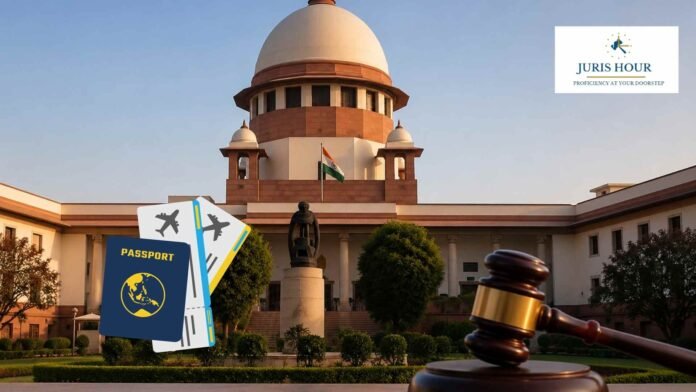
The Supreme Court has held that while an accused cannot be compelled to surrender his passport in the absence of sufficient justification, he may nevertheless be prohibited from leaving India without prior permission from the trial court.
The Bench of Justice Dipankar Datta and Justice Satish Chandra Sharma has observed that the accused need not deposit his passport. However, he cannot leave India without obtaining prior permission from the Sessions Court after committal of the case. Any request for foreign travel must be considered on its own merits. The Sessions Court may impose appropriate safeguards and conditions before granting such permission.
The dispute traces its origins to a complaint lodged in October 2014 regarding the suspicious death of the appellant’s father. Following investigation, an FIR was registered under Sections 120-B and 306 read with Section 34 of the Indian Penal Code, alleging criminal conspiracy and abetment of suicide.
The second respondent was named as an accused and a chargesheet was filed in February 2016. Over the years, the accused initiated multiple proceedings before the High Court seeking quashing of the criminal case and obtained interim protections. He later left India after the operation of a Look Out Circular (LoC) was suspended by the High Court.
Upon returning to India in April 2025, the accused was arrested at Hyderabad Airport. After his release, he sought return of his passport and permission to travel back to the United States, where he claimed to be undergoing medical treatment and residing with his family.
The Judicial Magistrate had directed release of the passport but clarified that possession of the passport would not automatically entitle the accused to travel abroad. Any foreign travel would require permission from the competent court.
However, the Sessions Court subsequently reversed this order, directing the accused to deposit his passport and recommending restrictions under the Passports Act, 1967 due to the prolonged pendency of the criminal proceedings.
The High Court later restored the Magistrate’s order and went a step further by permitting the accused to travel to the United States, citing his medical condition and the fact that he had appeared before the Magistrate on twelve previous occasions.
This High Court order was challenged before the Supreme Court.
The Supreme Court took note of the extraordinary delay in the proceedings. Although the chargesheet had been filed in 2016, the matter had still not progressed beyond the committal stage nearly ten years later.
The Court observed that the accused had actively pursued multiple proceedings before the High Court, obtaining interim protections at various stages which effectively stalled progress of the trial. It also expressed concern over the pattern of withdrawing petitions after securing interim relief.
According to the Court, such conduct raised serious doubts regarding the bona fides of the accused and warranted greater judicial caution.
The accused had argued that he suffered two brain strokes in 2023 and required continued medical treatment in the United States.
The Supreme Court was not persuaded. The Bench observed that India possesses medical facilities comparable to those available abroad and found that the High Court had been unduly indulgent in accepting the plea for foreign travel.
The Court held that the mere existence of medical treatment abroad could not automatically justify permission to leave the country, particularly when serious criminal proceedings remained pending and the trial had not yet commenced.
One of the most important aspects of the judgment is the Court’s discussion on Article 21 of the Constitution.
The respondent argued that requiring court permission before travelling abroad would violate his fundamental right to personal liberty and freedom of movement.
Rejecting the argument, the Supreme Court emphasized that Article 21 protects not only personal liberty but also the right to a speedy trial. Therefore, courts must strike a balance between an accused person’s freedom and society’s interest in ensuring effective criminal justice administration.
The Bench relied upon the earlier decision in Rajesh Ranjan Yadav v. CBI, where the Supreme Court held that no fundamental right is absolute and reasonable restrictions may be imposed in the larger public interest.
While disagreeing with both the High Court and the Sessions Court, the Supreme Court ultimately restored the Magistrate’s original order.
To ensure compliance, the Supreme Court directed civil authorities, police authorities and airport officials to coordinate with each other so that the accused does not leave India without express permission from the Sessions Court.
The Court also urged expeditious completion of the committal process and clarified that its observations should not be treated as findings on the merits of the criminal case.
Case Details
Case Title: Seesa Santosh Versus The State Of Telangana And Anr.
Citation: JURISHOUR-1560-SC-2026
Case No.: SLP (CRL) No. 18022 OF 2025
Date: 04/06/2026
Read More: How SEBI Used Supreme Court’s Investor Injury Doctrine in the Rajesh Exports Fraud Probe?

