
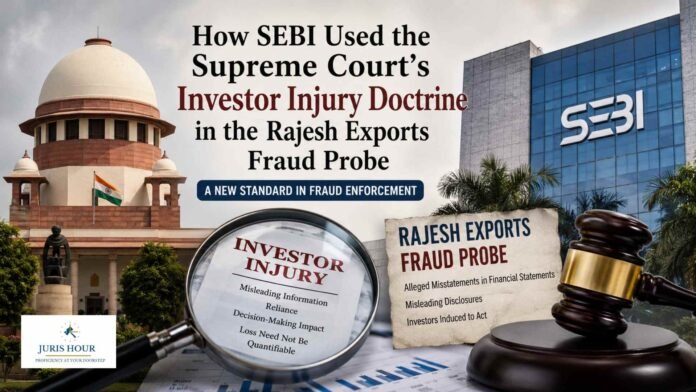
The Securities and Exchange Board of India (SEBI) appears to have taken a significant step in aligning its fraud enforcement strategy with the Supreme Court’s recent interpretation of securities fraud.
The regulator’s ex-parte interim order against Rajesh Exports has drawn attention not only because of the allegations involved but also because it reflects the practical application of the Supreme Court’s observations in the Reliance Industries Ltd. v. SEBI case regarding the concept of “investor injury.”
The development is being closely watched by market participants, legal experts, and corporate governance professionals as it could redefine how fraud is investigated and established under India’s securities laws.
Supreme Court Expanded the Understanding of Investor Injury
In the Reliance Industries matter, the Supreme Court clarified that investor injury can itself constitute sufficient grounds for establishing fraud, even where the exact financial loss suffered by investors cannot be quantified. The Court recognized that in modern securities markets, investors rely heavily on disclosures made by listed companies while making investment decisions.
The judgment emphasized that the harm caused by misleading information is not limited to measurable monetary losses. Investors suffer injury when they are induced to make decisions based on inaccurate, incomplete, or deceptive disclosures. This interpretation shifts the focus from proving actual financial loss to examining whether investors were deprived of the ability to make informed decisions.
Rajesh Exports Becomes a Key Test Case
The Rajesh Exports proceedings appear to be one of the first major instances where SEBI has applied this broader understanding of investor injury.
According to SEBI’s interim findings, the company allegedly presented a misleading picture of its financial position through its disclosures and financial statements. The regulator observed that investors rely primarily on such disclosures when assessing a company’s performance and making investment decisions.
While the proceedings did not involve a direct quantification of investor losses, SEBI concluded that the dissemination of allegedly inaccurate information itself caused investor injury by influencing market participants’ decision-making processes.
Allegations Relating to Financial Misstatements
The regulator’s order reportedly found that revenues aggregating approximately ₹15.15 lakh crore, accounting for nearly 99.80% of the company’s total reported revenue between FY2021 and FY2025, had been falsely stated.
SEBI viewed the alleged misstatements as material because financial statements are among the most important documents used by investors, analysts, lenders, and other stakeholders. Any distortion in such information has the potential to influence investment decisions irrespective of whether immediate financial losses can be demonstrated.
The regulator’s approach reflects the principle that market integrity depends upon the accuracy and reliability of corporate disclosures.
Focus Shifts From Loss to Reliance
A notable aspect of SEBI’s reasoning is the emphasis on investor reliance rather than investor loss.
Traditionally, regulators often faced the challenge of proving that investors suffered identifiable financial harm as a direct consequence of misleading disclosures. The Supreme Court’s interpretation reduces this burden by recognizing that the very act of inducing investors to rely on false information constitutes injury.
Under this approach, the key question becomes whether investors were influenced by misleading disclosures rather than whether a specific amount of loss can be calculated. This significantly strengthens the regulator’s ability to pursue fraud cases involving accounting irregularities and disclosure failures.
Implications for Listed Companies
The Rajesh Exports order sends a strong signal to listed companies that disclosure obligations will be scrutinized more rigorously than ever before.
Corporate management, promoters, and boards of directors may now face increased accountability for ensuring that financial statements and regulatory filings accurately reflect the company’s financial position. Errors, omissions, or misrepresentations that materially affect investor understanding could attract serious regulatory consequences.
The decision also reinforces the importance of robust internal controls, transparent accounting practices, and effective governance mechanisms.
Greater Responsibility for Auditors and Compliance Professionals
The evolving fraud framework is likely to increase expectations from auditors, compliance officers, and independent directors. Since financial statements form the foundation of investor decision-making, any material inaccuracies may now be viewed through the lens of investor injury rather than merely technical non-compliance.
This could lead to heightened scrutiny of audit processes, financial reporting standards, and disclosure controls across listed entities.
Potential Impact on Future SEBI Investigations
Legal experts believe that the Supreme Court’s reasoning, coupled with SEBI’s application of the principle in the Rajesh Exports matter, could reshape future fraud investigations.
The regulator may increasingly focus on whether misleading conduct impaired investor decision-making rather than solely on proving direct financial loss. Such an approach could make it easier to pursue cases involving false disclosures, earnings manipulation, accounting irregularities, and other forms of market misconduct.
At the same time, courts may eventually need to define the limits of the investor injury doctrine to ensure that the distinction between fraud and negligence remains clear.
Conclusion
SEBI‘s reliance on the Supreme Court’s investor injury doctrine in the Rajesh Exports proceedings marks an important development in Indian securities regulation. The case illustrates a broader shift toward protecting market integrity by recognizing that misleading disclosures can harm investors even when precise monetary losses cannot be established. As this jurisprudence evolves, listed companies, promoters, auditors, and compliance professionals will likely face greater responsibility to ensure the accuracy and reliability of information provided to the market. The Rajesh Exports case may ultimately be remembered as a landmark example of how the Supreme Court’s interpretation of investor injury began reshaping SEBI’s fraud enforcement framework.

