
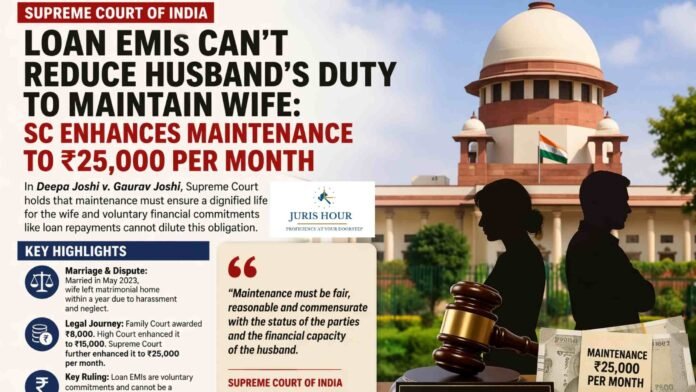
The Supreme Court while enhancing the monthly maintenance payable to a wife from ₹15,000 to ₹25,000, held that loan EMIs cannot reduce husband’s duty to maintain wife.
The bench of Justice Sanjay Karol and Justice Augustine George Masih has observed that the maintenance law is intended to prevent destitution and ensure that a wife can live with dignity. Referring to precedents such as Chaturbhuj v. Sita Bai, Shamima Farooqui v. Shahid Khan, and Rajnesh v. Neha, the Court reiterated that maintenance must be realistic and commensurate with the financial capacity of the husband.
The judgment came in the case of Deepa Joshi v. Gaurav Joshi, where the Court modified an earlier order of the Uttarakhand High Court and emphasized that maintenance must be fair, realistic, and sufficient to ensure a dignified life for the dependent spouse.
The dispute arose from a marriage solemnized in May 2023. Within a year, the relationship deteriorated, leading the wife to leave the matrimonial home and reside separately without any independent source of income. She subsequently initiated maintenance proceedings under Section 144 of the Bharatiya Nagarik Suraksha Sanhita, 2023, seeking ₹50,000 per month. The Family Court awarded ₹8,000 per month, which was later enhanced to ₹15,000 by the High Court.
Still dissatisfied, the wife approached the Supreme Court, arguing that the amount awarded was grossly inadequate and failed to reflect the husband’s true earning capacity. She contended that excessive reliance had been placed on deductions such as loan repayments, which were voluntary and related to asset creation, thereby unfairly reducing the maintenance amount.
The husband, on the other hand, maintained that his disposable income was significantly reduced due to financial liabilities and that the High Court had already granted reasonable relief.
A key issue before the Court was whether deductions from the husband’s salary—particularly loan repayments—could be treated as legitimate factors to reduce maintenance liability. The Court decisively answered in the negative, holding that such repayments, especially when they contribute to asset creation, are in the nature of voluntary financial commitments and cannot override the husband’s primary duty to maintain his wife.
The bench noted that the husband, employed as a Manager with Canara Bank, was earning a gross monthly salary of approximately ₹1.15 lakh. It held that equating loan EMIs with essential expenses would undermine the purpose of maintenance law and allow individuals to structure their finances in a manner that defeats statutory obligations.
Balancing the needs of the wife and the financial capacity of the husband, the Court concluded that ₹25,000 per month would be a just and reasonable amount. It directed that arrears be cleared within three months and that future payments be made by the 7th of each month.
Case Details
Case Title: Deepa Joshi Versus Gaurav Joshi
Citation: JURISHOUR-810-SC-2026
Case No.: SLP (CRL.) NO.15662 OF 2025
Date: 16/04/2026

