
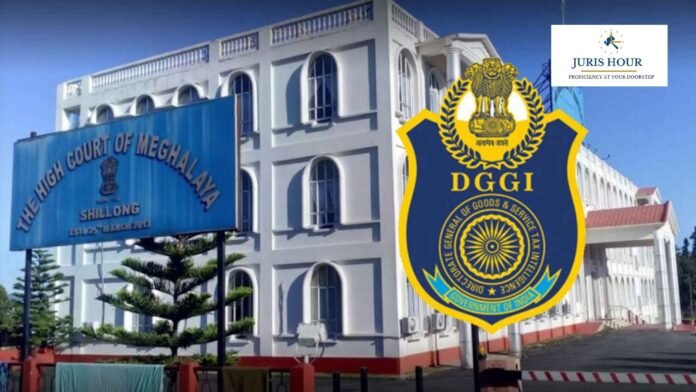
The Meghalaya High Court has quashed a service tax adjudication order against the Assam Rifles Group Insurance Scheme, holding that an unexplained delay of nearly eight-and-a-half years in deciding the show-cause notice violated the statutory timeline under Section 73(4B) of the Finance Act, 1994.
The Division Bench of Justice H.S. Thangkhiew and Justice B. Bhattacharjee held that the department cannot keep tax proceedings pending indefinitely and conclude them at their convenience and found that the adjudication order, passed 3,081 days after the show-cause notice, was arbitrary, contrary to Section 73(4B)(b), and bad in law.
Buy Now: Service Tax E-Magazine – August 2026
The petitioner/assessee has challenged an Order which confirmed a service tax demand by invoking the extended limitation period and imposed interest and penalties under Sections 75, 76, 77 and 78 of the Finance Act.
The underlying show-cause notice was issued on October 5, 2016. However, the first personal hearing was granted only on April 5, 2024—approximately 2,704 days after the notice. The adjudication order was eventually passed on March 12, 2025.
The dispute concerned three schemes operated for Assam Rifles personnel: the Death Benefit Insurance Scheme along with administrative charges, the Disability Benefit Scheme and the Post-Retirement Insurance Scheme.
The department treated the activities undertaken under these schemes as taxable services and alleged non-payment of service tax. For the period between April 1, 2011, and March 31, 2012, the schemes were treated as taxable life insurance services under the positive-list regime.
Assessee argued that it was a public authority performing statutory welfare functions and that mandatory deductions made from the salaries of Assam Rifles personnel for their mutual benefit did not amount to consideration for providing a taxable service.
It contended that the schemes were statutory welfare arrangements and not commercial insurance activities. Since participation involved compulsory salary deductions rather than a voluntary contractual bargain, the amounts collected could not be regarded as consideration involving a quid pro quo.
Assessee also maintained that it was exempted under Section 118(c) of the Insurance Act, 1938, pursuant to a government order dated July 31, 1978. It therefore could not be treated as an insurer carrying on life insurance business for service tax purposes.
For the period covered by the negative-list regime, assessee alternatively argued that its activities amounted to services provided by the government and were consequently covered by the exclusion under Section 66D(a) of the Finance Act.
The principal issue examined by the High Court was whether the adjudication order had become legally unsustainable because it was passed nearly eight-and-a-half years after issuance of the show-cause notice.
Section 73(4B) required the Central Excise Officer to determine the service tax payable within six months from the date of notice in ordinary cases, where possible. Where the extended limitation period was invoked, the determination was required to be made within one year, where possible.
In the present case, the department invoked the extended limitation period under the proviso to Section 73(1) on allegations of wilful suppression. Consequently, the one-year timeline prescribed under Section 73(4B)(b) applied.
The court held that the phrase “where it is possible to do so” did not permit tax authorities to disregard the statutory timeline or keep proceedings pending for an indefinite period.
While some reasonable delay could be justified depending on the circumstances, the authorities were required to demonstrate legally acceptable reasons showing why it was impossible to complete the adjudication within the contemplated period.
The revenue sought to justify the delay by alleging that the assessee had failed to provide complete documents, clarify discrepancies and furnish the records necessary to complete the assessment.
It also submitted that the matter involved complex issues, inter-departmental coordination, examination of statutory records and detailed scrutiny of the insurance schemes. According to the department, assessee had repeatedly approached the Department of Revenue seeking retrospective exemption from service tax, which contributed to the delay.
The revenue further argued that Section 73(4B) was directory rather than mandatory and that an adjudication order could not be declared time-barred solely because it was passed beyond the one-year period.
The High Court rejected these explanations, observing that the show-cause notice itself contained the relevant facts, allegations and grounds on which the proposed levy was based. The claim that the schemes required detailed examination could not justify leaving the proceedings unresolved for more than eight years.
The Bench held that the representations made by assessee seeking exemption did not legally prevent the authorities from completing the adjudication.
“The respondents were therefore duty bound to complete the adjudication as expeditiously as possible, and cannot regard the representations made by the petitioner to be a restraint or a bar under law,” the court observed.
The department also relied on several communications and adjournment requests allegedly made by assessee between 2017 and 2025.
The High Court found that this explanation was of no assistance to the revenue in view of Section 33A of the Finance Act. The provision permits an adjudicating authority to grant adjournments for sufficient cause but stipulates that not more than three adjournments may be granted to a party during the proceedings.
Therefore, repeated requests or representations could not be used to extend adjudication proceedings indefinitely.
The court noted that the first personal hearing was offered only in April 2024, nearly seven-and-a-half years after the show-cause notice. The respondents failed to establish any justified cause that prevented them from taking the notice to its logical conclusion within a reasonable period.
The Bench relied upon the Bombay High Court’s decision in IDFC First Bank v. Union of India, which held that the expression “where it is possible to do so” under Section 73(4B) provides only limited flexibility to the adjudicating officer.
It does not give tax authorities complete freedom to adjudicate a notice at their “own sweet will” after an inordinate and unexplained delay.
The Meghalaya High Court also referred to decisions including Sunder System Pvt. Ltd. v. Union of India, L.R. Sharma and Company v. Union of India and Power Spectrum Sarbidipur v. Union of India.
The court said these rulings consistently recognise that a statutory authority must exercise its jurisdiction within a reasonable period. Even where a statutory timeline is not expressed as an absolute limitation, adjudication cannot be delayed indefinitely without a valid explanation.
Section 73(4B), the court emphasised, was enacted to ensure effective and timely tax administration. Treating its six-month and one-year timelines as having no real consequence would defeat the object of the provision.
The High Court concluded that the department failed to provide any justifiable reason for keeping the proceedings pending for nearly eight-and-a-half years.
It held that the Order-in-Original dated March 12, 2025, was passed after an undue and unexplained delay and therefore violated Section 73(4B)(b) of the Finance Act.
The delay also rendered the order arbitrary and contrary to Article 14 of the Constitution, the Bench added.
The revenue objected to the maintainability of the writ petition on the ground that assessee had bypassed the statutory appellate remedy available under the Finance Act.
The High Court acknowledged that constitutional courts ordinarily exercise restraint where an effective statutory appeal is available. However, the present dispute involved the interpretation of Section 73(4B) and the legality of an adjudication completed after an extraordinary delay.
Since the issue was essentially a question of law and the impugned order was found to be arbitrary, the existence of an appellate remedy did not bar the High Court from exercising jurisdiction under Article 226 of the Constitution.
Assessee had also challenged Notification No. 22/2014-Service Tax dated September 16, 2014, which conferred all-India jurisdiction upon officers of the Directorate General of Central Excise Intelligence.
It argued that Delhi-based authorities could not issue and adjudicate proceedings concerning a Shillong-based entity. Assessee also alleged institutional bias because the notice was issued and adjudicated by officers belonging to the same departmental organisation.
Other questions included whether compulsory salary deductions constituted consideration, whether assessee qualified as “Government” for the negative-list exemption and whether the allegation of wilful suppression justified invoking the extended limitation period.
The High Court did not decide these substantive and jurisdictional questions. It held that its finding concerning the unexplained eight-and-a-half-year delay was sufficient to dispose of the case.
Accordingly, the court set aside the adjudication order dated March 12, 2025, on the ground of delay alone and allowed the writ petition to that extent.
Membership Required to Access Case Details & Order Copy
To view the complete Case Details and Download Order Copy, you must have an active membership. Please subscribe to continue.
Read More: DRI Busts International Gold-Smuggling Syndicate Operated By Chinese National

