
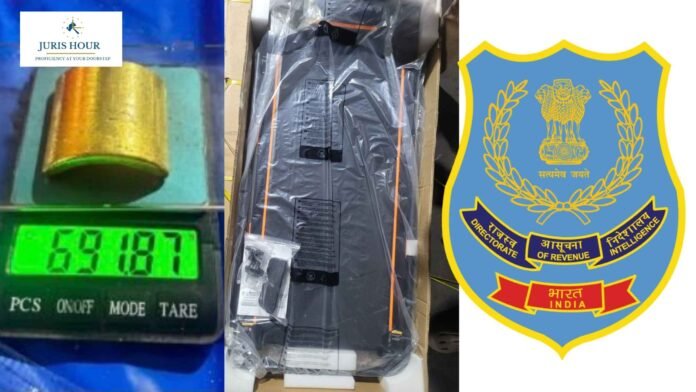
The Directorate of Revenue Intelligence (DRI), Mumbai Zonal Unit, has busted an international gold-smuggling syndicate allegedly operated by Chinese nationals in association with Indian accomplices. Officials seized 691.870 grams of 24-carat gold, valued at approximately Rs. 1.10 crore, from a commercial consignment imported from Hong Kong.
The contraband was ingeniously concealed inside the motor of a treadmill and was detected at the Air Cargo Complex in Mumbai. Two persons, including a Chinese national and an individual responsible for managing the importing firm, were arrested under the provisions of the Customs Act, 1962.
Buy Now: Service Tax E-Magazine – August 2026
Acting on specific intelligence, DRI officers intercepted the consignment after its arrival from Hong Kong. The shipment had ostensibly been imported as part of a legitimate commercial transaction. A detailed examination, however, revealed that the treadmill motor had been used as a specially designed cavity to conceal the smuggled gold.
Upon dismantling the motor, officers recovered 691.870 grams of foreign-origin gold of 24-carat purity. The estimated market value of the seized gold was placed at around Rs. 1.10 crore.
The investigation indicated that the consignment was not an isolated attempt but formed part of a broader and organised smuggling operation. According to the DRI, Chinese nationals, working with Indian associates, had devised a method of bringing gold into India under the cover of legitimate commercial imports.
Instead of relying on conventional passenger-based smuggling routes, the syndicate allegedly used machinery and commercial equipment imported through the air-cargo channel. The gold was concealed within internal components that would ordinarily not attract suspicion during a routine visual inspection.
The use of a treadmill motor suggests that the syndicate had taken technical measures to disguise the contraband as an integral part of the imported equipment. Such concealment was allegedly intended to defeat Customs examination and avoid payment of the applicable import duty.
Following the initial seizure, the DRI carried out coordinated searches at several locations across Maharashtra and Tamil Nadu. The searches covered premises in Mumbai, Chennai, Tiruvallur and Chengalpattu.
The multi-city operation was aimed at identifying other persons connected with the importing entity, tracing the financial and logistical network behind the consignment, and determining whether similar shipments had previously been cleared through Indian ports or air-cargo facilities.
During the investigation, the authorities identified the role of a Chinese national as well as the person allegedly managing the affairs of the importing firm. Both individuals were arrested for their suspected involvement in the smuggling operation.
The arrests were made under the Customs Act, 1962, which empowers Customs and revenue-intelligence authorities to seize smuggled goods and arrest persons believed to have committed offences punishable under the legislation.
The case highlights the growing use of legitimate supply chains and commercial cargo for smuggling high-value commodities. By routing the consignment through an importing firm and concealing the gold inside industrial or fitness equipment, the syndicate allegedly attempted to create the appearance of an ordinary business import.
Investigators are now examining the ownership and operations of the importing firm, the origin and routing of the consignment, the parties responsible for arranging the shipment in Hong Kong, and the intended recipients of the gold in India.
The DRI is also expected to scrutinise past imports linked to the concerned entities to establish whether the same concealment technique had been used earlier. Authorities may examine shipping records, invoices, payment trails, communications and other commercial documents to determine the scale of the alleged syndicate’s activities.
The involvement of foreign nationals and the movement of the consignment from Hong Kong have added an international dimension to the case. The investigation is likely to focus on identifying the persons financing the transactions, coordinating the overseas dispatches and arranging the domestic distribution of the smuggled gold.
Smuggled gold is liable to confiscation under the Customs Act. Persons knowingly concerned with its importation, concealment, transportation or disposal may also face prosecution and other penal consequences, subject to the outcome of the investigation and judicial proceedings.
The operation demonstrates the DRI’s focus on detecting sophisticated concealment methods used in commercial cargo. Further investigation is underway to identify the remaining members of the syndicate, uncover possible earlier consignments and establish the complete financial and operational chain behind the alleged smuggling network.

