
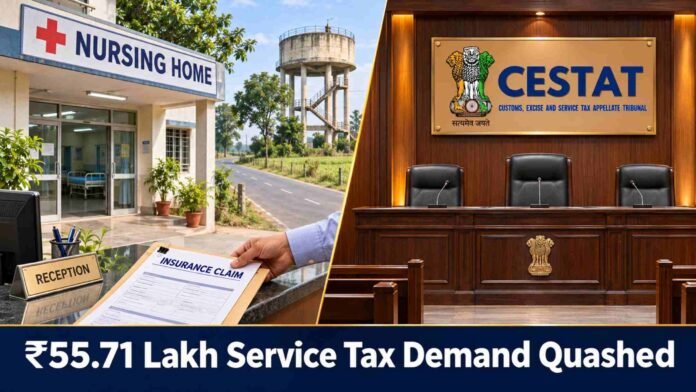
The Customs, Excise and Service Tax Appellate Tribunal (CESTAT), Kolkata, has set aside a service tax demand of about ₹55.71 lakh, along with interest and penalty, against a Malda-based proprietorship that ran a nursing home and undertook public infrastructure works. The dispute covered financial years 2015–16 and 2016–17.
The bench of R. Muralidhar (Judicial Member) and K. Anpazhakan (Technical Member) held that the documents established what the payments were for. The receipts from insurers and third-party administrators (TPAs) were settlements for healthcare delivered to patients. Work orders and payment records tied the other receipts to public roads and a water-supply reservoir. The bench found all these receipts covered by Notification No. 25/2012-ST dated 20 June 2012.
Buy Now: Indirect Tax Judgments E-Compilation – October 2026
The department issued a show-cause notice on 28 April 2021 invoking the extended limitation period and proposing recovery of ₹1,27,98,555 in service tax, along with interest and penalties. The Additional Commissioner confirmed the full demand on 30 November 2023.
The Commissioner (Appeals) partly allowed the first appeal on 4 April 2025 after considering supporting documents. The remaining demand included ₹42,15,083 on healthcare services and ₹13,56,079 on works contract services. Before CESTAT, the department maintained that the Commissioner (Appeals) had already granted exemptions wherever the appellant had produced adequate documents.
The tribunal noted that the Commissioner (Appeals) had acknowledged that the appellant operated a nursing home. The registration certificate and licence established its status as a clinical establishment. The bench then reviewed the empanelment agreements, sample invoices and corresponding money receipts to determine what the insurers and TPAs had paid for.
Those records showed a direct link between the payments and treatment provided to patients. CESTAT held that the nursing home’s healthcare receipts of ₹2,85,33,950 were exempt under Entry 2 of Notification No. 25/2012-ST. The bench held that gaps in the earlier documentation could not defeat the exemption once the records before it established the nature of the services and the nursing home’s status.
The tribunal examined three sets of receipts totalling ₹90,98,872. It linked payments of ₹17,50,250 in FY 2015–16 and ₹13,68,822 in FY 2016–17 to two rural road projects in Malda district. The roads connected Makorsui to Pratappur and Khottapara to Srikrishnapur. The bench found that these projects qualified under Entry 13(a), which covers the construction of roads for public use.
The remaining ₹59,79,800, received in FY 2016–17, related to construction of a 350-cubic-metre elevated reservoir for the Uttar Kumedpur Water Supply Scheme in Harishchandrapur-II block. The Commissioner (Appeals) had accepted that the nature of the work fell under Entry 12(e), but had retained the demand on those receipts because the supporting work orders had not been correlated with the payments. After examining the records submitted on appeal, CESTAT found that the receipts related to the exempt water-supply project.
CESTAT set aside the Order-in-Appeal and allowed the appeal with consequential relief, if any, as per law. The ruling rests on the documentary evidence linking each category of receipts to an exempt service.
Membership Required to Access Case Details & Order Copy
To view the complete Case Details and Download Order Copy, you must have an active membership. Please subscribe to continue.

