
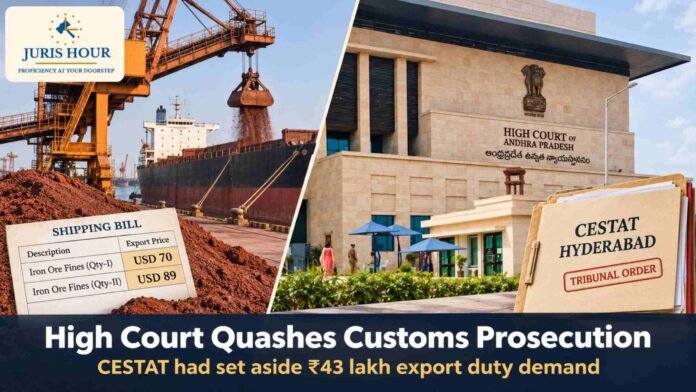
The Andhra Pradesh High Court has quashed a criminal complaint over the alleged undervaluation of two iron ore export consignments after the Customs, Excise and Service Tax Appellate Tribunal (CESTAT), Hyderabad, set aside the entire differential customs duty demand of ₹43,01,233 and all penalties.
The Bench of Justice Battu Devanand and Justice Tuhin Kumar Gedela found that the tribunal’s order had attained finality and that the criminal complaint rested on the same allegations examined by CESTAT. The tribunal had found that Customs failed to establish that the exporter received any additional consideration that would justify revising the declared export value.
Buy Now: Indirect Tax Judgments E-Compilation – October 2026
The dispute concerned two shipments of iron ore fines with 57% iron content, exported in 2013 aboard M.V. Olympus and M.V. Ruby Halo. The exporter declared a free-on-board (FOB) price of USD 70 per dry metric tonne in both shipping bills, in line with its contract with a Singapore buyer.
During its investigation, Customs identified a separate contract between two Singapore companies that recorded a price of USD 89 per dry metric tonne for iron ore fines of the same grade. The department alleged that the USD 70 contract was a dummy arrangement and that the exporter received the difference in cash. On that basis, Customs sought to recover ₹43,01,233 in differential export duty.
The exporter maintained that it shipped the consignments to its contractual buyer and received payment at the agreed rate of USD 70 per dry metric tonne. It denied receiving any amount over and above that price.
CESTAT examined whether Customs had linked the higher-priced contract to the two shipments and shown that the exporter actually received the alleged cash differential. The department relied on statements recorded under Section 108 of the Customs Act, 1962, along with emails, computer printouts and other documents.
The tribunal found no panchnama or other recovery record showing how Customs obtained the emails and documents on which it relied. It also found that the department had failed to establish compliance with Section 138C, which governs the admissibility of electronic records under the Customs Act. A witness whose statement was relied on was also unavailable for cross-examination because the request to cross-examine him had been refused.
Several statements had been retracted during adjudication. The tribunal regarded the late retractions as an afterthought but said the adjudicating authority should have given detailed reasons for rejecting them. Taking the evidentiary gaps together, CESTAT concluded that Customs had failed to establish receipt of additional consideration for either shipment. It allowed all four appeals on 7 April 2026, setting aside the duty demand and penalties.
The petitioners moved the High Court under Article 226 of the Constitution, arguing that the criminal complaint repeated the very allegation CESTAT had rejected. The complaint, pending before the Special Judge for Economic Offences in Visakhapatnam, alleged offences under Sections 132 and 135 of the Customs Act, read with Section 140, and criminal conspiracy under Section 120B of the Indian Penal Code.
Counsel for the Central Board of Indirect Taxes and Customs argued that departmental adjudication and criminal prosecution are independent proceedings and can run in parallel. The High Court held that the petitioners’ case was governed by the authorities on exoneration in adjudication. It noted that there was no dispute that the CESTAT order had attained finality and relied on authorities including the Supreme Court’s decision in K.C. Builders v. Assistant Commissioner of Income Tax.
The distinction matters where the two proceedings rest on identical allegations. The Supreme Court has explained that adjudication and prosecution may proceed simultaneously, while exoneration on the merits can preclude prosecution on the same facts. Where adjudication ends in relief on a technical ground, prosecution may still continue.
The High Court allowed the writ petition, quashed the criminal complaint in and made no order as to costs.
Membership Required to Access Case Details & Order Copy
To view the complete Case Details and Download Order Copy, you must have an active membership. Please subscribe to continue.
Read More: CESTAT Cuts Security to Rs. 60 Lakh for Release of Bangladesh Garments Outside IPR Dispute

