
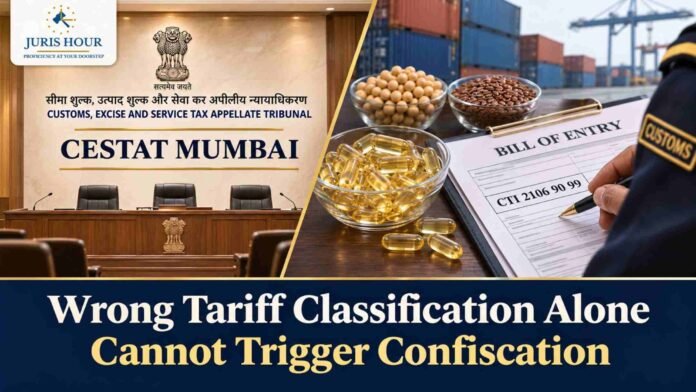
The Mumbai bench of the Customs, Excise and Service Tax Appellate Tribunal (CESTAT) has held that choosing the wrong tariff heading in a Bill of Entry does not, by itself, make imported goods liable to confiscation under Section 111(m) of the Customs Act, 1962.
The bench of Dr. Suvendu Kumar Pati (Judicial Member) and P.V. Subba Rao (Technical Member) found that the imported soy/tofu and flaxseed capsules matched their declared description and that the dispute arose from the tariff heading chosen during self-assessment.
Buy Now: Indirect Tax Judgments E-Compilation – October 2026
The bench upheld the department’s classification of the capsules under Customs Tariff Item (CTI) 2106 90 99. It rejected the extended five-year demand after finding no evidence of collusion, wilful misstatement or suppression of facts.
The appellant/assessee filed ten Bills of Entry for capsules containing a dry mix powder of soy/tofu and flaxseed. It declared the goods under tariff items 12119011, 12089000 or 12119099 and paid duty accordingly. After clearance, Customs issued show cause notices proposing to reclassify the capsules under CTI 2106 90 99, recover differential duty, confiscate the goods and impose penalties.
The adjudicating authorities confirmed the proposals, and the Commissioner (Appeals) upheld the orders. The importer, its director Maneesh Sapte and customs broker Sunshine Enterprises filed eleven appeals before CESTAT.
Both sides accepted that CESTAT had already classified the same product imported by the company under CTI 2106 90 99 in April 2019. That decision drew on the Assistant Drug Controller’s report, the Harmonized System of Nomenclature notes and the product literature. The bench followed the earlier classification for the ten Bills of Entry in dispute.
The tribunal explained that a Bill of Entry serves two functions. Under Section 46, the importer declares factual particulars such as the nature, quantity and weight of the goods. Under Section 17, the importer uses the same form to self-assess duty, which includes choosing the tariff item.
Section 111(m) addresses discrepancies between imported goods and the particulars declared in the customs entry. Here, the capsules matched the description in the Bills of Entry. The tribunal held that the importer had to declare the facts accurately and could classify the goods according to its understanding of the tariff. A later disagreement over the tariff heading did not establish a factual discrepancy warranting confiscation.
The bench explained that Customs can correct an erroneous self-assessment through reassessment under Section 17. If the department discovers a short payment after clearance, it may seek recovery under Section 28 within the applicable limitation period.
For the notices at issue, the tribunal noted that the normal limitation period was six months before 8 April 2011 and one year from that date. The five-year period required evidence that the short payment resulted from collusion, wilful misstatement or suppression of facts. CESTAT found that the short payment arose solely from the classification dispute. It therefore set aside demands beyond the normal period and overturned the importer’s penalties under Section 114A.
Once it overturned the confiscation findings, CESTAT set aside the two redemption fines of ₹30 lakh and ₹5 lakh under Section 125. It also overturned penalties totalling ₹45 lakh on the director and ₹7 lakh on the customs broker. Those penalties, imposed under Section 112(a), depended on acts or omissions that rendered the goods liable to confiscation.
The importer’s appeals were partly allowed, with differential duty and interest surviving only within the normal limitation period. The tribunal allowed the director’s and customs broker’s appeals in full.
Membership Required to Access Case Details & Order Copy
To view the complete Case Details and Download Order Copy, you must have an active membership. Please subscribe to continue.

