
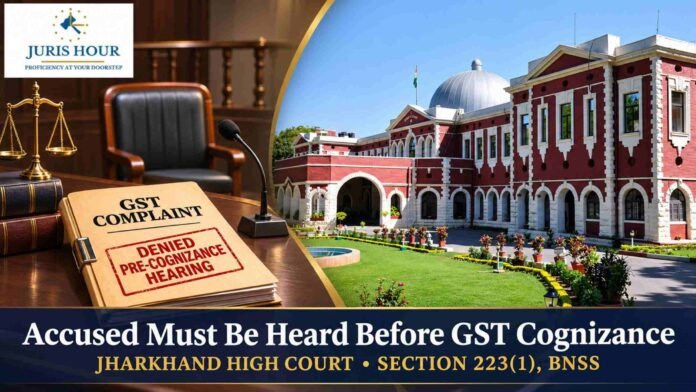
The Jharkhand High Court has quashed an order taking cognizance of alleged GST and Indian Penal Code offences because the accused were given no opportunity to be heard and held that the hearing requirement under the first proviso to Section 223(1) of the Bharatiya Nagarik Suraksha Sanhita, 2023 (BNSS) applied because the court took cognizance after the BNSS came into force, even though the complaint had been filed under the earlier procedural regime.
The bench of Justice Anil Kumar Choudhary sent the complaint back to the Special Magistrate, Economic Offences, East Singhbhum, Jamshedpur, for a fresh order after giving the accused an opportunity to be heard.
Buy Now: 210+ GST Judgments E-Magazine – October 2026
The complaint was filed on 25 June 2024, when the Code of Criminal Procedure, 1973 was still in force. The BNSS came into force on 1 July 2024. The Special Judge, Economic Offences, took cognizance on 23 August 2024 under Section 132(1)(i) of the Central Goods and Services Tax Act, 2017, and several provisions of the Indian Penal Code concerning alleged cheating, forgery, use of forged documents, criminal conspiracy and evidence-related offences.
The two petitioners invoked the High Court’s inherent powers under Section 528 of the BNSS to seek quashing of the entire criminal proceedings, including the cognizance order. Their counsel argued that the first proviso to Section 223(1) barred the court from taking cognizance on the complaint without first giving them an opportunity to be heard. Counsel for the Directorate General of GST Intelligence opposed the petition but acknowledged that no pre-cognizance hearing had been given.
The petitioners relied on Parvinder Singh v. Directorate of Enforcement, 2026 INSC 519, where the Supreme Court dealt with a prosecution complaint under the Prevention of Money Laundering Act filed before the BNSS commenced. Cognizance in that case was taken on 2 July 2024. The Supreme Court held that failure to give the accused the hearing required under Section 223(1) vitiated the cognizance order. It also rejected the argument that the accused had to separately show prejudice from being denied a hearing.
The petitioners also cited Kushal Kumar Agarwal v. Directorate of Enforcement, 2025 SCC OnLine SC 1221, in which the Supreme Court explained that the first proviso restricts the court’s power to take cognizance until the accused has been given an opportunity to be heard.
The High Court treated 23 August 2024, the date on which cognizance was taken, as decisive for applying the hearing requirement in this case. Since the BNSS was in force by then, the court had to give the petitioners an opportunity to be heard before taking cognizance. The omission made the order legally unsustainable.
Membership Required to Access Case Details & Order Copy
To view the complete Case Details and Download Order Copy, you must have an active membership. Please subscribe to continue.
Read More: CESTAT Quashes Service Tax Demand on Insurer-Paid Nursing Home Bills and Public Works

