
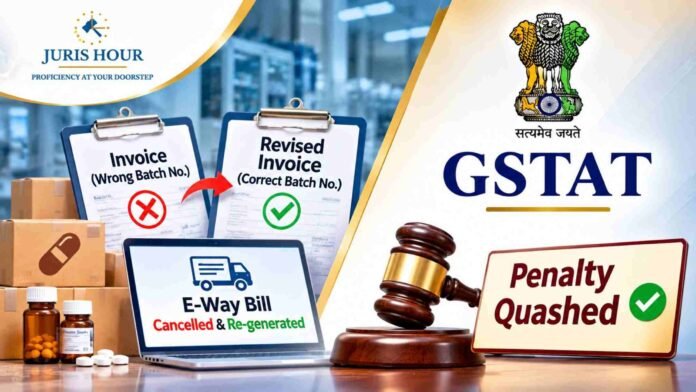
The GST Appellate Tribunal (GSTAT), Bengaluru has set aside a penalty of ₹9,49,868 imposed on assessee under Section 129 of the CGST/KGST Acts, holding that a genuine clerical error in the batch number of pharmaceutical raw material, followed by cancellation and generation of corrected invoices, could not justify detention and penalty when the identity, quantity and tax-paid nature of the goods remained undisputed.
The bench of Srikanth Venkatraman (Judicial Member) and Sudha Koka (Technical Member) upheld a penalty of ₹9,49,868 under Section 129(1)(a) of the CGST/KGST/IGST Acts and directed the Department to refund the entire penalty amount paid by the company, along with applicable interest, within eight weeks from the date of the order.
Buy Now: All 200+ GSTAT Judgements Till November 2026 | Comprehensive E-Magazine
The appellant/assessee is a pharmaceutical and nutraceutical manufacturer registered under GST in Maharashtra and Tamil Nadu, undertook an inter-State stock transfer of raw materials from its manufacturing facility at Roha, Maharashtra, to its own unit in Chennai, Tamil Nadu.
The consignment comprised 275 boxes weighing 7,345.950 kilograms, having a taxable value of ₹27,45,799.50 and IGST liability of ₹4,74,933.52. The total invoice value was ₹32,20,733.02.
The goods included Acid Casein, Malt Extract, Extruded Rice Powder, Soya Lecithin, Caramel, Sodium Bicarbonate, L-Ascorbyl Palmitate and BOPP Film.
Before dispatch on July 12, 2022, the company generated Stock Transfer Invoice No. 9903000168 with a valid Invoice Reference Number (IRN) and E-Way Bill No. 231453783295 at 09:43 AM.
However, during the evening stock verification, the company’s personnel discovered a clerical error in the batch number of Malt Extract. The invoice mentioned batch number 0000210012 instead of the actual batch number 0000211614.
Considering the batch-traceability requirements applicable to pharmaceutical and food-grade inputs, the company decided to cancel the incorrect invoice and generate a corrected invoice.
Accordingly, the earlier E-Way Bill was cancelled at 05:03 PM on July 12, 2022, to facilitate cancellation of the erroneous invoice.
Since the cancellation took place late in the evening and the accounts personnel were unavailable, the revised e-invoice could not be generated immediately.
On the following morning, July 13, 2022, the company’s accounts personnel resumed work and completed the necessary corrections.
The earlier invoice was reversed through SAP Reversal Document No. 9903000169 at 09:29:50 AM. Subsequently, a fresh Stock Transfer Invoice No. 9903000170 was generated at 09:49:14 AM with a valid IRN.
Importantly, the corrected invoice retained the same description of goods, HSN codes, quantities, taxable value and IGST liability. Only the incorrect Malt Extract batch number was rectified.
The vehicle was intercepted by the enforcement authorities at Pattan Circle, Aland Road, Kalaburagi, between 11:15 AM and 11:30 AM on July 13, 2022.
The replacement E-Way Bill No. 211454281635 was generated at approximately 11:50–11:53 AM, following a portal accessibility/synchronisation gap around the interception period.
During the physical verification proceedings, the authorities recorded the details of the consignment in Form GST MOV-04.
The verification report did not identify any discrepancy in the identity, description, classification, quantity or value of the goods.
Nevertheless, the department treated the movement as unauthorised on the ground that the original E-Way Bill had been cancelled and the replacement E-Way Bill was generated after interception.
The Proper Officer detained the goods and vehicle, issued the notice in Form GST MOV-07 and subsequently passed an order in Form GST MOV-09 dated July 14, 2022, imposing a penalty of ₹9,49,868 under Section 129(1)(a) read with Section 129(3).
The company paid the penalty through Form GST DRC-03 on July 14, 2022, to secure the release of the goods and avoid further delay involving pharmaceutical raw materials.
Aggrieved by the penalty, the company filed an appeal before the First Appellate Authority on October 7, 2022, along with supporting documents, including SAP system extracts and records establishing the cancellation of the earlier invoice and generation of the corrected invoice.
However, the Joint Commissioner of Commercial Taxes (Appeals), Kalaburagi Division, dismissed the appeal through Order-in-Appeal dated November 23, 2023.
The appellate authority primarily held that the original E-Way Bill had been cancelled on July 12, 2022, while the replacement E-Way Bill was generated only after the vehicle had been intercepted on July 13, 2022.
It further observed that the company or transporter should have extended the validity of the earlier E-Way Bill under Rule 138(10) of the CGST Rules, 2017.
The authority also relied upon the Supreme Court’s decision in State of Gujarat & Anr. v. M/s. Saw Pipes Ltd., holding that once a statutory contravention was established, the absence of an intention to evade tax would not prevent imposition of penalty.
The company challenged the appellate order before GSTAT under Section 112 of the CGST Act, 2017, read with the corresponding provisions of the KGST Act and Section 20 of the IGST Act.
The Tribunal observed that Form GST MOV-04 did not record any discrepancy in the identity, description, classification, quantity or value of the goods.
The consignment consisted of 7,345.950 kilograms of pharmaceutical and nutraceutical inputs, with a taxable value of ₹27,45,799.50 and IGST of ₹4,74,933.52 duly accounted for.
There was no allegation or material indicating tax evasion or revenue loss.
The Tribunal accepted that the original E-Way Bill had been generated before dispatch and was valid until July 19, 2022.
However, it was cancelled because the corresponding invoice contained an incorrect Malt Extract batch number.
The Tribunal observed that this was not a situation requiring extension of the earlier E-Way Bill under Rule 138(10), since the underlying invoice itself contained an error and had to be cancelled.
Accordingly, the department’s reasoning that the company should have extended the earlier E-Way Bill was found to be misconceived.
The Tribunal specifically considered the time-stamped SAP records.
The earlier invoice was reversed at 09:29:50 AM on July 13, 2022, and the fresh invoice was generated at 09:49:14 AM.
Both events took place before the vehicle was intercepted between 11:15 AM and 11:30 AM.
The Tribunal accepted that the correction of the batch number was necessary for regulatory and quality-related accuracy in the pharmaceutical and food-grade business.
It also accepted the explanation that the next-morning generation of the corrected invoice was attributable to the late-evening cancellation of the earlier invoice and the unavailability of accounts personnel after working hours.
The Tribunal considered the operational interface between the company’s SAP system, the e-invoice portal and the E-Way Bill portal.
It observed that the fresh E-Way Bill was generated at approximately 11:50–11:53 AM, following a portal accessibility/synchronisation gap around the interception period.
The Tribunal treated this as an operational issue rather than evidence of any intention to evade tax.
One of the significant observations in the order concerned the manner in which the First Appellate Authority had dealt with the company’s documentary evidence.
The Tribunal noted that the SAP reversal records and fresh e-invoice details had been produced before the First Appellate Authority. However, the authority completely ignored these documents and failed to record any finding on the cancellation of the earlier invoice and generation of the corrected invoice before interception.
The Tribunal also criticised the mechanical reliance placed on the Supreme Court’s decision in State of Gujarat v. Saw Pipes Ltd. without examining the evidence, the MOV-04 report or the statutory scheme of GST law.
The Tribunal recorded its strong disapproval of such mechanical adjudication and observed that passing an order without appreciating evidence and recording findings on material submissions was improper.
It further noted that such an approach inflicted avoidable hardship and litigation burdens on taxpayers who had already paid tax and were compelled to pay penalty to secure the release of their goods.
The Tribunal held that the penalty imposed under Section 129(1)(a) could not be sustained.
Membership Required to Access Case Details & Order Copy
To view the complete Case Details and Download Order Copy, you must have an active membership. Please subscribe to continue.
Read More: GSTAT Quashes Rs. 1.30 Lakh Penalty for Vehicle Number Error in E-Way Bill

