
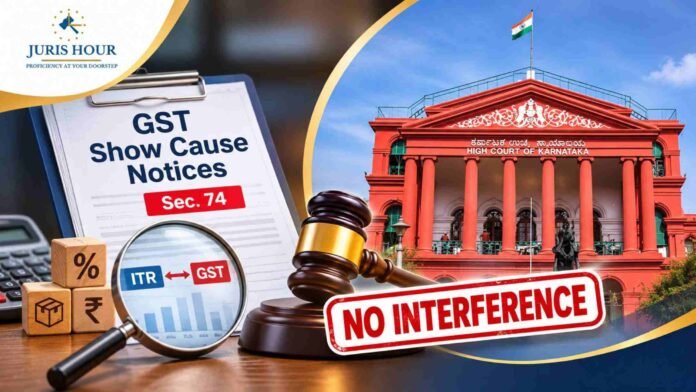
The Karnataka High Court has refused to interfere with five GST show cause notices issued under Section 74 of the CGST Act for FY 2020-21 to FY 2024-25, observing that the taxpayer can raise all objections before the adjudicating authority, which must follow the principles of natural justice.
The bench of Chief Justice Vibhu Bakhru and Justice K.S. Hemalekha, has dismissed a writ appeal challenging the dismissal of its writ petition against five show cause notices issued by the GST Department under Section 74 of the Central Goods and Services Tax Act, 2017.
The Bench held that no jurisdictional error warranting interference under Article 226 of the Constitution of India had been established at the threshold.
Buy Now: All 200+ GSTAT Judgements Till November 2026 | Comprehensive E-Magazine
The appellant/assessee, a proprietorship firm represented by its proprietor, challenged five show cause notices dated March 25, 2026, issued by the GST authorities for the financial years 2020-21 to 2024-25.
The notices were issued under Section 74 of the CGST Act, 2017, read with Section 122 of the Karnataka Goods and Services Tax Act, 2017.
The department had raised several allegations against the taxpayer, including: Differences were allegedly noticed between the turnover declared in the income tax returns and the GST returns filed for the relevant financial years; The department alleged invalid declaration of exempted and non-GST supplies; and Allegations were also raised regarding the application of incorrect GST rates on supplies.
The taxpayer challenged the notices before the Karnataka High Court by filing W.P. No. 12182 of 2026.
The Single Judge declined to entertain the writ petition on the ground that the challenge was directed against show cause notices.
The Court observed that the taxpayer had a full opportunity to contest the allegations before the adjudicating authority by raising all available grounds and objections.
It was further observed that the adjudicating authority was required to comply with the principles of natural justice and that the taxpayer’s opportunity to defend itself was not foreclosed.
Although the time granted for responding to the notices had already expired, the Single Judge, with the consent of the parties, permitted the taxpayer to appear before the adjudicating authority on September 21, 2026, and granted liberty to file replies to the show cause notices.
The taxpayer specifically contended that the proceedings initiated for FY 2020-21 had already been dropped by the concerned authority.
It was submitted that the authority had examined the GST returns furnished by the taxpayer and was satisfied with the explanation, resulting in the dropping of proceedings for that financial year.
The taxpayer sought to challenge the continuation of the remaining proceedings through the writ appeal.
During the appellate proceedings, the High Court was informed that, pursuant to the liberty granted by the Single Judge, the taxpayer had appeared before the adjudicating authority.
The taxpayer had sought copies of the documents relied upon by the department in support of the allegations contained in the show cause notices.
The State’s counsel informed the Court that the requested documents had been supplied to the taxpayer.
The Division Bench examined whether the issuance of the show cause notices disclosed any jurisdictional error warranting interference under Article 226 of the Constitution of India.
The Court declined to accept, at the threshold, that any such jurisdictional error existed.
It observed that the taxpayer was not precluded from raising all objections and grounds available to it before the adjudicating authority.
The Bench further emphasised that the adjudicating authority was required to follow the principles of natural justice before arriving at an informed decision.
Accordingly, the Court found no reason to interfere with the order passed by the Single Judge.
Membership Required to Access Case Details & Order Copy
To view the complete Case Details and Download Order Copy, you must have an active membership. Please subscribe to continue.
Read More: Rule 138(10) Not Applicable Where E-Way Bill Cancelled Due to Incorrect Invoice: GSTAT

