
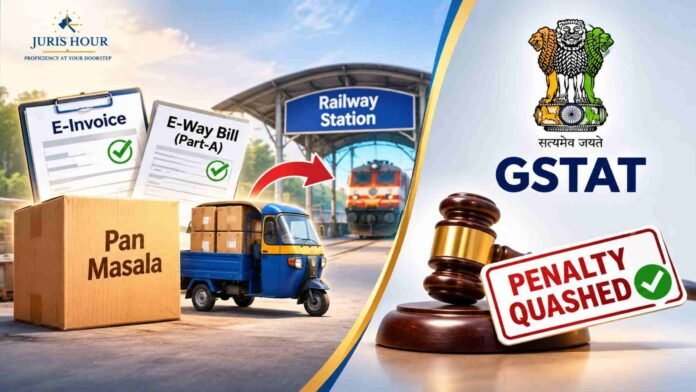
The Goods and Services Tax Appellate Tribunal (GSTAT), Lucknow State Bench has held that Rules 138(2A) and 138(3) protect initial road movement of goods to railway station and held that non-updation of Part-B cannot attract penalty under section 129 without establishing statutory contravention.
The bench of Santosh Kumar Srivastava (Judicial Member) and Arvind Kumar (Technical Member) has observed that the initial road movement of goods from the supplier’s premises to the railway station was covered by the statutory exemptions under Rule 138 of the CGST/UPGST Rules, 2017.
The bench found that the Department could not sustain penalty proceedings merely because Part-B of the e-way bill had not been updated during the initial road movement, particularly when the transaction was supported by a valid e-invoice and Part-A of the e-way bill and physical verification revealed no discrepancy in the goods.
Buy Now: All 200+ GSTAT Judgements Till November 2026 | Comprehensive E-Magazine
The appellant/assessee was engaged in the wholesale supply of Pan Masala (HSN 21069020). The company supplied goods. The consignment comprised 20 bags weighing 521.850 kg, containing 2,96,480 pouches of Shri Royal Sada Pan Masala, valued at ₹42,32,947, inclusive of applicable taxes.
The tax invoice expressly mentioned the destination as Lucknow and specified the dispatch mode as railway, with the transporter identified as the Ministry of Railways.
Before commencement of movement, the taxpayer generated a valid e-invoice bearing IRN and acknowledgement details and also generated Part-A of E-Way Bill No. 4014 9984 9633 at 11:11 AM on November 16, 2024.
The goods were initially transported in a three-wheeler bearing registration No. UP78FT7720 from the taxpayer’s premises in Fazalganj, Kanpur, to the railway station for onward transportation by rail.
At approximately 11:51 AM, around 40 minutes after generation of Part-A of the e-way bill, the Mobile Squad intercepted the vehicle at Dipti Padav, Kanpur.
During interception, the transporter produced the tax invoice. However, since Part-B of the e-way bill had not been updated with the vehicle details, the Department initiated detention proceedings under Section 129 of the CGST/UPGST Act, 2017.
The goods were physically verified, and the verification report in FORM GST MOV-04 recorded that the actual quantity of goods matched the quantity declared in the invoice, with zero discrepancy.
Thereafter, the Proper Officer issued a detention order and show cause notice in FORM GST MOV-06 and FORM GST MOV-07 respectively on November 16, 2024.
The taxpayer submitted its reply explaining that the goods were being transported to the railway station for onward transportation by rail and that the relevant e-invoice and Part-A of the e-way bill had already been generated.
However, the adjudicating authority rejected the explanation and imposed a penalty of ₹4,85,894 under Section 129(3) of the CGST/UPGST Act, 2017. The penalty comprised ₹53,200 under Central Tax, ₹53,200 under State Tax and ₹3,79,494 under Compensation Cess.
The taxpayer deposited the penalty under protest to secure the immediate release of the goods.
Aggrieved by the adjudication order, the taxpayer preferred an appeal before the First Appellate Authority.
The Additional Commissioner Grade-2 (Appeal-III), State Tax, Kanpur, vide Order-in-Appeal dated July 22, 2025, allowed the taxpayer’s appeal and set aside the penalty of ₹4,85,894.
The First Appellate Authority observed that the goods matched the invoice, Part-A of the e-way bill had been generated before commencement of movement, and the goods were intended for onward transportation through the railway system.
The authority treated the non-updation of Part-B during the initial road movement as a technical lapse rather than an attempt to evade tax and directed consequential relief.
Aggrieved by the appellate order, the Department filed a second appeal before GSTAT under Section 112(3) of the CGST Act, 2017.
Before the Tribunal, the Department argued that Section 129 of the CGST Act does not require the Revenue to independently establish mens rea or an intention to evade tax in every case.
It contended that Rule 138 requires every registered person causing the movement of goods exceeding the prescribed threshold to generate a complete e-way bill before commencement of movement.
According to the Department, generation of Part-A alone was insufficient for road transportation and the absence of vehicle details in Part-B rendered the movement non-compliant.
The Department further argued that the goods were being transported by road in a three-wheeler and, therefore, the requirement of Part-B was applicable.
It also highlighted that the commodity involved was Pan Masala, attracting GST at the rate of 28% along with applicable compensation cess, and argued that strict compliance was necessary considering the revenue implications.
On behalf of the taxpayer, Advocate Dinesh Kumar Shukla argued that the Department’s case proceeded on an incorrect assumption that the goods were being transported through ordinary road transportation.
The taxpayer submitted that the actual transaction involved a multimodal movement of goods, with the initial road movement being limited to transportation from the supplier’s premises to the railway station.
It was specifically argued that the e-invoice was generated before commencement of movement. Part-A of the e-way bill was generated at 11:11 AM, before the vehicle departed. The invoice clearly mentioned the dispatch mode as railway. The transporter was identified as the Ministry of Railways. Part-B could be furnished after the Railway Receipt (RR) number was generated, which was possible only after the goods reached the railway station and were booked for transit. Physical verification established that the goods matched the invoice without any discrepancy.
The taxpayer further relied upon the relevant provisions of Rule 138, particularly Rule 138(2A), the Third Proviso to Rule 138(3), and Rule 138A(1), to contend that the initial road movement was statutorily protected.
The Tribunal observed that Rule 138(2A) specifically governs goods transported by railways and provides that the registered person causing the movement of goods shall furnish the information in Part-B of FORM GST EWB-01 before or after commencement of movement.
The provision recognises the practical difficulty in generating railway receipt details before the goods actually reach the railway station and are booked for transportation.
Accordingly, the Tribunal held that the taxpayer was not required to furnish Part-B details before commencement of the initial road movement in the circumstances of the case.
The Tribunal also examined the Third Proviso to Rule 138(3), which provides an exemption from furnishing conveyance details in Part-B for transportation of goods for a distance of up to 50 kilometres within the State from the place of business of the consignor to the place of business of the transporter for further transportation.
The Tribunal found that the movement from the taxpayer’s premises in Fazalganj to the railway station at Kanpur was within the prescribed 50-kilometre limit.
Consequently, the taxpayer was not required to furnish Part-B details for this initial feeder movement, subject to the statutory conditions.
The Tribunal further referred to Rule 138A(1), which provides an exemption from the requirement of physically carrying a copy of the e-way bill in cases where goods are transported by rail.
The Tribunal considered this provision as part of the statutory framework facilitating railway transportation and multimodal movement of goods.
An important aspect considered by the Tribunal was that the taxpayer had generated the IRN-authenticated e-invoice and Part-A of the e-way bill before the vehicle commenced its journey.
The tax invoice clearly recorded the dispatch mode as railway, while the e-way bill identified the transporter as the Ministry of Railways.
The Tribunal observed that these contemporaneous documents established that the goods were intended for transportation to Lucknow through the railway system.
The Tribunal also relied upon the physical verification report in FORM GST MOV-04, which established that the goods found in the vehicle matched the description and quantity mentioned in the tax invoice.
There was no difference in the quantity or value of the goods, nor was any discrepancy found during physical verification.
The Tribunal considered these circumstances significant in determining whether there was any genuine attempt to evade tax.
The Tribunal observed that Section 129(1) provides for detention and penalty where goods are transported or stored in transit in contravention of the provisions of the Act or the Rules made thereunder.
However, the existence of a statutory contravention is a necessary foundation for invoking the detention and penalty provisions.
The Tribunal found that the relevant exemptions under Rule 138 applied to the initial movement of goods to the railway station.
Consequently, the Department’s reliance on the non-updation of Part-B, without considering the applicable statutory exemptions, could not sustain the penalty.
The Tribunal also observed that the digital documentation and physical verification established complete transparency regarding the origin and destination of the consignment.
It noted that the absence of any discrepancy in the goods, coupled with the pre-generated e-invoice and Part-A of the e-way bill, demonstrated the absence of any fraudulent intent or mens rea to evade tax.
Membership Required to Access Case Details & Order Copy
To view the complete Case Details and Download Order Copy, you must have an active membership. Please subscribe to continue.
Read More: S. 54 Limitation Applies Even to Tax Paid Under Mistake of Law: GSTAT

