
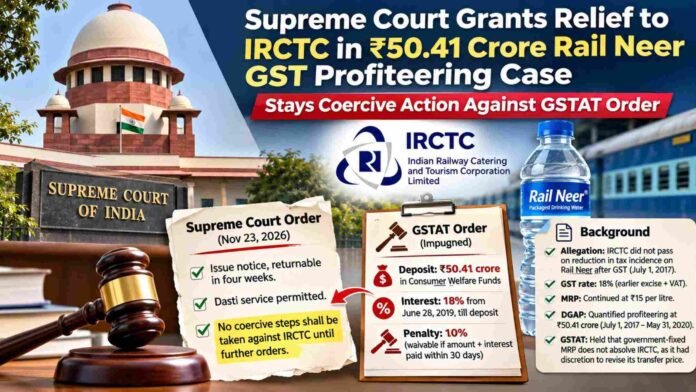
The Supreme Court has granted interim protection to the Indian Railway Catering and Tourism Corporation Limited (IRCTC) in its challenge to the Goods and Services Tax Appellate Tribunal’s (GSTAT) order directing it to deposit ₹50.41 crore for allegedly failing to pass on the benefit of reduced tax incidence on Rail Neer packaged drinking water.
The bench of Justice J.B. Pardiwala and Justice K. Vinod Chandran issued notice in IRCTC’s appeal against the Director General of Anti-Profiteering and another respondent. The Court directed that notice be made returnable within four weeks and permitted dasti service.
Importantly, the Supreme Court ordered that no coercive steps shall be taken against IRCTC until further orders, thereby granting interim protection to the public sector undertaking while its appeal is pending consideration.
Buy Now: 210+ GST Judgments E-Magazine – October 2026
Background: GSTAT Directs IRCTC to Deposit ₹50.41 Crore
The proceedings originated from an application filed by the then Commissioner of CGST and Central Excise, Audit Thane, alleging that IRCTC had failed to pass on the benefit of reduced tax incidence on Rail Neer following the introduction of GST with effect from July 1, 2017.
Before GST implementation, Rail Neer attracted central excise duty and VAT. Following the introduction of GST, the applicable tax rate became 18%. However, the maximum retail price of a one-litre bottle continued at ₹15 during the relevant period.
Following a reference from the Standing Committee on Anti-Profiteering, the Directorate General of Anti-Profiteering (DGAP) investigated the matter and, through its report dated June 11, 2021, quantified the alleged profiteering at ₹50,41,44,461 for the period July 1, 2017, to May 31, 2020.
The DGAP compared the average pre-GST base prices during April–June 2017 with the actual invoice prices after GST implementation, covering different categories of supplies, including supplies made through railway-operated and licensee-operated units.
GSTAT Holds That Government-Fixed MRP Does Not Exempt IRCTC
IRCTC contended before GSTAT that the Ministry of Railways determined the maximum retail price of Rail Neer through its circulars and that IRCTC had no independent authority to reduce the retail price.
It further argued that it primarily supplied Rail Neer to the Railways, licensees, sub-licensees and contractors, who were responsible for the ultimate retail sale to passengers.
However, GSTAT distinguished between the maximum retail price charged to passengers and the transfer price charged by IRCTC to its distributors and licensees.
Referring to Railway Board instructions authorising IRCTC to determine the transfer price for supplies to departmental and licensee-operated units, the Tribunal held that IRCTC had sufficient discretion to pass on the benefit of reduced tax incidence at its own stage of supply.
The Tribunal observed that the transfer price comprised the basic price and applicable taxes. Accordingly, IRCTC was required to reduce the transfer price commensurately with the reduction in tax incidence.
Public Sector Status and Subsidised Pricing No Defence Against Profiteering
IRCTC also argued that Rail Neer was supplied pursuant to a government mandate to provide safe drinking water to railway passengers and that its pricing was approximately 25% lower than competing packaged drinking water brands.
It contended that the benefit arising from subsidised pricing exceeded the alleged tax benefit.
GSTAT rejected these submissions, observing that Section 171 of the CGST Act does not distinguish between private and government organisations. The statutory obligation to pass on the benefit of reduced tax incidence applies equally to government-owned entities.
The Tribunal also rejected IRCTC’s argument seeking exclusion of complimentary supplies made to passengers travelling in Rajdhani, Shatabdi, Duronto and other premium trains, observing that the cost of such water formed part of the fare collected from passengers.
GSTAT Rejects Objections to DGAP’s Methodology
IRCTC had also challenged the investigation methodology, arguing that the original notice referred to failure to reduce MRP, whereas the eventual computation was based on average base prices and transfer prices.
The Tribunal, however, held that IRCTC had been informed of the allegations and had actively participated in the investigation by furnishing invoice-wise sales details, GST returns, pre-GST tax returns and sample invoices.
Relying on the Delhi High Court’s decision in Reckitt Benckiser India (P.) Ltd. v. Union of India, GSTAT observed that there need not be one uniform mathematical formula for determining profiteering and that the methodology could depend upon the facts of each case, provided it was fair and reasonable.
Consequently, GSTAT upheld the DGAP’s computation and concluded that IRCTC had contravened Section 171 of the CGST Act.
GSTAT Orders Deposit of ₹50.41 Crore Along With 18% Interest
Accepting the DGAP’s report, GSTAT directed IRCTC to deposit ₹50,41,44,461 within one month of the order.
The amount was directed to be distributed equally between the Central Consumer Welfare Fund and the relevant State Consumer Welfare Funds, in accordance with the state-wise allocation determined in the investigation report.
The Tribunal further directed payment of interest at 18% from June 28, 2019, until the date of deposit.
Additionally, GSTAT held IRCTC liable to a penalty equivalent to 10% of the profiteered amount, having regard to the fact that the alleged contravention continued beyond January 1, 2020, when Section 171(3A) came into force.
However, the Tribunal clarified that the penalty would not be payable if IRCTC deposited the entire profiteered amount along with applicable interest within 30 days of the order.
Membership Required to Access Case Details & Order Copy
To view the complete Case Details and Download Order Copy, you must have an active membership. Please subscribe to continue.
Read More: JURISHOUR | TAX LAW DAILY BULLETIN : 24 November 2026

