
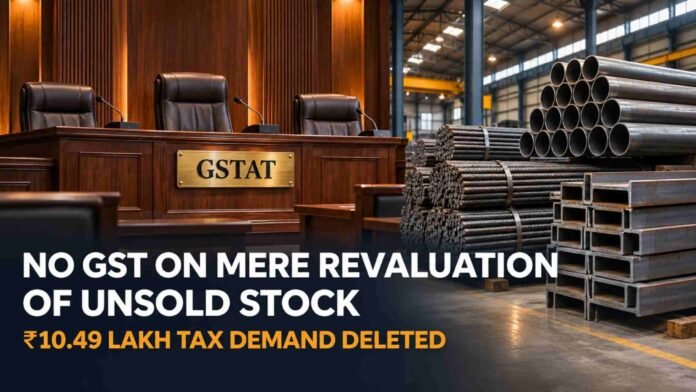
The Goods and Services Tax Appellate Tribunal (GSTAT) has held that a difference between the book value and the purchase cost of unsold stock does not by itself give rise to a taxable supply and deleted ₹10,49,248 in GST imposed on the revaluation of an iron and steel dealer’s closing stock. It also held that the first appellate authority had introduced a ground absent from the show-cause notice, contrary to Section 75(7).
The bench of Mahtab Ahmad (Judicial Member) and Ashish Varma (Technical Member) partly sustained ₹3,47,826 in tax on five other heads, including an unexplained physical stock shortage and sales evidenced by seized business records. It imposed an equal penalty under Section 74(9) and restricted interest to the portion of the confirmed tax relating to periods before November 2022.
Buy Now: All 200+ GSTAT Judgements Till November 2026 | Comprehensive E-Magazine
The bench upheld GST on a 5.3-tonne stock shortage and unreported sales backed by seized records, reducing the confirmed tax from ₹13.97 lakh to ₹3.48 lakh.
The dispute arose from a November 29, 2022 survey by the Special Investigation Branch of the Uttar Pradesh State Tax Department at the dealer’s registered premises in Naini, Prayagraj. Officers recorded 177.433 metric tonnes of iron and steel goods in the panchnama and left them in the dealer’s custody. No stock register or regular books were produced at the premises during the survey.
Officers seized three sets of records: three “Sunrise” booklets containing 220 slips, a manual tax invoice book and 55 loose slips relating to purchases and sales. The dealer’s authorised representative acknowledged on oath under Section 70 that the records belonged to the business. His statement was never retracted.
The department issued a Section 74 show-cause notice on October 16, 2024, alleging unreported sales between April and November 2022. An ex parte order dated March 30, 2025 confirmed ₹38,07,748 in gross tax, besides interest and penalty. The first appellate authority reduced the tax to ₹13,97,074 after examining the dealer’s records. It discarded the original estimate-based stock calculations and separately assessed a physical shortage and a revaluation difference.
The dealer’s revised trading account recorded 182.733 tonnes of closing stock at ₹35,81,594, or about ₹19.60 per kg. The first appellate authority applied an average purchase rate of ₹51.50 per kg, valued the same quantity at ₹94,10,750 and treated the ₹58,29,156 difference as suppressed sales taxable at 18%.
The Tribunal held that the calculation merely assigned a second value to the same stock. The revaluation was unsupported by any sale invoice, buyer, sale price, transaction date or other record pointing to a supply. The survey itself established that 177.433 tonnes of the goods were still on the dealer’s premises. The bench explained that the stock-account requirements in Section 35(1)(c) and Rule 56(2) could justify scrutiny of the dealer’s books, while the levy under Section 9 still required a supply or an applicable deeming provision.
The demand also failed on an independent procedural ground. Under Section 75(7), an order cannot confirm a demand on grounds other than those set out in the notice. The notice had raised estimated stock-based demands. The theory that the difference between the book value and purchase cost represented suppressed sales first appeared in the appellate order, leaving the dealer without an opportunity to answer it in the notice proceedings.
The Tribunal upheld the separate demand on 5.3 tonnes of goods missing from physical stock. The dealer’s own revised account showed 182.733 tonnes, while officers found 177.433 tonnes. The dealer gave no explanation for the difference or linked it to any specific sales captured in the seized records.
Section 35(6) allows the proper officer to determine tax on goods that a registered person fails to account for, as if the goods had been supplied. The Tribunal held that the unexplained shortage met that test. It also found that the stock comparison fell within the original notice and that the first appellate authority had recomputed it using the dealer’s revised figures. The shortage, valued at ₹2,72,950 at average purchase cost, attracted ₹49,131 in GST.
The dealer argued that the Sunrise slips were estimates, the manual invoices were entered later by a part-time accountant, and the loose slips included calculations, truck tare weights and scrap notes. The Tribunal accepted the principle that loose papers by themselves require corroboration. Here, the records were seized from the registered premises, acknowledged on oath by the authorised representative and substantially corroborated by the dealer’s own ledger, invoices and returns.
About half the recorded value in each of the Sunrise booklets and manual invoice book could be traced to declared transactions. About 86% of the relevant loose-slip value was reconciled. The Tribunal sustained the demands on the remaining entries after the dealer failed to link them to declared supplies or substantiate its alternative explanations. It also upheld a separate ₹41,236 difference in November 2022 outward supplies because the dealer produced no cancelled invoice, credit note or customer confirmation to support its claim that some bills had been cancelled.
| Demand component upheld | Taxable value | GST at 18% |
| Sunrise booklets (Sanket-01) | ₹7,74,187 | ₹1,39,354 |
| Manual tax invoice book (Sanket-02) | ₹4,77,708 | ₹85,987 |
| Loose slips (Sanket-03) | ₹3,66,282 | ₹65,931 |
| November 2022 outward supply difference | ₹41,236 | ₹7,423 |
| Physical stock shortage of 5.3 tonnes | ₹2,72,950 | ₹49,131 |
| Total | ₹19,32,363 | ₹3,47,826 |
The bench noted that the November 2022 return had yet to fall due when the survey took place. It based its finding of suppression for that month on the dealer’s subsequent filing of the return without declaring the supplies identified in the seized records. The omissions also persisted in the annual filings. Audited accounts and lump-sum payments through Form GST DRC-03 did not cure the failure to report those supplies. The Tribunal found intent to evade tax on the facts and upheld the use of Section 74.
The Tribunal treated the confirmed tax as discharged by the first DRC-03 tax payment of ₹4 lakh on November 29, 2022. It held that interest under Section 50 applied only to the portion of the sustained tax relating to earlier periods, from the respective due dates up to November 29. No interest was payable on the November 2022 component because the tax was covered before it fell due.
After crediting ₹6 lakh in tax and ₹90,000 in penalty already paid through DRC-03, the bench adjusted the excess tax payment against the equal penalty, leaving ₹5,652 unpaid. Subject to ledger verification, it directed the authorities to apply the cash portion of the appeal pre-deposits to that balance and the recomputed interest. Any surplus cash must be refunded within 60 days of receipt of the order, with applicable interest from payment to refund. The amount debited from the electronic credit ledger must be restored through Form GST PMT-03.
Membership Required to Access Case Details & Order Copy
To view the complete Case Details and Download Order Copy, you must have an active membership. Please subscribe to continue.
Read More: GSTAT Imposes Rs. 10K Cost On Food Retailer That Missed 6 Consecutive Months Of GSTR-3B Returns

