
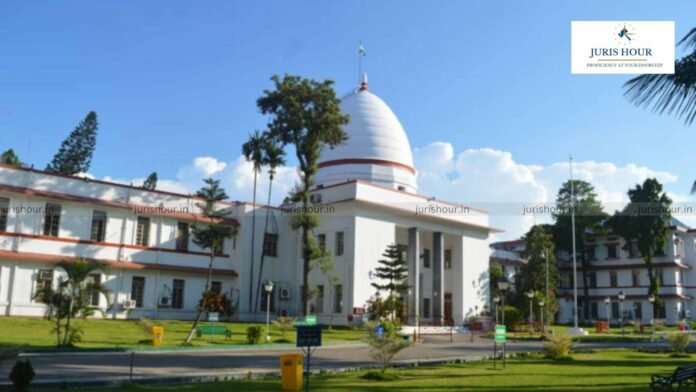
The Gauhati High Court has quashed an order cancelling a taxpayer’s GST registration after finding that the Proper Officer failed to provide adequate reasons for the cancellation. The Court held that an order cancelling GST registration must be a speaking order and must comply with the statutory requirements prescribed under the GST law.
The bench of Justice Manish Choudhury observed that cancellation of GST registration carries serious civil consequences and therefore cannot be based on vague observations or mechanical reasoning. The Court emphasized that recording reasons is an integral component of natural justice and fair procedure.
The petitioner/assessee was engaged in the business of providing light motor vehicles on hire and was registered under the GST regime since November 2021. The GST department issued a Show Cause Notice dated 13 August 2024 proposing cancellation of her GST registration on the ground that returns had not been furnished for a continuous period of six months. Her registration was simultaneously suspended.
Subsequently, an order dated 13 September 2024 was passed cancelling the GST registration. The petitioner approached the High Court contending that the cancellation order was arbitrary, lacked proper reasoning and had been passed without application of mind. She also submitted that due to miscommunication with her tax consultant, she could not file a reply to the show cause notice within time.
The petitioner argued that the cancellation order issued in Form GST REG-19 was legally defective because it did not disclose any specific reasons for cancellation. It was contended that the statutory framework under the CGST Rules requires the Proper Officer to record reasons while cancelling registration. According to the petitioner, the impugned order was a cryptic and non-speaking order that violated principles of natural justice.
The petitioner further submitted that although she later attempted to seek revocation of cancellation, the GST portal did not permit filing because the prescribed limitation period had already expired. Similarly, the statutory appeal could not be filed due to the lapse of limitation.
The GST Department argued that the taxpayer had continuously failed to file GST returns for more than six months and that such default justified cancellation under Section 29(2)(c) of the CGST Act read with Rule 21 of the CGST Rules. The Department also contended that the petitioner neither responded to the show cause notice nor pursued available statutory remedies within time, demonstrating lack of diligence on her part.
The Court analysed Sections 29 and 39 of the CGST Act as well as Rules 21, 21A and 22 of the CGST Rules governing cancellation of GST registration. It noted that while the law empowers authorities to cancel registration for continuous non-filing of returns, such power must be exercised strictly in accordance with the prescribed procedure.
The Court observed that Rule 22 requires issuance of a show cause notice, consideration of the taxpayer’s response and passing of a reasoned order in Form GST REG-19 where cancellation is warranted. The statutory form itself contemplates recording specific reasons for cancellation.
A significant aspect highlighted by the Court was the inadequacy of the show cause notice itself. The notice merely stated that the registration was liable to be cancelled due to “failure to furnish returns for a continuous period of six months” without specifying the exact period of default or relevant details.
According to the Court, the purpose of a show cause notice is to inform the taxpayer of the precise allegations so that an effective response can be submitted. A vague notice that fails to disclose material particulars falls short of this requirement.
The Court found that the cancellation order merely recorded that no reply had been submitted and that registration was liable to be cancelled because the taxpayer had not filed GSTR-3B returns and had not responded to the show cause notice. No independent reasoning or analysis was provided.
Justice Choudhury held that the Proper Officer was under a statutory obligation to provide reasons while exercising the power of cancellation. The absence of reasons rendered the order a non-speaking order and demonstrated lack of application of mind.
The Court further clarified that even where a taxpayer fails to respond to a show cause notice, the authority is not relieved of its duty to pass a reasoned order. Administrative orders producing adverse civil consequences cannot be reduced to mere formalities.
Membership Required to Access Case Details & Order Copy
To view the complete Case Details and Download Order Copy, you must have an active membership. Please subscribe to continue.
Read More: How the GST Dept. Is Using Your Biometrics: Know New GST Registration Surveillance Framework

