
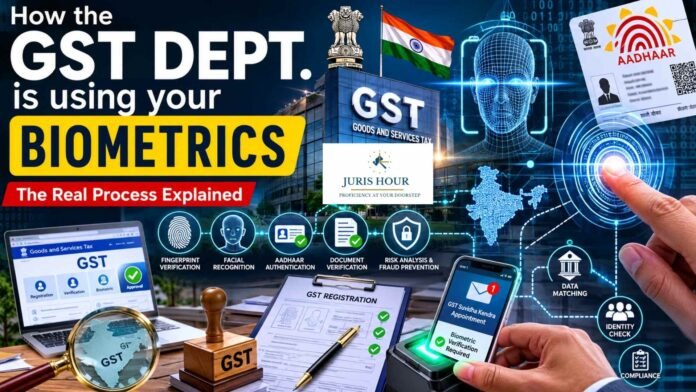
For years, GST authorities struggled with a major problem—fake GST registrations, bogus firms, fraudulent Input Tax Credit (ITC) claims, and shell entities created using forged documents. To combat these tax frauds, the Government has introduced a nationwide system of biometric-based Aadhaar authentication, facial capture, and document verification as part of the GST registration process. Today, your fingerprints, photographs, Aadhaar-linked identity, and other verification data may play a crucial role in determining whether your GST registration is approved, scrutinized, or even rejected.
Why Has GST Introduced Biometric Verification?
The GST ecosystem has witnessed several instances where fraudsters created multiple fake entities to generate bogus invoices and pass on fake ITC. Many of these registrations were obtained using forged documents, rented premises, or identities of unsuspecting individuals.
To address this issue, the Government amended the GST registration framework and empowered GSTN to use data analysis, risk parameters, Aadhaar authentication, biometric verification, and original document verificationbefore granting GST registration.
The objective is straightforward:
- Eliminate fake GST registrations.
- Prevent ITC fraud.
- Verify the actual existence of promoters and authorized signatories.
- Create a digital identity trail for every taxpayer.
- Enable risk-based scrutiny before registration is granted.
What Exactly Are Biometrics?
In the GST context, biometrics generally include:
- Fingerprint authentication.
- Iris scan authentication (where applicable).
- Live photograph capture.
- Aadhaar-linked identity verification.
- Physical verification of original documents.
The information is matched with Aadhaar records and other government databases to confirm that the person seeking GST registration is genuine.
How the Process Works
When an applicant files Form GST REG-01 on the GST portal, GSTN conducts a risk-based assessment.
Based on the applicant’s profile, GSTN may route the application into different verification categories. Some applicants may receive an OTP-based Aadhaar authentication link, while others may be directed to undergo biometric verification at a designated GST Suvidha Kendra (GSK).
If biometric verification is required, the applicant receives an email containing:
- Appointment booking link.
- Details of the GST Suvidha Kendra.
- Jurisdiction information.
- Instructions regarding documents to be carried.
The applicant must then visit the designated GSK in person.
At the GSK, authorities may:
- Capture fingerprints or other biometric details.
- Take a live photograph.
- Verify original documents uploaded during registration.
- Authenticate Aadhaar details.
- Verify the identity of promoters, partners, directors, or authorized signatories.
Who Can Be Asked for Biometric Verification?
GST authorities are not selecting applicants randomly.
Applications are assessed using data analytics and risk parameters. Various factors may trigger biometric verification, including:
- High-risk business categories.
- Suspicious registration patterns.
- Multiple registrations linked to the same person.
- Association with previously cancelled GST registrations.
- Address-related anomalies.
- Risk indicators identified by GSTN algorithms.
This means the GST Department is increasingly relying on technology-driven risk profiling rather than traditional manual scrutiny.
GST’s Growing Use of Data Analytics
The biometric initiative is only one part of a larger GST intelligence framework.
GSTN already uses:
- PAN verification.
- Aadhaar authentication.
- Bank account validation.
- E-way bill analytics.
- E-invoice matching.
- Return reconciliation systems.
- AI-assisted risk assessment models.
Biometric verification adds another layer of certainty by confirming that a real individual is standing behind a GST registration application.
Can Existing Taxpayers Also Be Affected?
Although biometric verification is primarily associated with new GST registrations, authorities can use Aadhaar authentication and identity verification mechanisms during various compliance processes.
Taxpayers linked to suspicious transactions, fake invoicing networks, or high-risk registrations may face enhanced scrutiny and verification procedures. The overall trend indicates a movement toward stronger digital identity validation throughout the GST ecosystem.
What Happens If You Do Not Complete Biometric Verification?
Failure to complete the prescribed verification process can delay or jeopardize GST registration.
In many cases, applicants who are directed to visit a GST Suvidha Kendra must complete the required verification and document checks before their registration application proceeds further. GSTN advisories have also emphasized strict compliance with appointment and verification requirements.
Privacy Concerns and Legal Questions
The growing collection of biometric data naturally raises concerns regarding privacy and data protection.
Since biometric information constitutes highly sensitive personal data, questions arise regarding:
- Storage of biometric records.
- Data security standards.
- Access by government agencies.
- Duration of retention.
- Potential misuse of biometric information.
While the Government views biometric verification as a necessary anti-fraud measure, taxpayers and privacy advocates continue to debate the balance between tax enforcement and informational privacy. The issue also intersects with principles laid down by the Supreme Court in the landmark Aadhaar and privacy judgments.
The Bigger Picture: GST Registration Is No Longer Just a Paper Process
The era when GST registration could be obtained merely by uploading documents is rapidly ending.
The modern GST registration framework increasingly combines:
- Aadhaar authentication,
- Facial identification,
- Biometric verification,
- Original document checks,
- Risk-based analytics, and
- AI-driven fraud detection systems.
For genuine businesses, these measures may result in faster and more secure registrations. For fake entities and fraudulent operators, however, the GST Department’s biometric infrastructure is becoming a powerful tool to detect and prevent abuse before a GSTIN is even issued.
Conclusion
The GST Department is no longer relying solely on paperwork to verify taxpayers. Through biometric authentication, Aadhaar-based identity checks, photographs, document verification, and sophisticated risk analytics, GST authorities are building a technology-driven registration system designed to combat fake registrations and tax fraud. As the rollout expands across India, biometric verification is likely to become one of the most significant compliance requirements for new GST applicants in the coming years.
Read More: ITR Deadline Extension Highly Unexpected: Know Why?

