
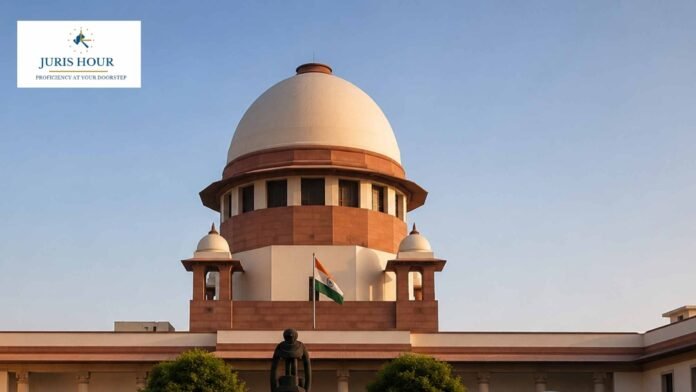
The Supreme Court has held that claims towards interest under Section 7Q and damages under Section 14B of the Employees’ Provident Funds and Miscellaneous Provisions Act, 1952, which had not been determined before the commencement of the Corporate Insolvency Resolution Process (CIRP), cannot be enforced against a successful resolution applicant if they are not provided for in the approved resolution plan.
The bench of Justice Manoj Misra and Justice Vijay Bishnoi while the Committee of Creditors may, in its commercial wisdom, choose to allocate a lump-sum amount to meet possible contingent liabilities arising from uncrystallized claims, the absence of such a provision cannot by itself invalidate an otherwise compliant resolution plan. The commercial decisions of the CoC are entitled to judicial deference, particularly when the plan satisfies the statutory requirements under Section 30(2) of the IBC.
Buy Now: JurisHour Ultimate Legal Research Combo – 4 Premium E-Magazines at an Unbeatable Price
The appeal was filed by the Employees’ Provident Fund Organisation (EPFO) challenging an order of the National Company Law Appellate Tribunal (NCLAT), which had affirmed the approval of a resolution plan excluding EPFO’s claims for interest and damages while providing for the principal provident fund dues.
The Corporate Debtor entered CIRP pursuant to an order dated May 1, 2023. Following the public announcement inviting claims, the EPFO submitted a total claim of ₹22.49 lakh. The claim comprised ₹73,120 towards provident fund dues determined under Section 7A, ₹9.32 lakh towards statutory interest under Section 7Q, and ₹12.44 lakh towards damages under Section 14B of the EPF Act.
The Committee of Creditors (CoC), with a unanimous 100% voting share, approved the resolution plan, which was subsequently sanctioned by the Adjudicating Authority on May 17, 2024. However, the plan provided payment only of the principal provident fund dues of ₹73,120 and excluded the interest and damages claimed by the EPFO.
Aggrieved by the exclusion of these amounts, the EPFO approached the NCLAT, contending that provident fund dues are excluded from the liquidation estate under Section 36(4)(a)(iii) of the IBC and therefore cannot be subjected to any haircut under a resolution plan.
The appellate tribunal rejected the EPFO’s challenge after noting that proceedings for determination of interest and damages had commenced only on May 10, 2023, whereas the CIRP had already commenced on May 1, 2023. Since no adjudication had taken place before the insolvency commencement date, the tribunal held that these liabilities had not crystallized and could not be adjudicated during the moratorium period. Consequently, the protection available to provident fund dues under Section 36(4)(a)(iii) of the IBC did not extend to these unadjudicated claims.
Dismissing the EPFO’s appeal, the Supreme Court relied heavily on its recent decision in Tata Steel Ltd. v. Varsha & Anr.and the landmark judgment in Committee of Creditors of Essar Steel India Ltd. v. Satish Kumar Gupta, reiterating that successful resolution applicants cannot be burdened with uncertain or undecided liabilities after approval of a resolution plan.
The Court observed that allowing unresolved claims to resurface after approval of a resolution plan would defeat the objective of the IBC by creating uncertainty regarding the liabilities that a resolution applicant would ultimately have to bear. It noted that the insolvency framework is designed to ensure that all claims are submitted, examined and decided during the resolution process so that prospective applicants can accurately assess the financial obligations associated with taking over the corporate debtor.
The Bench clarified that although provident fund dues themselves are protected from forming part of the liquidation estate, this protection does not automatically extend to interest and damages that have not been determined before the commencement of CIRP.
According to the Court, liabilities under Sections 7Q and 14B of the EPF Act remain contingent until they are formally determined and finalized. Such contingent liabilities cannot be enforced against the successful resolution applicant if they are absent from the approved resolution plan.
The Supreme Court found that the approved resolution plan had adequately provided for the principal provident fund dues payable by the corporate debtor. Since the proceedings relating to interest and damages had not even commenced before the insolvency commencement date, their exclusion from the plan did not amount to any blatant violation of the IBC.
Accordingly, the Court held that there was no justification to interfere with the concurrent findings of the NCLAT and the Adjudicating Authority and dismissed the appeal.
Membership Required to Access Case Details & Order Copy
To view the complete Case Details and Download Order Copy, you must have an active membership. Please subscribe to continue.
Read More: Bombay High Court Pulls Up ITAT for Repeatedly Releasing Reserved Matters Without Judgment

