
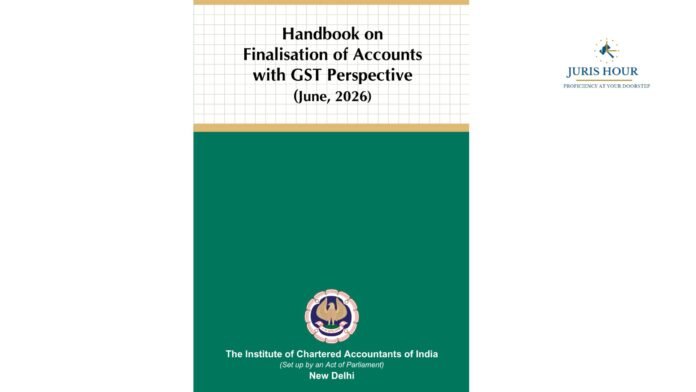
The Institute of Chartered Accountants of India (ICAI) has released the revised edition of its “Handbook on Finalisation of Accounts with GST Perspective” (June 2026), sending a clear message to auditors and businesses that GST compliance cannot be treated as a separate post-audit exercise.
The publication emphasizes that financial statements may fail to present a true and fair view if critical GST reconciliations and liabilities are not examined before accounts are finalized.
The handbook notes that although the statutory GST audit requirement under Section 35(5) of the CGST Act was removed from August 1, 2021, the obligation to file annual returns and self-certified reconciliation statements continues for eligible taxpayers. Consequently, auditors often finalize financial statements under the Companies Act and Income-tax law much before GST annual reconciliations are undertaken. According to ICAI, this practice can result in material misstatements remaining undetected in audited financial statements.
GST Reconciliation Must Precede Audit Sign-Off
One of the strongest observations in the handbook is that auditors should broadly review GST reconciliation items before issuing audit reports. ICAI cautions that discrepancies discovered during the preparation of GSTR-9 and GSTR-9C may reveal under-reported liabilities, excess input tax credit claims, unrecorded reversals, refund-related adjustments, or compliance failures that directly impact financial statements.
The handbook specifically identifies reconciliations between books of accounts, GST returns, electronic cash and credit ledgers, GSTR-2B, e-way bills, refunds, ITC reversals, and demand notices as essential audit procedures.
Hidden GST Liabilities Can Impact Financial Statements
ICAI highlights that unreconciled GST issues can lead to understatement of liabilities or overstatement of assets. Examples cited include:
- Failure to discharge Reverse Charge Mechanism (RCM) liability.
- Availment of ineligible input tax credit.
- Non-reversal of ITC due to vendor payment defaults beyond 180 days.
- Differences between books and GST returns.
- Unrecorded GST demands and notices.
According to the handbook, such discrepancies, if material, can affect the accuracy of audited accounts and undermine the auditor’s conclusion regarding the true and fair presentation of financial statements.
Major Focus on Input Tax Credit Verification
The publication devotes significant attention to input tax credit reconciliation. Auditors are advised to reconcile ITC appearing in books with electronic credit ledgers and GSTR-2B, while identifying credits that may be blocked under Section 17(5) of the CGST Act.
The handbook reiterates that GST paid on ineligible items such as certain motor vehicles, construction of immovable property, and other blocked-credit categories should be capitalized or expensed appropriately rather than being treated as recoverable input tax credit.
Job Work, Goods in Transit and Inventory Risks Under Scanner
ICAI has also warned auditors to closely review inventories lying with job workers, goods sent on approval basis, and goods in transit. Failure to receive inputs or capital goods back within prescribed timelines may trigger deemed supply provisions and create GST liabilities along with interest exposure.
Similarly, input tax credit on goods in transit must be evaluated carefully based on the nature of the contract and actual receipt of goods. Premature availment of ITC could result in compliance violations and financial statement distortions.
Export Receivables and Foreign Exchange Realisation
The handbook identifies export transactions as another critical audit area. Auditors are expected to verify whether export proceeds have been realized within the prescribed timelines under FEMA and GST provisions. Failure to realize export proceeds may result in GST consequences, including repayment of refunds received on exports.
The ICAI has cautioned that unaddressed export-related GST exposures can materially affect financial statements and should be evaluated before audit completion.
Finance Act 2026 Amendment on Post-Supply Discounts
The handbook also discusses the significant amendment introduced by the Finance Act, 2026 relating to post-supply discounts under Section 15(3)(b) of the CGST Act. The amendment simplifies the conditions for reducing taxable value by allowing deduction of post-supply discounts where a valid credit note is issued and the recipient reverses the corresponding ITC.
However, ICAI notes that the amendment is not yet operational until notified. Until then, the earlier conditions requiring pre-existing agreements and invoice linkage continue to apply. Auditors have been advised to carefully assess discount schemes and their GST implications while finalizing accounts.
The central theme emerging from the June 2026 Handbook is that GST compliance and financial reporting are now inseparably linked. ICAI has emphasized that statutory auditors can no longer afford to treat GST annual reconciliation as a subsequent compliance exercise. Instead, GST reviews must be integrated into the financial statement audit process itself to ensure that accounts present a true and fair view and do not conceal tax exposures that could later emerge during GST scrutiny or annual reconciliation.

