
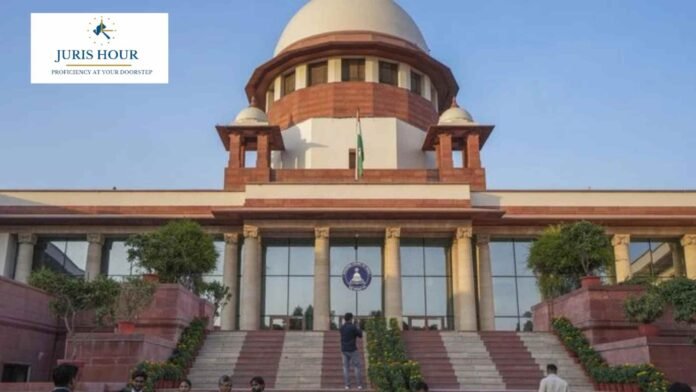
The Supreme Court has delivered a landmark judgment clarifying the legal status of shamilat deh (village common land) in Haryana, holding that land recorded as village common land in the revenue records vested in the Gram Panchayat and rejecting the claims of private parties over a large tract of land in Gurugram.
The Bench of Justice Sanjay Kumar and Justice K. Vinod Chandran allowed a batch of civil appeals and set aside the Punjab and Haryana High Court’s 2007 judgment, which had recognised the ownership claims of private parties over approximately 436 bighas and 18 biswas of land situated in the uninhabited village (be chiraag mauza) of Haiderpur in present-day Gurugram.
The bench confirmed that the mutation sanctioned on 13 September 1955 in favour of the Gram Panchayat, Wazirabad, would continue to operate for the benefit of its successor, the Municipal Corporation, Gurugram.
Buy Now: 50+ Supreme Court Judgments – July 2026
The litigation centred on whether the land in Haiderpur constituted shamilat deh—village common land—or was privately owned by various pattis (revenue estates). Following the enactment of the Punjab Village Common Lands (Regulation) Act, 1953, the land was mutated in favour of the Gram Panchayat in 1955. However, in 1985, several individuals instituted proceedings under Section 13A of the Haryana Common Lands (Regulation) Act, contending that the land never vested in the Panchayat because it belonged to private proprietors and had not been used for common village purposes.
Revenue authorities initially granted substantial relief to the plaintiffs, and those findings were affirmed by the Collector. The Commissioner subsequently reversed those decisions and restored the Panchayat’s title. In 2007, the Punjab and Haryana High Court set aside the Commissioner’s order and held that most of the land belonged to the private proprietors, except for a small area used as a pond and pathway.
In an extensive judgment, the Supreme Court undertook a detailed examination of the historical evolution of shamilat deh, tracing its origins to customary law in undivided Punjab. The Court analysed historical writings, including Sir W.H. Rattigan’s work on Punjab customary law and scholarly research on village common lands, to explain the legal concept and significance of shamilat deh as land reserved for common village purposes such as grazing, ponds, pathways and future village expansion.
The Court also reviewed the statutory framework beginning with the Punjab Village Common Lands (Regulation) Act, 1953, followed by the Punjab and Haryana Common Lands (Regulation) Act, 1961, explaining how these enactments vested village common lands in Gram Panchayats for the benefit of village communities.
A central issue before the Court was the interpretation of historical revenue records and the Sharat-Wajib-ul-Arz (record of village customs). The Court found that these documents consistently described the disputed land as shamilat deh. Merely because the revenue entries also reflected “makbuja malkan” (joint possession of proprietors) or references to pattis did not transform the character of the land into privately owned property.
The Bench emphasised that the crucial test was whether the land was recorded as shamilat deh and whether the revenue records established that it was reserved or used for common village purposes. It observed that the High Court had incorrectly treated references to possession by proprietors as conclusive proof of private ownership while overlooking the legal significance of the revenue entries identifying the land as village common land.
The Supreme Court held that the High Court committed an error in concluding that the land could not vest in the Panchayat merely because Haiderpur was an uninhabited village or because evidence of actual common use was not established in the manner expected by the High Court.
The Bench concluded that the disputed land answered the statutory description of shamilat deh and that the mutation effected in 1955 in favour of the Gram Panchayat was legally valid.
The Court allowed all the civil appeals, set aside the High Court’s judgment dated 24 August 2007, and restored the mutation in favour of the Gram Panchayat, whose rights now stand vested in the Municipal Corporation, Gurugram.
Membership Required to Access Case Details & Order Copy
To view the complete Case Details and Download Order Copy, you must have an active membership. Please subscribe to continue.

