
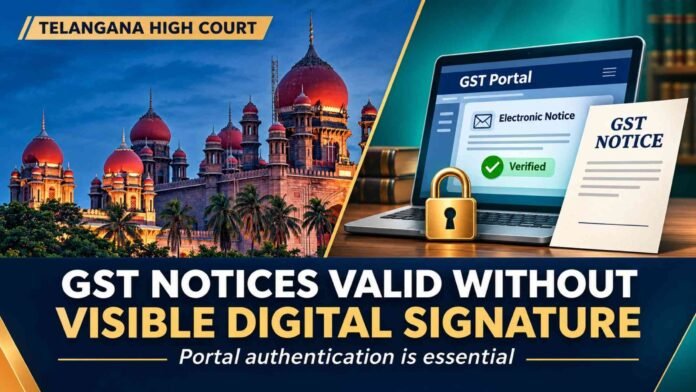
The Telangana High Court has held that GST show cause notices and adjudication orders electronically authenticated by the proper officer and uploaded on the common portal cannot be invalidated merely because the downloaded documents do not display a physical or digital signature.
The Bench of Chief Justice Aparesh Kumar Singh, Justice N. Tukaramji and Justice G.M. Mohiuddin further held that making these documents available on the common portal constitutes valid service under Section 169(1)(d) of the Central Goods and Services Tax Act, 2017. Limitation for pursuing a statutory remedy or making the required compliance begins from the date of upload.
Buy Now: Indirect Tax Judgments E-Compilation – October 2026
However, the court clarified that the documents must carry either a Document Identification Number (DIN) or a Reference Number (RFN). A document bearing neither would be invalid.
The petitioners challenged show cause notices and adjudication orders issued through the GST portal, principally because they did not display signatures of the proper officers.
The dispute reached the Full Bench following a reference dated June 12, 2026, against the background of conflicting Division Bench decisions concerning unsigned GST documents, including Silver Oak Villas LLP and Bigleap Technologies and Solutions Private Limited.
The central question was whether these notices and orders were legally unsigned and consequently a nullity when examined under the GST legislation, the CGST Rules and the Information Technology Act, 2000.
The petitioners relied on signature requirements appearing in the prescribed forms. They argued that authentication within the portal could not replace the signature required on the document itself.
The Full Bench examined GSTN’s explanation and demonstration of the process through which officers generate, authenticate and issue notices and orders.
It accepted that the relevant documents under Chapter XVIII of the CGST Rules, dealing with demands and recovery, undergo electronic authentication through the proper officer’s digital signature certificate and the portal’s authorised workflow.
The court distinguished between authentication of an electronic record and the appearance of a signature on the PDF downloaded by the taxpayer. The absence of a visible signature did not establish that the document had never been authenticated.
Reading the GST framework with Sections 3, 3A and 5 of the Information Technology Act, the Bench held that such electronic authentication had legal recognition.
The ruling concerns documents electronically authenticated by the proper officer. It does not dispense with the requirement of authentication itself.
The petitioners relied on the signature columns in forms prescribed under the demands and recovery framework, including the DRC forms.
The Bench rejected the contention that the absence of a visible signature in these forms necessarily invalidated the proceedings. It held that forms are subservient to the rules and cannot supplant them.
The court also examined Rule 26(3) of the CGST Rules, which appears in Chapter III concerning registration. It rejected its automatic application to notices and orders under Chapter XVIII merely because the prescribed forms contained a signature field.
The Bench explained that the rules prescribe different authentication methods in different chapters. The requirements therefore had to be understood within their respective statutory framework.
The court considered the statutory presumptions applicable to secure electronic records, electronic signatures and official acts.
It found that the petitioners had not rebutted these presumptions through appropriate pleadings or proof. The State had also pointed out that the petitions did not allege that the notices or orders had not actually been issued by the proper officers.
Consequently, the challenge based solely on the absence of a visible signature in the downloaded PDF could not succeed.
The Bench also observed that earlier concessions by tax authorities describing documents as unsigned could have resulted from an incomplete understanding of the GST system’s operation.
The Full Bench rejected the contention that a taxpayer must actually retrieve or read a notice before service can be treated as complete.
Under Section 169(1)(d), making the notice or order available on the common portal constitutes service. The court held that limitation for the statutory remedy and the time for other compliances run from the date of upload.
The Bench reasoned that the GST framework requires taxpayers to exercise diligence in using the portal for returns, refunds, assessments and other statutory obligations.
A taxpayer’s failure to notice a document on the portal therefore does not, by itself, postpone the legal consequences of service.
The court separately considered complaints that documents had been uploaded under the “Additional Notices and Orders” tab.
It noted that a clarification inserted on the portal on January 16, 2024, identified the categories of notices and orders available in that section.
For documents issued after that clarification, the Bench rejected the plea that service was defective merely because the document appeared under the additional notices section.
For documents uploaded before January 16, 2024, the court left it open to affected petitioners to raise the issue before the appropriate appellate forum or court. Earlier portal-service complaints could therefore be examined in appropriate proceedings.
The Full Bench considered CBIC Circular No.249/06/2025-GST dated June 9, 2025, which clarifies that communications generated through the common portal carrying a verifiable RFN need not separately quote a DIN.
It rejected the argument that this clarification could operate only prospectively. The Bench read the circular as recognising that an RFN-bearing portal communication does not require a second identification number in the form of DIN.
At the same time, the court held that a document must reflect either DIN or RFN. In the absence of both, it would not be valid in law.
In the petitions before it, the court recorded that either identifier appeared in the notice, its summary or attachment, or in the order, its summary or attachment. The documents therefore could not be invalidated on that ground.
The Full Bench held that the contrary view taken in decisions relied upon by the petitioners, including Bigleap Technologies, did not state the correct legal position on the issue.
Membership Required to Access Case Details & Order Copy
To view the complete Case Details and Download Order Copy, you must have an active membership. Please subscribe to continue.

