
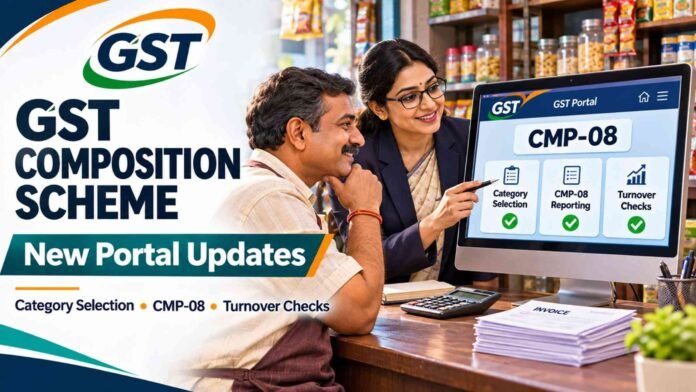
Composition taxpayers need to review their registration category, separate their outward supplies correctly and monitor turnover throughout the financial year following changes to the GST portal’s composition levy functionality. The updated framework distinguishes taxpayers covered by Section 10(1) from those eligible under Section 10(2A), while the revised CMP-08 format provides separate reporting for goods, services and services on which an electronic commerce operator pays GST.
The changes described in GSTN Advisory No. 685 dated November 1, 2026 concern registration, amendments, opting into the scheme and withdrawal. They should be read with the prescribed forms and the eligibility conditions under the Central Goods and Services Tax Act, 2017. Selecting a category on the portal does not, by itself, establish entitlement to a concessional rate.
Buy Now: All 200+ GSTAT Judgements Till November 2026 | Comprehensive E-Magazine
Understanding The Composition Scheme
Section 10 offers eligible small businesses a simpler method of paying GST. Instead of collecting output tax through ordinary tax invoices and adjusting eligible input tax credit against that liability, composition taxpayers pay tax at prescribed rates and comply through a quarterly payment statement and an annual return.
The principal arrangement under Section 10(1), read with Section 10(2), covers eligible manufacturers, traders and restaurant suppliers. Section 10(2A) provides an alternative for eligible registered persons who cannot opt under the principal arrangement, including qualifying service providers and businesses supplying both goods and services.
These are existing statutory routes. The separate portal category for Section 10(2A) does not create a new composition scheme or a fresh entitlement to use it.
Turnover Limits And Applicable Rates
Eligibility generally depends on aggregate turnover during the preceding financial year, computed across registrations sharing the same PAN. Businesses must also remain within the applicable limit during the current year.
| Category | General preceding-year turnover ceiling | Combined CGST and SGST/UTGST rate | Broad tax base |
| Eligible manufacturers under Section 10(1) | ₹1.5 crore; ₹75 lakh in specified States | 1% | Turnover in the State or Union territory, subject to statutory exclusions |
| Eligible traders and other qualifying suppliers under Section 10(1) | ₹1.5 crore; ₹75 lakh in specified States | 1% | Taxable supplies of goods and services in the State or Union territory |
| Eligible restaurant suppliers | ₹1.5 crore; ₹75 lakh in specified States | 5% | Relevant turnover in the State or Union territory |
| Eligible suppliers under Section 10(2A) | ₹50 lakh | 6% | Turnover of supplies of goods and services in the State or Union territory, subject to statutory exclusions |
The ₹75 lakh ceiling applies to eligible registrations in Arunachal Pradesh, Manipur, Meghalaya, Mizoram, Nagaland, Sikkim, Tripura and Uttarakhand. Businesses should not assume that every State commonly described as a special category State has this lower composition limit.
Aggregate turnover for eligibility and the turnover on which composition tax is payable are different concepts. An amount may count towards the eligibility ceiling without attracting composition tax in the supplier’s hands. Supplies covered by Section 9(5) are a significant example.
Limited Services Permitted Under Section 10(1)
An eligible supplier under Section 10(1) may provide services other than the specified restaurant services within the higher of 10% of the preceding financial year’s turnover in the State or Union territory or ₹5 lakh.
For example, a trader whose preceding-year turnover in the State was ₹60 lakh would ordinarily have an allowance of ₹6 lakh for such services. Remaining below the overall ₹1.5 crore ceiling would not excuse exceeding this separate service restriction.
The restaurant services specifically recognised under Section 10(1) should not be treated as ordinary incidental services when applying this restriction. Similarly, the statutory treatment of exempt interest or discount income must be considered before mechanically counting every receipt towards the service allowance.
Registration Now Distinguishes Two Composition Routes
The updated registration functionality presents separate categories for the principal composition scheme and the arrangement under Section 10(2A).
Category A covers eligible manufacturers, the restaurant suppliers identified in Schedule II and other eligible suppliers under Section 10(1). More than one applicable subcategory may be selected within this group. Category B identifies persons eligible under Section 10(2A).
The two main categories are mutually exclusive. A taxpayer cannot select both as though they were interchangeable concessions. The selection must reflect the actual business activity and the statutory conditions applicable to it.
This distinction matters for both new registration in REG-01 and an existing taxpayer’s application to opt for composition through CMP-02. A service business incorrectly identified as a trader may encounter an unsuitable turnover validation or report liability using the wrong basis.
Existing Taxpayers Should Review Their Registered Category
The updated functionality allows composition category particulars to be amended through REG-14. Existing taxpayers should examine whether their registration accurately reflects the scheme under which they are legally eligible to pay tax.
An amendment may be relevant where a category was incorrectly selected, where the recorded particulars are incomplete or where business activities have changed. Registrations under the same PAN should also be reviewed for consistency with the applicable statutory requirements.
A registration amendment does not retrospectively cure an earlier eligibility breach. Nor does selecting Section 10(2A) automatically permit a business that has exceeded the ₹50 lakh ceiling to continue under composition. Historical liability and the date of any loss of eligibility require a separate examination.
Revised CMP-08 Separates Goods, Other Services And Section 9(5) Services
The substituted CMP-08 table separates outward supplies of goods, ordinary outward services and services supplied through an electronic commerce operator where the operator is liable under Section 9(5).
| Entry in the notified format | Reporting category | Main implication |
| 1 | Outward supplies of goods, including exempt supplies | Report goods turnover; determine liability under the applicable composition tax base |
| 1(a) | Outward services, including exempt services, excluding services on which the operator pays under Section 9(5) | Report relevant services separately |
| 1(b) | Services supplied through an operator liable under Section 9(5) | Report turnover separately without paying the operator’s tax again |
| 2 | Inward supplies attracting reverse charge, including import of services | Discharge applicable reverse-charge liability |
The notified format places ordinary services in entry 1(a) and Section 9(5) services in entry 1(b). Taxpayers should match their records with the descriptions in the live filing utility rather than rely on illustrations that reverse these labels.
Including exempt turnover in a reporting field does not make every exempt supply taxable at the composition rate. Liability depends on the taxpayer’s category, the prescribed tax base and the relevant exclusions.
Operator-Paid GST Does Not Remove Turnover From Eligibility Calculations
Section 9(5) shifts responsibility for paying GST on notified services to the electronic commerce operator. It does not generally remove the underlying supplies from the supplier’s aggregate turnover for composition eligibility.
For example, consider an eligible restaurant with ₹30 lakh of direct supplies and ₹20 lakh of platform supplies covered by Section 9(5). The operator discharges GST on the qualifying platform supplies, while the restaurant determines its own liability on its direct supplies. The full ₹50 lakh remains relevant to its turnover assessment.
The treatment applies only where the particular service and transaction fall within the relevant Section 9(5) notification. A service does not become operator-taxable merely because a customer booked it through an app.
Turnover Validation Requires Accurate Classification
CMP-08 turnover checks make correct category selection and a complete turnover reconciliation particularly important. An incorrect registration category, duplicated sales, omitted operator supplies or an additional zero in a reported value can create a mismatch.
Where the portal displays a threshold error, the taxpayer should first compare the figures with its books, earlier quarterly statements and PAN-level turnover. The review should also examine the separate restriction on services for Section 10(1) taxpayers.
For illustration, a manufacturer may remain below the general monetary ceiling yet lose eligibility because ordinary service supplies exceed the permitted allowance. Conversely, exactly reaching a monetary ceiling does not mean it has been exceeded: a Section 10(2A) supplier at precisely ₹50 lakh does not lose eligibility solely for reaching that amount.
A filing error message should therefore prompt an eligibility review. It should not be treated as sufficient reason to reduce correctly recorded turnover or change the category without legal justification.
When Composition Eligibility Ends
Section 10(3) provides that the option lapses from the day aggregate turnover during the financial year exceeds the applicable limit. The rules also address failure to satisfy other conditions of the scheme.
A taxpayer becoming ineligible must begin paying tax under the regular provisions from the applicable date and issue tax invoices for taxable supplies from that date. Withdrawal is intimated through CMP-04, ordinarily within seven days of the event requiring exit. A voluntary withdrawal is applied for before the intended withdrawal date.
The business must complete composition compliance for the period during which it validly paid under the scheme and furnish the applicable regular returns for the subsequent period. Filing CMP-04 later does not postpone the statutory date on which eligibility was lost.
Credit On Leaving The Scheme Is Subject To Conditions
Moving from composition to regular taxation may permit credit under Section 18(1)(c) on eligible inputs held in stock, inputs contained in semi-finished or finished goods and eligible capital goods, subject to prescribed adjustments and conditions.
The relevant stock position is generally that on the day immediately preceding the date from which regular tax liability begins. ITC-01 must be furnished within the prescribed period, ordinarily 30 days from becoming eligible, subject to any permitted extension.
Credit is not available automatically on every historical business purchase. Documentary requirements, time restrictions and the special treatment of capital goods must be examined before making a claim.
Opting Into Composition Also Requires Credit Adjustment
A new applicant may exercise the composition option through REG-01 where eligible. An existing regular taxpayer generally opts through CMP-02 before the financial year for which the option is intended to operate.
Such a transition also requires the adjustment prescribed by Section 18(4) and the relevant rules. The taxpayer ordinarily furnishes ITC-03 within 60 days of commencement of the financial year concerned and accounts for the credit attributable to eligible stock and capital goods as prescribed.
The decision should therefore consider both future compliance and the financial effect of reversing or paying back credit.
Quarterly Payment And Annual Return Deadlines
CMP-08 is the quarterly statement for payment of self-assessed tax. Its ordinary deadline is the 18th day of the month following the quarter. Accordingly, the ordinary deadline for October–December 2026 is January 18, 2027, unless subsequently extended.
For financial years 2024-25 onwards, the ordinary annual GSTR-4 deadline is June 30 following the financial year. The earlier April 30 date should not be used for current annual compliance. For FY 2026-27, the ordinary annual deadline is therefore June 30, 2027, subject to any subsequent extension.
Tax and interest payable through CMP-08 are discharged through the electronic cash ledger. Composition taxpayers cannot use input tax credit to settle their composition liability. The statement should be reconciled carefully before filing, because CMP-08 does not provide an ordinary revision facility.
Continuing Restrictions Under The Scheme
Composition taxpayers cannot collect GST separately from customers and must issue a bill of supply bearing the prescribed declaration. They must also display their composition status as required and cannot claim ordinary input tax credit.
Inter-State outward supplies remain restricted. Restrictions concerning non-GST supplies, casual taxable persons, non-resident taxable persons and notified manufacturing activities must also be considered before opting in or continuing.
Eligible intra-State supplies of goods through electronic commerce operators are permitted subject to the applicable framework. However, the treatment of services through an operator collecting tax under Section 52 must be distinguished from notified services for which the operator itself pays GST under Section 9(5).
Reverse-charge liability remains separate from the concessional composition levy and is discharged at the applicable rate in cash. A low composition rate does not replace the normal rate applicable to a reverse-charge transaction.
What Businesses Need To Change In Their Records
The updated reporting framework calls for a clear separation of goods, ordinary services, exempt supplies and operator-taxable services in the books. Taxpayers should reconcile these figures each quarter and track the applicable turnover ceiling throughout the year.
For Section 10(1) businesses, monitoring the additional service allowance is equally necessary. Where the registration category is incorrect, an appropriate amendment should accompany an examination of past reporting and liability.
Accurate classification at the transaction stage will make quarterly filing easier and help identify the point at which a business must move to regular taxation.

