
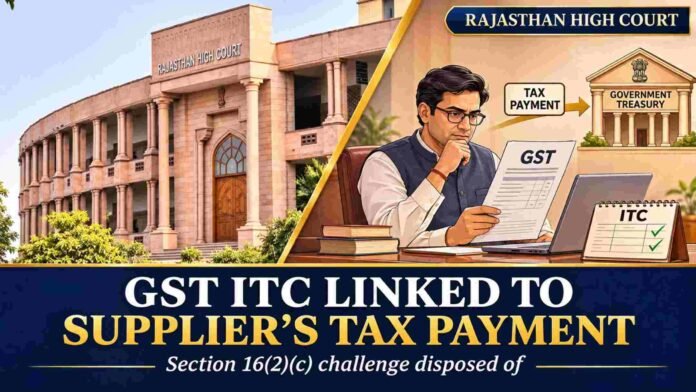
The Rajasthan High Court has disposed of a petition challenging the constitutional validity of Section 16(2)(c) of the Central Goods and Services Tax Act, 2017, read with Section 20 of the Integrated Goods and Services Tax Act, 2017, after noting that the Supreme Court had already upheld the provision.
A Division Bench comprising Chief Justice Sanjay K. Agrawal and Justice Sameer Jain while treating the constitutional challenge as answered by the Supreme Court, granted the petitioner liberty to approach the competent authority for redressal of its remaining grievances.
The provision at the centre of the dispute makes actual payment of tax to the Government a condition for claiming input tax credit.
The appellant/assessee had questioned the validity of Section 16(2)(c), which links a recipient’s entitlement to ITC with payment of the tax charged on the supply to the Government.
During the hearing, Additional Advocate General Vigyan Shah submitted that the Supreme Court had upheld the provision in Bhandari Scrap Traders v. Union of India and Others, SLP (C) No. 23931/2026. Consequently, the State argued that the constitutional relief no longer survived for consideration.
The Rajasthan High Court reproduced the Supreme Court’s conclusion approving the Gujarat High Court’s refusal to declare the provision unconstitutional or read it down.
Applying that decision, the Bench held that the petitioner’s first relief had already been considered and answered by the Supreme Court. For the other reliefs, it permitted the petitioner to approach the competent authority and disposed of the writ petition and pending applications.
Section 16(2)(c) requires the tax charged on a supply to have actually reached the Government, either through cash payment or utilisation of admissible ITC, subject to Section 41.
The statutory framework therefore distinguishes between a purchaser paying the invoice amount to the supplier and the tax being paid to the Government. Possession of an invoice and payment to the supplier do not independently replace the tax-payment condition.
Other Conditions Governing ITC
The surrounding conditions under Section 16 explain why an ITC claim must be examined against several requirements.
| Provision | Requirement |
| Section 16(1) | The inward supply must be used or intended for business purposes, subject to statutory conditions. |
| Section 16(2)(a) | The recipient must possess a prescribed tax-paying document. |
| Section 16(2)(b) | Goods or services must have been received, including qualifying deemed-receipt cases. |
| Section 16(2)(d) | The recipient must furnish the return under Section 39. |
The provisos address goods received in lots, failure to pay the supplier value plus tax within 180 days—excluding reverse-charge supplies—and restoration of credit after payment. Section 16(3) prevents credit on a capital-goods tax component for which income-tax depreciation is claimed. These requirements are distinct from supplier non-payment of tax.
Section 16(2)(aa) additionally requires supplier reporting and communication of invoice details under Section 37. Section 16(2)(ba) requires that the credit communicated under Section 38 is not restricted.
Section 16(4) generally requires credit to be taken by November 30 following the relevant financial year or before furnishing the relevant annual return, whichever is earlier. The provisions applicable to the particular tax period must be checked.
Sections 16(5) and 16(6) provide specific time-limit relief for older financial years and qualifying registration-restoration cases respectively. They do not generally dispense with Section 16(2)(c).
Section 20(iv) of the IGST Act applies the CGST Act’s ITC provisions, with necessary adaptations and subject to the IGST framework, to integrated tax. This explains the challenge to Section 16(2)(c) read with Section 20.
This provision concerns application of CGST provisions to IGST; it should be distinguished from Section 20 of the CGST Act, which concerns Input Service Distributors.
Under the substituted Section 41, eligible ITC is self-assessed in the recipient’s return. Where the supplier has not paid the tax, the provision requires reversal with applicable interest in the prescribed manner.
Its proviso permits re-availment of the reversed credit after the supplier pays the tax. Consequently, reversal does not necessarily result in permanent loss of credit. The earlier statutory wording must be considered when examining earlier periods.
Rule 37A, inserted through Notification No. 26/2022-Central Tax dated December 26, 2022, provides a specific reversal mechanism.
Broadly, where the supplier has reported an invoice but has not furnished the corresponding GSTR-3B by September 30 following the financial year in which the recipient availed credit, the recipient must reverse that credit by November 30.
Failure to reverse within the prescribed period attracts interest under Section 50. Where the supplier subsequently furnishes the relevant GSTR-3B, the rule permits re-availment in a subsequent return. Its operation depends on satisfaction of the specified conditions.
Section 155 places the burden of proving ITC eligibility on the claimant.
Sections 73 and 74 govern the respective non-fraud and fraud-related determination regimes through FY 2023-24, while Section 74A addresses FY 2024-25 onward. Section 75 provides adjudication safeguards, including hearing and reasoned-order requirements. Section 107 provides the statutory first appeal against appealable decisions, subject to its conditions.
These provisions explain the wider legal framework. The Rajasthan order does not identify which particular demand provision governed the petitioner’s remaining grievances.
Supreme Court Distinguished GST From Delhi VAT Framework
The Supreme Court’s reasoning in Bhandari Scrap Traders, reproduced in an official Delhi High Court order, distinguished the CGST scheme from the Delhi VAT regime in considering a purchasing dealer’s ITC entitlement where the supplier failed to pay tax.
The Supreme Court also referred to the possibility of re-availing reversed credit once the supplier discharged the tax liability. It affirmed the Gujarat High Court’s judgment and dismissed the special leave petitions.
Membership Required to Access Case Details & Order Copy
To view the complete Case Details and Download Order Copy, you must have an active membership. Please subscribe to continue.

