
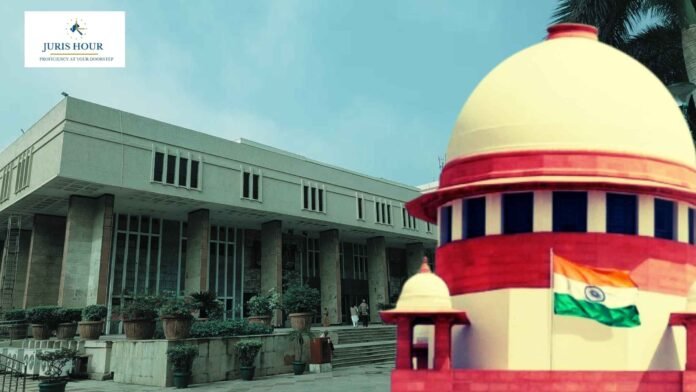
The Supreme Court has declined to interfere with a Delhi High Court order directing a taxpayer to pursue the statutory appellate remedy in a dispute over the limitation period for recovery of an allegedly erroneous GST refund. The controversy concerned whether the five-year period under Section 74(10) of the Central Goods and Services Tax Act, 2017 should be calculated from the date of the erroneous refund or from the due date for furnishing the annual return for the relevant financial year.
A bench of Justice J.B. Pardiwala and Justice K. Vinod Chandran, on October 12, 2026, dismissed the special leave petition against the High Court’s order. The Supreme Court stated that, after hearing the company’s senior counsel and examining the material on record, it was not inclined to interfere.
Buy Now: 160+ GST E-Magazine September 2026
The company had approached the Delhi High Court challenging an adjudication order dated March 28, 2026. Although the availability of a statutory appeal against that order was undisputed, the company sought intervention in writ jurisdiction on the ground that the order had been passed beyond the prescribed limitation period.
Before the High Court, the company argued that the latter limb of Section 74(10) applied to the proceedings. According to its submission, the adjudication order was required to be passed within five years from the date of the erroneous refund.
The company maintained that this period had already expired when the order was issued. On that basis, it contended that the High Court should entertain the writ petition instead of directing it to file a statutory appeal.
The High Court order does not specify the date of the refund or the amount involved in the disputed recovery.
The GST department opposed the company’s interpretation. It submitted that the company had undergone an audit under Section 65 of the CGST Act and that the allegedly erroneous refund had come to the department’s notice during that exercise.
According to the department, the first limb of Section 74(10) governed the proceedings, making the due date for furnishing the annual return the relevant starting point for calculating the five-year period.
The department identified the relevant financial year as 2019–20. It submitted that the annual return filing deadline had initially been extended to February 28, 2021 through Notification No. 95/2020-Central Tax dated December 30, 2020, and subsequently to March 31, 2021 through Notification No. 04/2021-Central Tax dated February 28, 2021.
In rejoinder, the company argued that the matter concerned adjudication rather than audit. The rival submissions thus raised a dispute over which statutory starting point governed the impugned order.
The bench of Justice Anil Kshetarpal and Justice Harish Vaidyanathan Shankar held that the applicability of the two limbs of Section 74(10) was debatable on the facts presented.
The bench observed that the provision contemplated different starting points for limitation depending on the nature of the demand. Resolving the dispute would therefore require examination of the demand itself, the underlying proceedings and the factual foundation of the adjudication.
In these circumstances, the High Court declined to determine the limitation issue in writ jurisdiction and directed the company to pursue the alternative statutory remedy of appeal.
The High Court consequently did not decide whether the March 28, 2026 adjudication order was within time or time-barred. Its decision concerned the appropriate forum for examining that question.
While disposing of the writ petition, the High Court also addressed the time spent pursuing proceedings before it.
The bench observed that, if the company filed an application under Section 14 of the Limitation Act, 1963 seeking exclusion of the period during which the writ petition remained pending, the appellate authority should consider that application pragmatically.
This observation did not automatically exclude the period or grant an unconditional extension for filing the appeal. It left the application for consideration by the appellate authority.
The company subsequently challenged the High Court’s order before the Supreme Court through a Special Leave Petition.
After hearing senior counsel for the company, the Supreme Court dismissed the petition and disposed of any pending applications. Its brief order contains no separate determination of which limb of Section 74(10) applies to the disputed demand.
Membership Required to Access Case Details & Order Copy
To view the complete Case Details and Download Order Copy, you must have an active membership. Please subscribe to continue.
Read More: JURISHOUR | TAX LAW DAILY BULLETIN : 12 OCTOBER, 2026

