
HomeGSTGST Dilemma After Supreme Court Classifies 'Mortgagor' As 'Guarantor' 

GST Dilemma After Supreme Court Classifies ‘Mortgagor’ As ‘Guarantor’ 

Published on

🚀 Stay Connected With JurisHour

WhatsApp X Telegram

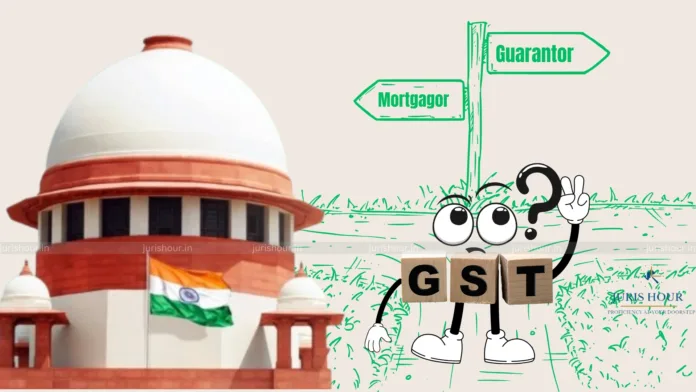
The Supreme Court has classified ‘Mortgagor’ as ‘Guarantor’.

The bench of Justice Abhay S Oka and Justice Pankaj Mithal has observed that if after the sale of hypothecated assets, there is any shortfall in the discharge of the liabilities of the Corporate Debtor is under an obligation to pay the shortfall or deficiency. Therefore, the Corporate Debtor, who is not the borrower, agreed to discharge the liability of the third parties in the case of default. Therefore, it amounts to a guarantee provided by the Corporate Debtor to the appellants in terms of Section 126 of the Contract Act.

The bench held that the mortgagor, who was not a direct borrower, assumed the responsibility of discharging the liability of third parties in the event of their default. This obligation to pay the shortfall was deemed a guarantee.

‘Mortgagor’ As ‘Guarantor’ : GST Implications & Confusion

No GST is applicable on mortgage. However, the GST on corporate guarantees is 18%, with an HSN Code of 999799. GST on corporate guarantee is calculated as 1% of the guarantee amount if no fee is charged or on the actual fee when one exists.

The Supreme Court’s ruling classifies the transaction as both a mortgage and a guarantee, but GST applicability requires further examination. This raises questions about GST implications for such transactions, especially in corporate guarantee arrangements.

Read More: 6% Excise Duty Payable On Railway Diesel Locomotive: CESTAT

Case Details

Case Title: China Development Bank versus Doha Bank Q.P.S.C. & Ors.

Case No.: Civil Appeal No. 7298 Of 2022

Date: 20/12/2024

Mariya Paliwala
Mariya Paliwalahttps://www.jurishour.in/
Mariya is the Senior Editor at Juris Hour. She has 7+ years of experience on covering tax litigation stories from the Supreme Court, High Courts and various tribunals including CESTAT, ITAT, NCLAT, NCLT, etc. Mariya graduated from MLSU Law College, Udaipur (Raj.) with B.A.LL.B. and also holds an LL.M. She started her career as a freelance tax reporter in the leading online legal news companies.

Latest articles

Challenge To CGST Provisions Restricting ITC To Bona Fide Purchasers: Allahabad High Court Issues Notice

The Allahabad High Court has issued notice in a writ petition challenging the constitutional...

Assam Cabinet Clears Draft Uniform Civil Code Bill; To Be Tabled In Assembly On May 26

The Assam Cabinet on Wednesday approved the draft Uniform Civil Code (UCC) Bill, paving...

RBI Removes Prior Approval Requirement for Non-Bank Tie-Ups in Outward Remittance Services

The Reserve Bank of India has relaxed the regulatory framework governing outward remittance services...

Why GST Dept. Must Recover Tax From Suppliers Instead of Punishing Purchasers?

The dispute surrounding denial of Input Tax Credit (ITC) to bona fide purchasers under...

More like this

Challenge To CGST Provisions Restricting ITC To Bona Fide Purchasers: Allahabad High Court Issues Notice

The Allahabad High Court has issued notice in a writ petition challenging the constitutional...

Assam Cabinet Clears Draft Uniform Civil Code Bill; To Be Tabled In Assembly On May 26

The Assam Cabinet on Wednesday approved the draft Uniform Civil Code (UCC) Bill, paving...

RBI Removes Prior Approval Requirement for Non-Bank Tie-Ups in Outward Remittance Services

The Reserve Bank of India has relaxed the regulatory framework governing outward remittance services...