
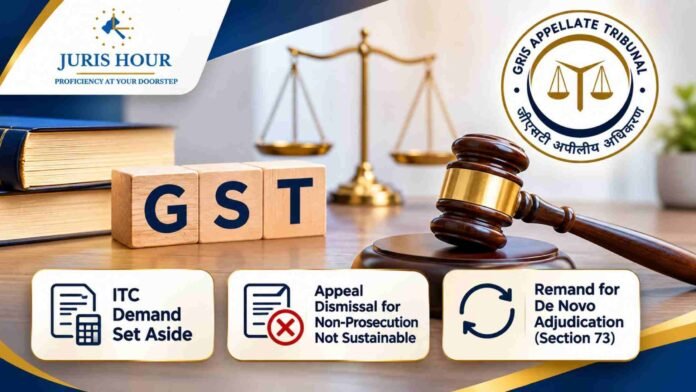
The Goods and Services Tax Appellate Tribunal (GSTAT), Bengaluru has set aside both the first appellate order dismissing the taxpayer’s appeal for non-prosecution and the original adjudication order confirming an ITC mismatch demand of ₹26.86 lakh, directing fresh adjudication after examining books of accounts and connected records within 90 days.
The bench of H.G. Nagarathna (Judicial Member) and Jagannatha Sagar Dasappa (Technical Member) has held that a statutory appellate authority cannot dismiss an appeal merely on account of non-appearance or non-prosecution without examining the grounds of appeal and passing a reasoned order on merits.
Buy Now: All 200+ GSTAT Judgements Till November 2026 | Comprehensive E-Magazine
The Tribunal accordingly set aside the appellate order dated August 20, 2025, as well as the original adjudication order dated July 23, 2024, and remanded the matter to the adjudicating authority for fresh adjudication under Section 73 of the CGST Act.
The taxpayer had filed GST returns in Form GSTR-3B for the period April 2019 to March 2020.
Earlier, the Assistant Commissioner of Commercial Taxes (Audit-3.2), Bengaluru, had issued an audit report in Form GST ADT-02 dated August 11, 2023, covering three issues, including interest liability arising from belated filing of GSTR-3B for April 2019 to July 2019 amounting to ₹4,72,686.
The audit report also examined non-payment of tax under the Reverse Charge Mechanism (RCM) on certain services and RCM relating to blocked credits. The latter two issues were subsequently dropped.
Thereafter, the Assistant Commissioner of Commercial Taxes, LGSTO-120, Bengaluru, scrutinised the returns under Section 61 of the CGST Act and noticed an alleged excess claim of Input Tax Credit (ITC) in GSTR-3B compared with the ITC reflected in GSTR-2A, amounting to ₹26,86,743.
The department attributed the difference to non-filing of GSTR-1 by suppliers.
An intimation in Form GST ASMT-10 dated November 17, 2023, followed by a pre-show cause notice in Form GST DRC-01A dated March 15, 2024, was issued to the taxpayer. Subsequently, a show cause notice in Form GST DRC-01 dated April 5, 2024, proposed a demand of ₹26,86,743 along with applicable interest and penalty.
Aggrieved by the adjudication order, the taxpayer preferred an appeal before the First Appellate Authority.
However, the Joint Commissioner of Commercial Taxes (Appeals-III), Bengaluru, dismissed the appeal vide order dated August 20, 2025, solely on the ground of non-prosecution, observing that the taxpayer had failed to appear despite personal hearing notices issued on June 20, July 9 and July 30, 2025.
Before the GSTAT, the taxpayer contended that the appeal had been filed online along with detailed statements of facts and grounds of appeal, followed by additional written submissions dated March 13, 2025.
It was argued that the First Appellate Authority failed to consider the written submissions already available on record and dismissed the appeal merely because the taxpayer did not attend the personal hearing.
The Tribunal examined the statutory requirements governing appellate proceedings under Section 107 of the CGST Act.
It observed that the language of Section 107(11) mandates the First Appellate Authority to apply its mind to the merits of the grounds raised in the appeal memorandum.
The statute does not permit the appellate authority to dismiss an appeal for default or non-prosecution without passing a speaking order on merits.
The Tribunal relied upon the decisions of the Kerala High Court in St. Antony Trading & Transport Pvt. Ltd. v. Joint Commissioner, GST (Appeals) and the Patna High Court in Purushotham Stores v. State of Bihar.
The Tribunal also noted that even where an appellant fails to appear after the maximum permissible three adjournments, the appellate authority remains duty-bound to determine the points for consideration and decide the appeal on merits based on the available records.
It held that dismissing an appeal for non-appearance without evaluating the merits amounts to abdication of statutory duty.
Accordingly, the impugned appellate order was held to be unsustainable in law and on facts and was set aside.
The taxpayer also challenged the subsequent adjudication proceedings under Section 73 by invoking Section 6(2)(b) of the CGST Act.
It was contended that the department had already conducted audit proceedings under Section 65 and issued Form GST ADT-02 dated August 11, 2023. Therefore, initiating subsequent proceedings under Section 73 for the same financial year amounted to impermissible parallel proceedings.
The taxpayer relied upon the Supreme Court’s decision in Armour Security (India) Ltd. v. Commissioner, CGST, Delhi East, dated August 14, 2025, along with other judicial precedents.
However, the Tribunal examined the actual issues covered by both proceedings and found that they were distinct.
The audit report dated August 11, 2023, dealt with interest liability of ₹4,72,686 arising from delayed filing of GSTR-3B and certain RCM-related issues.
On the other hand, the subsequent adjudication proceedings concerned an alleged excess ITC claim of ₹26,86,743 arising from the difference between GSTR-3B and GSTR-2A.
The Tribunal held that merely because both proceedings related to the same financial year, they could not automatically be treated as proceedings involving the same subject matter.
Referring to the Supreme Court’s ruling in Armour Security (India) Ltd., the Tribunal observed that Section 6(2)(b) bars proceedings where the authorities seek to assess or recover an identical or overlapping tax liability or deficiency.
Since the audit proceedings and subsequent adjudication proceedings involved distinct subject matters, the Tribunal held that the adjudication proceedings under Section 73 were not barred by Section 6(2)(b) of the CGST Act.
Although the Tribunal rejected the taxpayer’s contention regarding the applicability of Section 6(2)(b), it expressed concern over the fact that both the original adjudication order and the first appellate order were passed ex-parte.
The Tribunal observed that the adjudication order was passed because the taxpayer had not filed replies to the notices, while the appellate order was dismissed solely on account of non-prosecution.
In these circumstances, the Tribunal considered it appropriate that the tax liability fastened upon the taxpayer should be re-examined comprehensively by the competent adjudicating authority.
Consequently, it set aside the original adjudication order dated July 23, 2024, and directed fresh adjudication after examining the books of accounts and connected records and providing a reasonable opportunity of hearing to the taxpayer.
Membership Required to Access Case Details & Order Copy
To view the complete Case Details and Download Order Copy, you must have an active membership. Please subscribe to continue.
Read More: GST Appeals Can’t Be Dismissed Merely for Non-Appearance: GSTAT

