
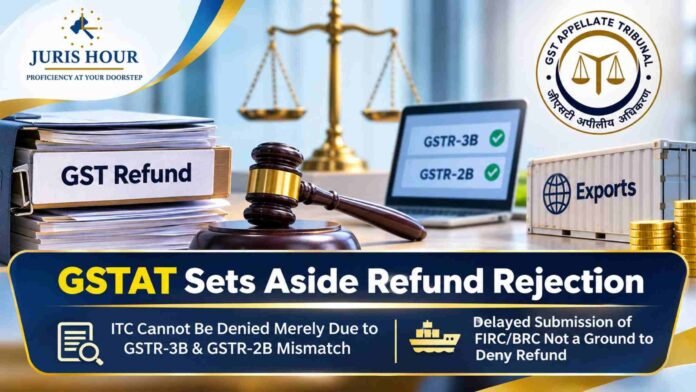
The Goods and Services Tax Appellate Tribunal (GSTAT), State Bench Chandigarh has ruled that the Input Tax Credit (ITC) mismatch can trigger verification but cannot, by itself, justify denial of credit and also found that delayed submission of Foreign Inward Remittance Certificates (FIRC) or Bank Realisation Certificates (BRC) cannot defeat refund where export proceeds were realised within the prescribed period.
The bench of Jatinder Pal Singh (Judicial Member) and Pradeep Kumar Goel (Technical Member) has held that Input Tax Credit (ITC) cannot be disallowed merely because of a mismatch between GSTR-3B and the auto-generated GSTR-2B, without examining whether the substantive conditions under Section 16 of the CGST Act, 2017, were fulfilled.
Buy Now: All 200+ GSTAT Judgements Till November 2026 | Comprehensive E-Magazine
The bench also observed that the time limit prescribed under Rule 96A of the CGST Rules relates to the realisation of export proceeds and not the submission of Foreign Inward Remittance Certificates (FIRC) or Bank Realisation Certificates (BRC).
The appellant/assessee is registered under GST for providing Information Technology (IT) design and development services, IT consulting and support services, research and development services, business support services and engineering support services.
The company exports IT services to clients located outside India without payment of IGST under a Letter of Undertaking (LUT). For the period April 2021 to June 2021, the company filed a refund application amounting to ₹12,54,368 in Form GST RFD-01 on August 24, 2022, under Section 54 of the CGST Act, 2017.
The refund application was acknowledged by the Department through Form GST RFD-02 dated September 30, 2022. Subsequently, the Department issued a Show Cause Notice in Form GST RFD-08 dated October 17, 2022, proposing rejection of the refund claim.
The company requested an adjournment of two weeks on October 21, 2022, citing ongoing statutory compliances, including tax audit, transfer pricing filings, income-tax return filing and intervening Diwali holidays.
However, the Assistant Commissioner of State Tax, SAS Nagar, proceeded to reject the refund claim through Form GST RFD-06 dated November 1, 2022.
The company challenged the rejection before the First Appellate Authority under Section 107 of the CGST/PGST Act, 2017. However, the appeal was dismissed, and the rejection of the refund was upheld.
Aggrieved by the decision, the company approached the GST Appellate Tribunal.
One of the principal issues before the Tribunal concerned the difference between the ITC claimed in GSTR-3B and the auto-generated figures reflected in GSTR-2B.
The company contended that the difference primarily related to two suppliers, namely Arushi Gupta and Ikeva Venture and Knowledge Advisory Services Private Limited.
It submitted that the ITC relating to Arushi Gupta was supported by valid tax invoices and that the conditions prescribed under Section 16(2) of the CGST Act, 2017, had been fulfilled.
Regarding the second supplier, Ikeva Venture and Knowledge Advisory Services Private Limited, the company submitted that the disputed ITC had already been reversed through Form GST DRC-03 vide ARN No. AD031221000970W dated December 9, 2021.
The company further argued that Section 16(2)(aa), which requires invoice details to be furnished by the supplier in GSTR-1 and communicated to the recipient in GSTR-2B, became effective only from January 1, 2022.
Since the refund period pertained to April 2021 to June 2021, the company contended that the subsequent statutory requirement could not be applied retrospectively.
The Tribunal observed that a mismatch between ITC claims in GSTR-3B and the auto-generated GSTR-2B can certainly trigger further verification of relevant documents. However, the Department is required to examine whether the substantive conditions for availment of ITC under Section 16 have been fulfilled.
The Tribunal categorically observed, “ITC cannot be disallowed merely on the basis of mismatch between ITC claimed in GSTR-3B and auto-generated Form GSTR-2B.”
It further directed the original authority to examine the relevant documents concerning ITC availment in light of Section 16 of the CGST Act and CBIC Circular No. 193/05/2023-GST dated July 17, 2023.
The second major issue concerned the Department’s allegation that export proceeds against three invoices had not been realised within the prescribed period.
The company maintained that the export proceeds had actually been received within one year from the date of export invoices and that the relevant FIRCs, along with a bank certificate, had been submitted to establish receipt of foreign remittances.
The company also submitted a letter dated October 29, 2025, issued by Bank of America, confirming that payments against the three invoices had been received within the stipulated timelines under RBI guidelines.
The Tribunal examined Rule 96A(1)(b) of the CGST Rules, 2017, which prescribes the period within which payment for export of services must be received.
It also considered Rule 89(2)(c) of the CGST Rules, which provides for submission of a statement containing invoice details and the relevant Bank Realisation Certificates or Foreign Inward Remittance Certificates along with the refund application.
The Tribunal observed that the time limit prescribed under Rule 96A relates to the realisation of export proceeds and not the submission of FIRC/BRC.
On examining the Bank of America letter, the Tribunal found that the inward remittances against the three invoices had been received within the period prescribed under Rule 96A.
Accordingly, even if there was a delay in submitting the certificates evidencing such realisation, the company could not be denied the refund on that ground.
The Tribunal also found serious procedural irregularities in the manner in which the refund application was rejected.
It noted that the refund application was filed on August 24, 2022, but the Department issued the acknowledgement in Form GST RFD-02 only on September 30, 2022, after 37 days.
Further, the Show Cause Notice dated October 17, 2022, required the company to submit its reply by October 23, 2022, thereby providing only six days to respond.
The Tribunal observed that Rule 92(3) of the CGST Rules clearly provides a period of fifteen days for submission of a reply to a notice proposing rejection of a refund claim.
Despite the company’s request for an extension of two weeks, the Adjudicating Authority proceeded to reject the refund claim on November 1, 2022, without adequately considering the request.
The Tribunal further noted an inconsistency between the orders passed by the two authorities.
While the original Adjudicating Authority recorded that no reply to the Show Cause Notice had been received, the First Appellate Authority recorded that the company had submitted its reply in Form GST RFD-09.
The Tribunal found that the First Appellate Authority had also failed to record proper findings on the submissions and documents produced by the company.
It accordingly concluded that the principles of natural justice had not been followed either by the original Adjudicating Authority or by the First Appellate Authority.
Another issue concerned ITC of ₹59,400 relating to the purchase of a computer from Zaco Computers Private Limited under an invoice dated June 12, 2021.
The company had accepted that proportionate refund pertaining to ITC on capital goods was not admissible under the applicable refund provisions.
However, it contended that the underlying ITC was otherwise admissible under Section 16(2) of the CGST Act and requested re-credit of the amount to its electronic credit ledger for future utilisation.
The company argued that even if the ITC on capital goods was not eligible for refund under Rule 89(4), the Department ought to have excluded only the inadmissible portion while calculating the refund instead of rejecting the entire application.
The Tribunal recorded this contention as one of the issues raised in the appeal and directed fresh consideration of the refund claim in accordance with its findings.
The Tribunal remanded the matter to the original Adjudicating Authority.
Membership Required to Access Case Details & Order Copy
To view the complete Case Details and Download Order Copy, you must have an active membership. Please subscribe to continue.
Read More: Delhi High Court Quashes Time-Barred S. 153C Assessment for AY 2009-10

