
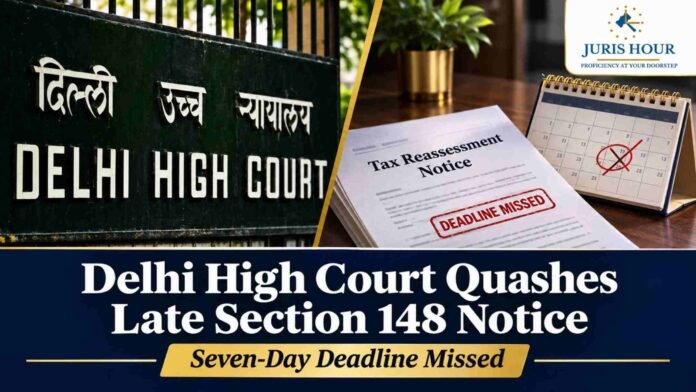
The Delhi High Court has quashed an income-tax reassessment notice for Assessment Year 2014–15 after finding that the Assessing Officer issued it 22 days after the statutory deadline. The officer had one day of the original limitation period left when the taxpayer replied. Even after applying the seven-day minimum under Section 149(1) of the Income-tax Act, 1961, the deadline expired on July 1, 2022. The officer issued the notice on July 23, 2022.
The Bench of Justice Dinesh Mehta and Dr Justice Aditi Choudhary also set aside the order passed under Section 148A(d) on the same date.
Buy Now: Direct tax (Income Tax) Judgments E-Magazine October 2026
The dispute turned on when the limitation clock resumed and how much time the department then had to act.
The Income Tax Department issued the original Section 148 notice on June 30, 2021, under the erstwhile reassessment regime. That was also the last day available to issue the notice under the Taxation and Other Laws (Relaxation and Amendment of Certain Provisions) Act, 2020 (TOLA).
On May 26, 2022, the Assessing Officer furnished the relevant material and called for a response under Section 148A(b). After the taxpayer sought an adjournment, the officer extended the reply deadline to June 24, 2022. The taxpayer submitted its reply that day.
The taxpayer argued that only one day of the TOLA-extended period survived and that the July 23 notice was time-barred. The Revenue’s counsel could not controvert the submission on facts or law, the Court recorded.
In Union of India v. Ashish Agarwal, the Supreme Court directed that notices issued under the old Section 148 during the transition to the new reassessment regime be treated as show-cause notices under Section 148A(b). Assessing Officers had to supply the relevant information and material and proceed under the substituted provisions.
The Delhi High Court applied the Supreme Court’s subsequent ruling in Union of India v. Rajeev Bansal. In calculating the surviving period, the Court explained, the interval from the original notice to the supply of the relevant material is excluded, as is the time allowed to the taxpayer to respond. The limitation clock resumes when the officer receives the reply. The officer must then consider the reply, decide under Section 148A(d) whether reassessment is warranted and, if so, issue the Section 148 notice within the time available.
Because the original notice was issued on June 30, 2021, the Bench found that only one day survived when the taxpayer replied on June 24, 2022. The fourth proviso to Section 149(1), as it stood in 2021, extended that remaining period to seven days. The Court held that the officer had until July 1, 2022, to pass the Section 148A(d) order and issue the consequential Section 148 notice.
The officer took both steps on July 23, 2022. The High Court allowed the writ petition and quashed the order and notice as barred by limitation.
Membership Required to Access Case Details & Order Copy
To view the complete Case Details and Download Order Copy, you must have an active membership. Please subscribe to continue.

