
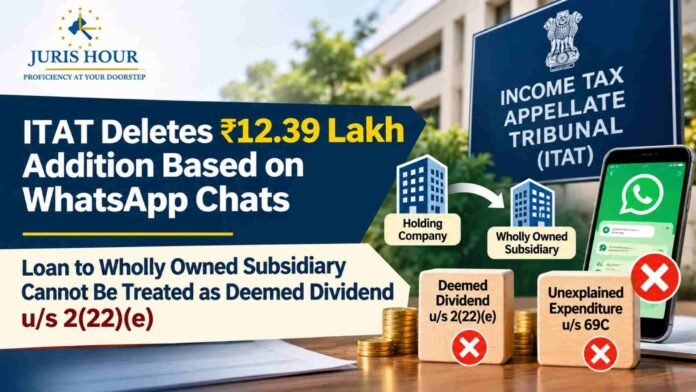
The Delhi Bench of the Income Tax Appellate Tribunal (ITAT) has held that a loan advanced by a holding company to its wholly owned subsidiary could not be treated as deemed dividend in the hands of an individual merely because he held substantial shareholding in the lending company.
The bench of Anubhav Sharma (Judicial Member) and Manish Agarwal (Accountant Member) also deleted an addition of ₹12,39,300 made under Section 69C of the Income Tax Act, 1961, observing that WhatsApp chats and images, without corroborative evidence or proper enquiry, could not conclusively establish unexplained expenditure.
Buy Now: Direct tax (Income Tax) Judgments E-Magazine October 2026
The assessee filed his income tax return for AY 2023-24 declaring total income of ₹2,27,49,420. His income included salary, income from house property, royalty income from the registered brand name “Made Easy”, capital loss and interest income.
Following a survey conducted at the premises of the Made Easy Group on May 6, 2023, the assessee’s case was selected for scrutiny assessment.
During assessment proceedings, the Assessing Officer proposed two major additions: ₹3,23,38,762 under Section 2(22)(e): Treating the loan advanced by Made Easy Education Private Limited to Hundred Million Agro Private Limited as deemed dividend in the hands of the assessee. ₹12,39,300 under Section 69C: Treating certain alleged expenditure reflected in WhatsApp chats and images impounded during the survey as unexplained expenditure.
The Assessing Officer rejected the assessee’s explanations and made both additions, raising a tax demand of ₹1,93,35,301.
The assessee approached the Commissioner of Income Tax (Appeals), who deleted the deemed dividend addition but sustained the addition of ₹12,39,300 under Section 69C. Both the Revenue and the assessee subsequently approached the Tribunal.
The department challenged the deletion of the addition of ₹3,23,38,762, arguing that the assessee held 75% shareholding in Made Easy Education Private Limited and was also a nominee in Hundred Million Agro Private Limited, which was wholly owned by Made Easy Education Private Limited.
According to the department, the assessee was ultimately the beneficial owner of the recipient company and, therefore, the transaction attracted Section 2(22)(e) of the Income Tax Act.
The assessee, on the other hand, submitted that he was neither a direct shareholder nor a beneficial shareholder in Hundred Million Agro Private Limited. The loan had been advanced by Made Easy Education Private Limited to its wholly owned subsidiary, and no loan amount had been received by the assessee.
The Tribunal examined the statutory requirements of Section 2(22)(e), which cover specified loans or advances made to a shareholder holding not less than 10% voting power, to a concern in which such shareholder has substantial interest, or payments made on behalf of or for the individual benefit of such shareholder.
The Tribunal observed that the loan was advanced by one company to its wholly owned subsidiary and that the assessee had admittedly received no direct or indirect benefit from the transaction.
It further noted that sufficient material was available on record to establish that the loan was advanced on a current account basis for the benefit of the recipient company to discharge its contractual obligations, including repayment of a bank loan and GST payments.
The Tribunal emphasised that where the utilisation of funds is established through bank account trails and supporting evidence, it would not be justified to invoke deeming provisions merely on the basis of the shareholding structure.
The Tribunal observed that deemed dividend income can be assessed only in the hands of a person who is both the registered and beneficial shareholder of the lending company and to whom the payment is made.
It was undisputed that no payment had been made to the assessee. Further, the entire shareholding of Hundred Million Agro Private Limited was held by Made Easy Education Private Limited.
The Tribunal also took note of Forms BEN-1 and BEN-2 and Form MGT-6, which recorded Made Easy Education Private Limited as the beneficial owner of the recipient company.
The Bench held that the expressions “nominee” and “ultimate beneficial owner”, relied upon by the Department, were not expressions falling within the scope of Section 2(22)(e).
Accordingly, the Tribunal found no merit in the Revenue’s contention and upheld the findings of the CIT(A) deleting the addition of ₹3,23,38,762.
The second issue concerned the addition of ₹12,39,300 under Section 69C, which had been made by the Assessing Officer on the basis of WhatsApp chats and certain slips and images impounded during the survey.
The assessee explained that the WhatsApp messages had been forwarded by his brother for seeking advice and did not establish that any unexplained expenditure had been incurred by him.
It was further explained that the messages related to discussions concerning a proposed mining lease business involving the assessee’s brother. The mining lease application was ultimately rejected.
The assessee also submitted that the slips related to M/s Maa Kali Tyres, a separate concern engaged in mining activities, and there was no established business association between the assessee and the said concern.
However, the CIT(A) had sustained the addition, observing that the WhatsApp chats were incriminating in nature and self-explanatory.
The Tribunal disagreed with the findings of the CIT(A) and observed that both the Assessing Officer and the first appellate authority had primarily relied upon WhatsApp text messages and images without bringing any corroborative material on record.
The Bench observed that WhatsApp chats and images could not be treated as conclusive evidence of a transaction unless they recorded the transaction comprehensively and completely.
It further held that describing such chats as self-explanatory would require the documents to contain sufficient details to establish all aspects of the alleged transaction without requiring the Assessing Officer to interpolate facts or draw assumptions and presumptions.
Importantly, the Tribunal noted that the Assessing Officer had not made any attempt to conduct enquiries from the concerned persons, namely Dalpat Singh, Padam Uttam Singh and Shub Narayan Singh, under Sections 133(6) and 131 of the Income Tax Act, to verify the WhatsApp chats and the slips shared.
The Tribunal also examined the material concerning the alleged expenditure and noted that the three slips related to periods from March 1, 2021, to June 30, 2021, and September 1, 2021, to June 30, 2022.
These periods did not fall within the relevant financial year under consideration.
Further, the sheets pertained to M/s Maa Kali Tyres, and no business association between the assessee and the said concern had been established.
In these circumstances, the Tribunal held that the inferences drawn from the WhatsApp chats and slips could not be considered conclusive evidence of unexplained expenditure.
The Tribunal accordingly held that the CIT(A) had erroneously treated the material as self-explanatory and sustained the addition without adequate supporting evidence.
Consequently, the addition of ₹12,39,300 under Section 69C was deleted.
Accordingly, the addition of ₹3,23,38,762 under Section 2(22)(e), already deleted by the CIT(A), remained deleted, while the addition of ₹12,39,300 under Section 69C was also deleted by the Tribunal.
Membership Required to Access Case Details & Order Copy
To view the complete Case Details and Download Order Copy, you must have an active membership. Please subscribe to continue.
Read More: ITAT Can Admit Additional Evidence to Advance Substantial Justice

