
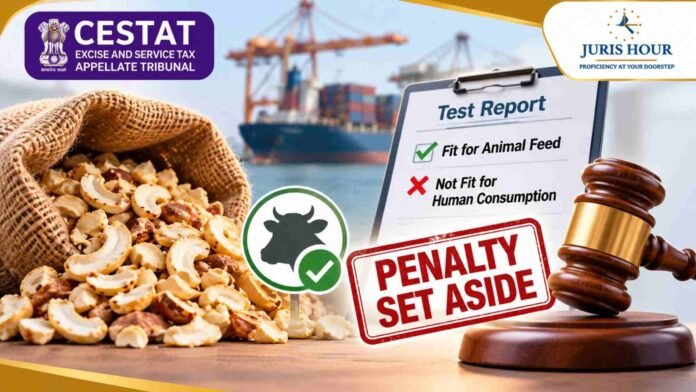
The Customs, Excise and Service Tax Appellate Tribunal (CESTAT), Ahmedabad Bench has ruled that the Customs Department failed to establish misclassification of imported rejected cashew nut pieces, as Central Revenues Control Laboratory (CRCL) and National Forensic Sciences University (NFSU) reports indicated that the goods were deteriorated and unfit for human consumption.
The bench of Somesh Arora (Judicial Member) and Satendra Vikram Singh (Technical Member) has set aside the confiscation order, differential classification and penalty of ₹2.50 crore was imposed in a dispute concerning the import of rejected cashew nut pieces and waste from Vietnam.
Buy Now: 50+ Judgements on Customs Valuation
The bench held that the Department had failed to establish that the imported goods were of superior quality or fit for human consumption so as to justify their classification under CTH 08013210 instead of the declared classification under CTH 23080000.
The appellant/assessee is, a proprietorship concern based in Jasdan, Gujarat, imported goods from Vietnam through five Bills of Entry, declaring the goods as “Agricultural Rejected Nut Pieces and Waste” and classifying them under Customs Tariff Heading (CTH) 23080000.
The importer declared the value of the goods at ₹96,87,370 and claimed the benefit of preferential rate of customs duty under Notification No. 46/2011-Cus dated June 1, 2011.
However, acting upon specific intelligence, the Directorate of Revenue Intelligence (DRI) initiated an investigation into the imports. Samples were drawn and forwarded to the Central Revenues Control Laboratory (CRCL), New Delhi, for testing.
The CRCL report dated December 18, 2025, recorded that the tested parameters were within the prescribed limits for compounded cattle feed under IS 2052:2023. However, CRCL expressed its inability to comment on whether the goods were fit for human consumption.
Subsequently, the samples were sent to the National Forensic Sciences University (NFSU), Gandhinagar, for further examination.
Based on the NFSU report dated January 21, 2026, read with clarification dated March 17, 2026, the Department concluded that the imported goods were broken cashew kernels belonging to the species Anacardium occidentale.
The Department alleged that the goods had been misdeclared as agricultural rejected nut pieces and waste to avoid applicable import restrictions and customs duty.
A Show Cause Notice dated April 23, 2026, was issued proposing rejection of the declared description and classification of the imported goods and their reclassification under CTH 08013210 as broken cashew kernels.
The Department also proposed confiscation of the imported consignments under Sections 111(d) and 111(m) of the Customs Act, 1962, along with penalties under Section 112.
The Commissioner of Customs, through the impugned adjudication order, rejected the declared classification and ordered reassessment of the imported goods under CTH 08013210, denying the preferential duty benefit claimed under Notification No. 46/2011-Cus.
The adjudicating authority further ordered confiscation of the live consignments with an option to redeem them on payment of redemption fine of ₹1,37,70,000; confiscated previously imported goods valued at ₹76,36,791 and imposed redemption fine of ₹1,10,16,000; and imposed a penalty of ₹2.50 crore under Section 112(a) of the Customs Act, 1962.
The appellant contended that the declared description and classification of the imported goods were correct and supported by the CRCL test report, which found the goods compliant with the prescribed parameters for compounded cattle feed.
It was argued that the Department had failed to discharge its burden of establishing that the goods were correctly classifiable under CTH 08013210.
The appellant also questioned the reliability and scope of the NFSU report, pointing out that DNA barcoding had been performed only on Parcel D and that sequencing had failed for certain highly broken and discoloured kernel categories.
Further, the appellant argued that no physical examination or sampling had been conducted in respect of the earlier three Bills of Entry. Consequently, the Department could not rely merely upon statements to reclassify goods that had already been assessed and cleared.
The appellant also relied upon the decision of the Supreme Court in HPL Chemicals Ltd. v. CCE, Chandigarh, 2006 (197) E.L.T. 324 (S.C.), to contend that the burden of proving the correctness of a proposed alternative classification rests upon the Revenue.
Reliance was also placed on Andaman Timber Industries v. Commissioner of Central Excise, 2015 (324) E.L.T. 641 (S.C.), concerning the admissibility and use of statements without following the statutory requirements.
An important aspect of the dispute was the scientific examination conducted by NFSU, Gandhinagar.
The report identified four categories of kernels based on their physical condition, including whole kernels, slightly broken kernels, extremely broken kernels and irregularly shaped kernels showing significant discolouration.
The CESTAT observed that the CRCL report dated December 18, 2025, categorically recorded that the goods were compounded animal feed.
The Tribunal further noted that the NFSU report, along with its subsequent clarification, demonstrated that the imported goods exceeded various prescribed FSSAI limits and were not fit for human consumption.
The Tribunal observed that neither of the two laboratory reports supported the Department’s allegation that the imported goods were of superior quality and, therefore, could not be classified as animal feed.
The Bench also emphasised that the burden of establishing the correctness of a different tariff classification rests upon the Revenue.
The Tribunal clarified that the Department was free to seek evidence that the goods proposed to be released would be used exclusively as animal feed, as declared by the importer.
This observation was made while examining the nature and intended use of the imported goods.
Holding that the classification adopted by the Department was not sustainable, CESTAT Ahmedabad set aside the impugned adjudication order and allowed the appeal with consequential relief.
The Tribunal accordingly set aside the confiscation and the consequential demands and penalty arising from the impugned classification order.
Membership Required to Access Case Details & Order Copy
To view the complete Case Details and Download Order Copy, you must have an active membership. Please subscribe to continue.
Read More: Donations Made As Part Of Mandatory CSR Expenditure Are Eligible For 80G Deduction: ITAT

